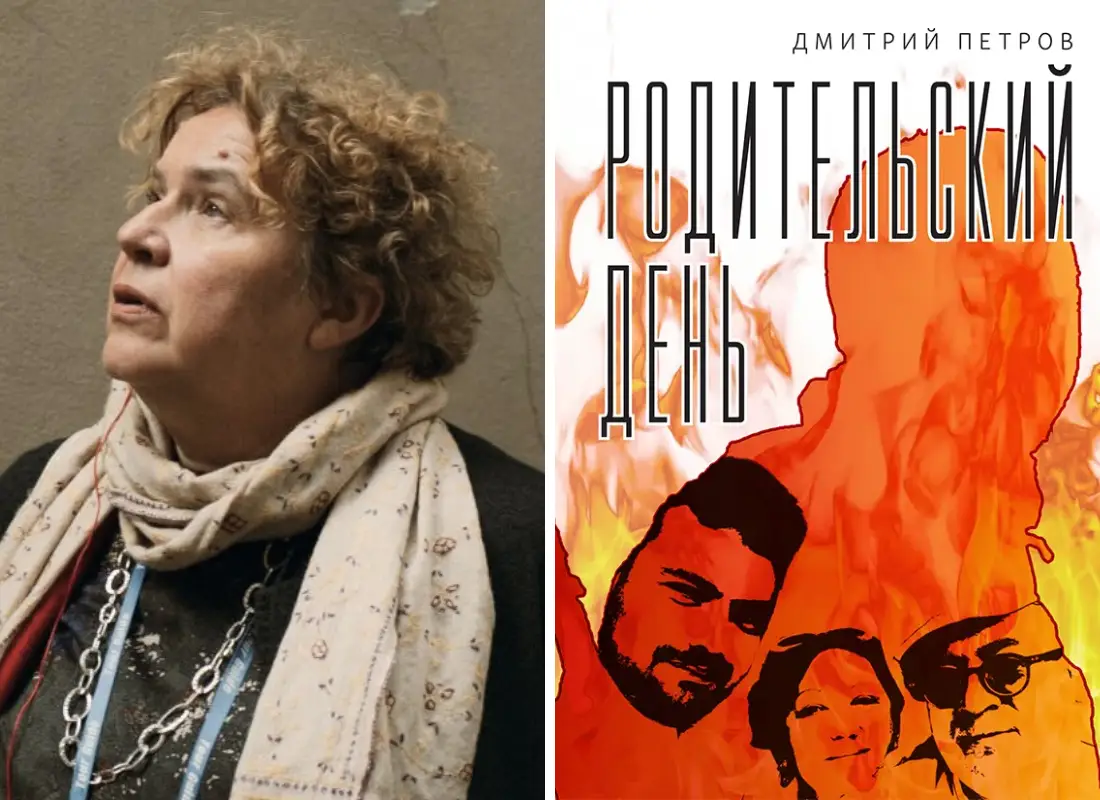
Историк и публицист Тамара Эйдельман — о книге Dmitry Petrov Parents’ Day, вошедшей в шорт-лист второго сезона независимой литературной премии «Дар»:
I read Dmitry Petrov's book Parent's Day, and I still can't get over it; I keep coming back to it in my mind.
From the very first pages, you read a description of wartime Kiev—and you sense that something terrible has happened in the narrator's life. For now, he simply recounts how he and his wife came to visit their son, who is volunteering to deliver water and food to the front, but you can feel something terrible approaching the whole time.
I rushed to Google and realized that Dmitry Petrov's son, Dmitry Petrov Jr., was a historian who studied the Kurds, was a well-known anarchist, a supporter of “direct action,” studied autonomy in Rojava, and fought for the Kurds. He then created an “anti-authoritarian platoon” and went to defend Ukraine.
“Parents' Day” — a meeting with his son in Kyiv in February 2023 — would be the last. In April 2023, Dmitry Petrov Jr. went missing near Bakhmut.
Nothing particularly remarkable appears to occur in the book—a father and son meet, converse, and debate anarchism. However, the tension escalates with each chapter, culminating in a cry of despair at the conclusion.
My son's body has not been found. Let him be captive, let him be crippled, but let him be alive. The uncertainty only increases the suffering of his parents...
But Parent's Day is much more than just a father's story about his terrible grief. It is also a reflection on his son's legacy (what a horrible phrase) and on anarchism in general.
And there is a whole world in the book — the streets of Israeli cities, the mountains and sea in Georgia, Paris, Athens, Rome...
And Kiev.
Kiev, however, is never mentioned by name. It is referred to only as “the City.” This immediately strikes a chord—a reference to Bulgakov's The White Guard. Parent's Day is full of references to literature, philosophy, and history.
It was this combination of raw lyricism and the ability to see one's own destiny against the backdrop of the world's destiny that made this book a real discovery for me.
Dmitry Petrov's book was shortlisted for the Dar Literary Prize this year. But it's not about the prizes. I would really like as many people as possible to read this book. It's not very long, but it's a big book.

What Are the Objectives of the Award?

The primary goal of the Award is to support authors and promote Russian-language literature worldwide. We welcome all who write and read in Russian, regardless of citizenship or place of residence. We aim to foster a Russian-language culture free from political and imperial influences.
How Is the Award Process Conducted?
The Prize is awarded annually. The Jury holds a vote in which each member selects between one and three works. The author whose work receives the highest number of votes becomes the winner.
What Awards Are Provided?
The Prize winner receives a grant for the translation of their work into English, French, and German.
When Does the Submission Period for the Competition Start and End?
Submissions for the third season of the prize will open on July 15, 2026, and close on October 15, 2026.
When will the list of finalists and winners be announced?
On January 20, 2027, the Council of Experts will announce the shortlist. The Independent Jury will announce the winner on May 25, 2027.
What are the conditions for the nomination of a book for the award
Works published in 2025 are eligible for the third season of the competition. Eligible works (novels, novellas, short story and essay collections, documentary prose) may have been published either as standalone editions or in literary magazines. Nominations may be submitted by publishing houses and magazine editorial boards, as well as by the authors themselves or third parties (with the author's consent and written confirmation). Texts must be submitted for consideration in electronic format. The DAR Prize is open to all authors. Given the prize's main goals — promoting contemporary Russian-language literature outside of Russia — and the nature of the award itself (a translation grant), priority will be given to authors whose works have not previously been translated into English, French, or German.