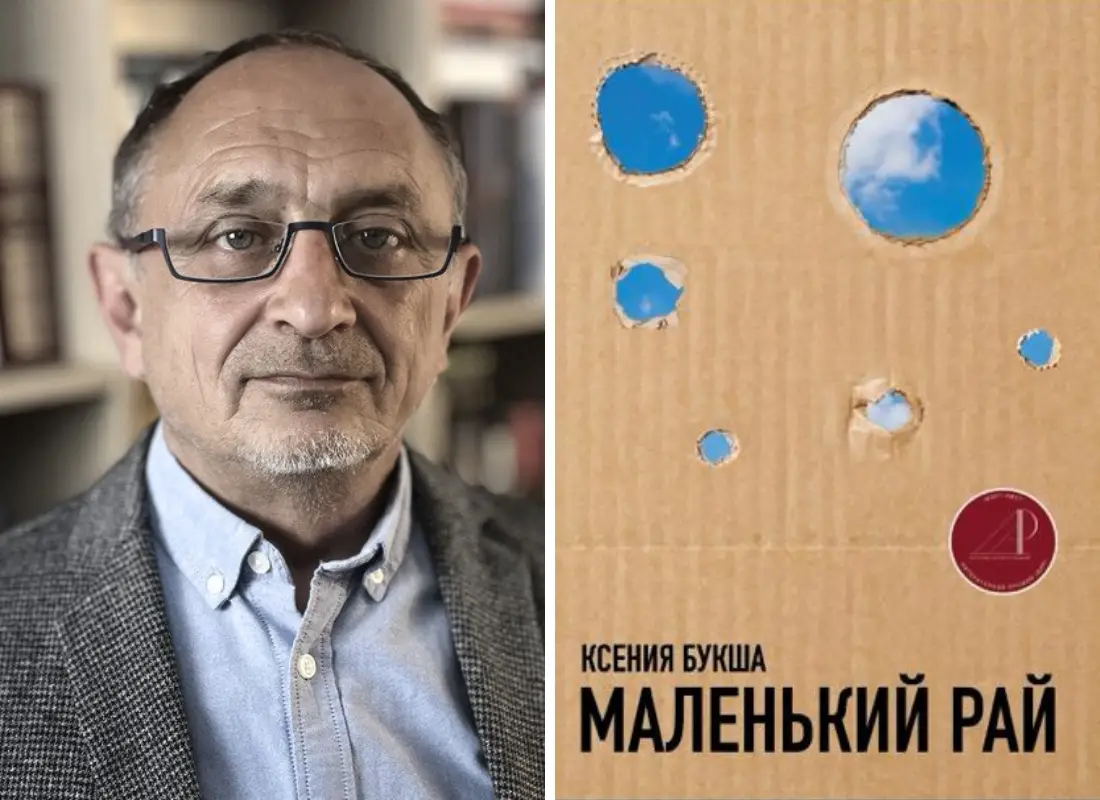
I was greatly impressed by the early novel Ksenia Buksha “The Freedom Factory.” I set out to read it without any enthusiasm, since I am an “old reader,” a “literary pensioner.” And everything written by people born in the 1980s and 1990s can no longer fit into the “old skins” (skins in the sense of “vessels”) . The generation to which I belong carries around its “written bag” — with Nabokov, Andrei Bitov, and Trifonov — and considers everything after Makanin to be non-existent in prose, or existing only in the form of moss. And so I read Buksha and was amazed. It was a small, intimate story about an attempt to figure out something seemingly very simple — “the history of a Soviet factory.” As the ‘author’ makes his efforts, the history of the factory does not so much become entangled as it falls into the realm of “epistemological paradox.” The author does not mock, does not boast, does not sneer, but honestly follows the “path of knowledge,” yet he and the reader drift further and further away from this factory. Not only the factory, but also all the witnesses of its existence, and the author himself, and everyone else — as they advance in their knowledge, they become more and more ghostly, losing their outlines... In short, I was shocked by the whole style, the completely new and incomparable “epistemology” in this work by Buksha. However, I did not delude myself. I thought: well, maybe this Buksha is just crazy. She wrote one strange novel in a “shift of consciousness” and then sank back into the “moss”...
And yesterday I read it “Little Paradise”, published by Urushadze in 2025. This, my friends, is simply a masterpiece. The Lord arranged it so well that Buksha moved from Russia to Montenegro because of the war in Ukraine, and as a result wrote a novel-parable about the Bosnian war. More precisely, about the consequences of some war somewhere in the Balkans. This novel is a response to both the Ukrainian war and all the debates about “politics of memory” and “trauma processing.”
It's worth reading. It's very subtle, profound, and avant-garde—that is, it's not just fiction (although it's clear that Buksha is a good fiction writer), but a radical epistemological break, going beyond fiction to a level where great literature takes risks.
Alexander Morozov

What Are the Objectives of the Award?

The primary goal of the Award is to support authors and promote Russian-language literature worldwide. We welcome all who write and read in Russian, regardless of citizenship or place of residence. We aim to foster a Russian-language culture free from political and imperial influences.
How Is the Award Process Conducted?
The Prize is awarded annually. The Jury holds a vote in which each member selects between one and three works. The author whose work receives the highest number of votes becomes the winner.
What Awards Are Provided?
The Prize winner receives a grant for the translation of their work into English, French, and German.
When Does the Submission Period for the Competition Start and End?
Submissions for the third season of the prize will open on July 15, 2026, and close on October 15, 2026.
When will the list of finalists and winners be announced?
On January 20, 2027, the Council of Experts will announce the shortlist. The Independent Jury will announce the winner on May 25, 2027.
What are the conditions for the nomination of a book for the award
Works published in 2025 are eligible for the third season of the competition. Eligible works (novels, novellas, short story and essay collections, documentary prose) may have been published either as standalone editions or in literary magazines. Nominations may be submitted by publishing houses and magazine editorial boards, as well as by the authors themselves or third parties (with the author's consent and written confirmation). Texts must be submitted for consideration in electronic format. The DAR Prize is open to all authors. Given the prize's main goals — promoting contemporary Russian-language literature outside of Russia — and the nature of the award itself (a translation grant), priority will be given to authors whose works have not previously been translated into English, French, or German.