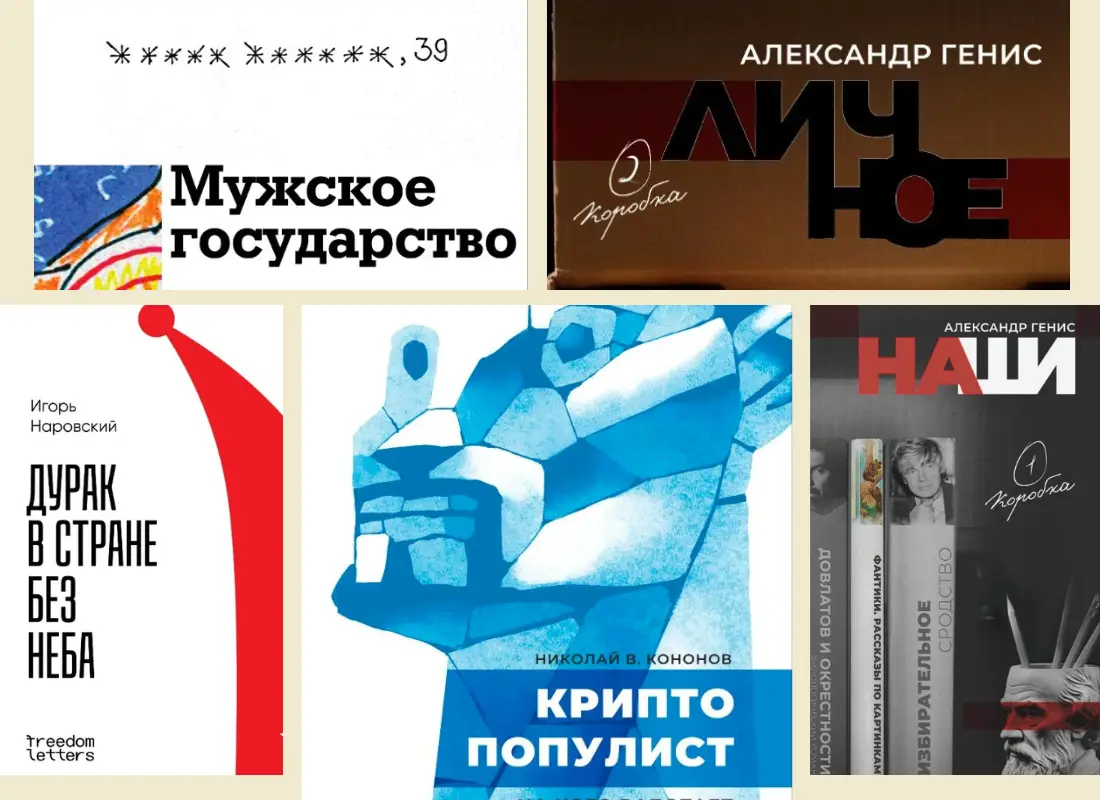
The independent publishing house Freedom Letters has released a new series of books, ranging from autobiographical prose and essays to novels about war, disappearance, and the boundaries of personal freedom.
Two volumes from Alexander Genis’s Quintet present different sides of his writing. Ours includes the “philological novel” Dovlatov and Its Surroundings, essays on Russian and world literature, and visual “stories from pictures.” Personal rings together autobiographical texts, from the lyrical Knitwear to the memoir Return Address, structured as a movement through an entire life, from before birth to its end.
Novel Male State,published anonymously, unfolds as the story of the disappearance of a young fashion designer in Moscow. The search turns into an unsettling journey through a reality where fear, state pressure, and personal vulnerability merge into a single current. It is a text about the intrusion of power into private life and the impossibility of taking shelter from it.
At the center of Nikolai Kononov’s Cryptopopulist is the figure of Pavel Durov. Through conversations with the author, the book builds a portrait of a man obsessed with the idea of freedom in technology, politics, and private life. Conflicts with states, intelligence services, and his own principles become part of this story.
Igor Narovsky’s A Fool in a Country Without Sky s prose about war and the attempt to preserve one’s humanity amid destruction. Two clowns set out to work in frontline territories and find themselves in a situation where art, moral choice, and survival become inseparable.

What Are the Objectives of the Award?

The primary goal of the Award is to support authors and promote Russian-language literature worldwide. We welcome all who write and read in Russian, regardless of citizenship or place of residence. We aim to foster a Russian-language culture free from political and imperial influences.
How Is the Award Process Conducted?
The Prize is awarded annually. The Jury holds a vote in which each member selects between one and three works. The author whose work receives the highest number of votes becomes the winner.
What Awards Are Provided?
The Prize winner receives a grant for the translation of their work into English, French, and German.
When Does the Submission Period for the Competition Start and End?
Submissions for the third season of the prize will open on July 15, 2026, and close on October 15, 2026.
When will the list of finalists and winners be announced?
On January 20, 2027, the Council of Experts will announce the shortlist. The Independent Jury will announce the winner on May 25, 2027.
What are the conditions for the nomination of a book for the award
Works published in 2025 are eligible for the third season of the competition. Eligible works (novels, novellas, short story and essay collections, documentary prose) may have been published either as standalone editions or in literary magazines. Nominations may be submitted by publishing houses and magazine editorial boards, as well as by the authors themselves or third parties (with the author's consent and written confirmation). Texts must be submitted for consideration in electronic format. The DAR Prize is open to all authors. Given the prize's main goals — promoting contemporary Russian-language literature outside of Russia — and the nature of the award itself (a translation grant), priority will be given to authors whose works have not previously been translated into English, French, or German.