by Tatsiana Zamirovskaya
translated by Marianna Suleymanova
The English translations of the excerpts were made possible thanks to the support of the WE EXIST! Foundation
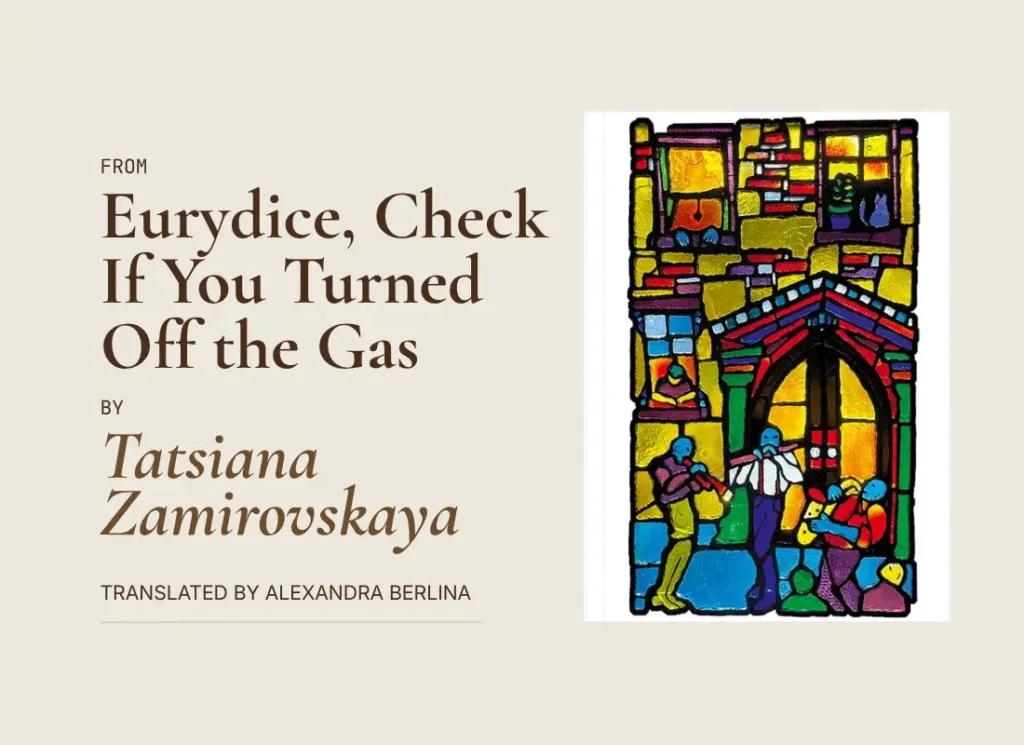
From the Author
Emigration is often associated with the loss of one or several identities. When I left Belarus, I lost only one of mine, but an important one, my identity as a music journalist. In New York, it ceased to be necessary, because I wrote about music to get closer to all these people, but here, they were all nearby. If you haven’t taken a selfie with Laurie Anderson at her Annual Benefit Concert in support of Tibet and haven’t attended her nighttime concerts for dogs in Times Square, then you’ve basically never lived in New York! It’s like a New York tarot card, a selfie with Laurie Anderson, Major Arcana, signifying an impossible closeness to something infinitely distant.
I liked to pretend that it was as if I was following my music heroes, as all of them moved to New York sooner or later. Where else would they go? Bowie moved to New York (I shared a city with him for an entire year), Patti Smith also moved to New York (even though she didn’t have to cross an ocean to do so), and Genesis P-Orridge, and John Lennon. So, I had to as well. Of course, I didn’t move to Strawberry Fields in Central Park, but instead I moved to Bushwick, which is a Northern part of Brooklyn, located beyond Williamsburg Bridge, which is now the new Williamsburg. Damn, that’s not it. How can I explain Bushwick? It’s populated by artists, Hasidic Jews, and hipsters. The first group rents studios from the second group, so they can hike up the rents of the third group due to the art-gentrification of the neighborhood, which the first group is responsible for.
The entire time I’ve lived in New York, in addition to literary fiction, I also wrote essays, blog posts, and expressionist diary longreads into the forgotten and therefore ultimately safe platform — LiveJournal. In the end, it turned out that most of my writing landed in a painful genre gap between autofiction, creative nonfiction, and metaphysical memoir. I wrote more of these texts than I did literary fiction, perhaps because I was looking for a way to deal with a new type of speechlessness, borne of being torn from my roots, which turned out to be ghosts, like any adaptation strategy of a psyche that masquerades as a sub-identity. Any emigrant, even a temporary one (we are all temporary emigrants, wherever we are), must reinvent their biography. To this end, I needed the illusion of continuity of my textual identity, in order to breathe, look, (and quote the lyrics of Belarusian bands).
And only when Russia’s full-scale invasion of Ukraine began, I wrote an essay about how I therapeutically dealt with the ongoing events through music and concerts. Pavel Antipov offered to release this essay as a standalone book, but then I realized that I had many more such essays. Did that mean they could all become a book? Almost anything can become a book in these post-traumatic times.
Post-traumatic pop is the term I accidentally came up with for the new album by the genius Belarusian female duo Sveta Ben and Galya Chikiss, or more precisely, some remaining grains and pieces of the music journalist in me came up with it. Coincidentally, I think that’s also the genre of this book, and we all often find ourselves in that genre. In these texts, through the ghost of the Belarusian music journalist in me, I am conceptualizing emigration not as a severance, but as a process and as a special, stained-glass window lens, not from the perspective of a single ray, that would never be able to penetrate the boarded-up window, but the stained glass window itself, that knows for certain that it exists even when there is no light, no ray and no observer. The material, factual qualia of that-which-doesn’t-exist.
And why am I doing so through this talkative ghost? Because, it turns out, it is the one who has something to say. As we all know, the classic ghost appears in exactly the place (ghosts are always of a place, tied to a point in space), where violence, replacement, rupture, the separation of body and soul, fate and memory took place. Every emigrant leaves such a ghost in their place, and mine, of course, is this musical person, who always stood nearby, but never took part in anything, didn’t save anyone, didn’t help anybody. They are the conduit for our joint traumas that we can’t discuss through anything that exists but can access only because of what is not there.
This music journalist, absent, knocked out of me like a tooth, turned out to be the very ghost through which I was able to write about what is important: about Belarus, about nostalgia, about loss. This is not a book about life in New York; it’s so not about that that I haven’t even included my stories of running into Eugene Hütz and Patti Smith on the street (who among us hasn’t run into them?) This book is about measuring the distance to the forever lost Belarus through forever lost identities, that existed and were possible only there, and about how a music journalist from Belarus finally ceases to be one in New York City.
Spending The War Without You
An essay, written in April 2023 for www.litradio.by
Everything I love is older than Putin
In some sense, I knew about the war from the very beginning, that it was inevitable, but I still couldn’t believe it until the very last moment. In January 2022, I was writing the accompanying text for the Ulrike Müller curatorial exhibition at MUMOK in Vienna. It was an exhibit about animals, abuse, and power, and I realized that all I could write about was war and being speechless. After about a month of futile groaning in suffering, I ended up writing about my grandfather, whose story of being mobilized for a war he didn’t want to take part in has transformed my now-adult consciousness into an endless post-stroke scream. That’s an easy way to lose your ability to speak, not metaphorically, but literally. Why then, if I still have that ability non-metaphorically, am I using it incorrectly? Why am I not using it to speak about what’s important, but instead writing about an apple orchard and a mechanical dog mechanically foaming at the mouth? Why don’t I talk about how somebody’s refusal to go to war and die can transform into this essay two generations later? I exist only because someone chose not to die at war, but many other people exist only because someone chose the opposite. However, there is no shame in not being a descendant of heroes.
What is shameful then? Almost anything is shameful in 2022, in the year of everyone being globally ashamed for everything. To be fair, my year started with the realization that if you’re not afraid, you can never be truly ashamed.
Shame, ice and fearlessness
In the beginning of February, I went to a citywide birthday party for one of my favorite (but not my most favorite) New York composers, Philip Glass. Everyone was welcome to wish him a happy birthday, but the format of the party required a certain overcoming, because it was a dance party on a skating rink. Laurie Anderson was the DJ. There was no other way to wish Philip Glass a happy birthday. If you loved Philip Glass and you wanted to wish him a happy birthday, you had to strap on some skates and move to Laurie Anderson’s music. My sisters in arms, mothers of many children and the winners of some of the most prestigious art awards on the planet, fastened the steel clamps of skates around their ankles and helplessly hung on the icy wall along with other crazed music lovers. I swung my arms and briskly charged forward, even though I had never skated before. I think that happened because I was not afraid, I had no experience in fearing this specific physical activity, so I managed just fine. Or maybe it was because I had health insurance. (Once, walking home on icy streets, I slipped and fell, and laying there, splayed out on the black Bushwick ice under the reconstructed ruins of a Protestant church, began to wail, not from the pain, but from sheer panic that if I broke anything, I wouldn’t have enough to cover the hospital bill.)
“Come on, come on, you’re not so bad!” Laurie Anderson cheered on the brave skaters, “You were total shit ten minutes ago, but you’re improving!”
After about an hour, Brownian motion on the rink was restored, and everyone crooned a minimalist rendition of the Happy Birthday song in unison, while the birthday boy was hiding out in a snow house by the Rockefeller Center entrance.
It was a wonderful party, but I couldn’t bring myself to write about it. My music journalist identity left me, checked out entirely, as if from a hotel where it had been staying on credit for the past few years. Now it is on wanted posters and it’s best if it doesn’t show itself anywhere in any way, so it doesn’t. I’ve long wondered why that happened. Sometimes I think the reason is that all the people who have directed various levels of aggression toward me-the-music-journalist, claiming that I am taking up their (these very people’s) spots and spamming the broadcast with my complicated, vapid metaphors, keeping them from eloquently conveying their unvarnished truths, have turned out to be, in my opinion, quite unpleasant individuals. When you come to such a realization, you get an urge to clear the music journalist train car expeditiously, and retroactively, so they can ride along that route from the very rocky start, right from the Borisov-Sortirovochny station, even though that station never existed until I put it on the map. It does now.
There were other possible explanations. Sometimes I thought that I could no longer get the reader to love what I love. To be frank, that’s always been my only goal—I wrote about music only because I deeply loved it and wanted to find a way to multiply that love. If only I knew how to create it (music, or love) myself, I would never have started writing. Writing, in my case, was born of ineptness, an inability to express my feelings, and of course, out of fear, as I’ve always found playing music live terrifying. I’ve never been so scared to death of anything as I was of playing music in public. I still have nightmares about music school. The people that perform music every day and enjoy it are the most fearless people in the world. That’s why I’ve decided to turn writing about these people into a career. I suppose we all made dumb decisions when we were idealistic 16-year-olds.
Also, at some point, I became ashamed of my music taste. When I was 20, it was a point of pride, at 30 I grew a little ashamed, but closer to 40 my shame turned nightmarish. Maybe that is somehow connected to getting more experienced and educated. At 15, I, mentally belting “Kill the DJ”, the anthem of my halcyon youth, could kick the boring European DJ off the turntables at a summer camp in a Slovak village in the High Tatras, and, relishing in my own coolness, play George Harrison’s “I Got My Mind Set On You”, but then at 34, when my friend Pogodina invited me to DJ an event to save me from dying of depression (thank you, friend), I helplessly combed through songs, while choice paralysis took hold. Laibach was too pompous, as if I wanted to seem different, but if I played Iggy Pop, everyone was going to think that I was not evolving but merely listening to what I liked as a kid. Was it cool to listen to Santigold, or should I have played Kendrick Lamar? That way everyone would know that I follow what Pitchfork likes. I noticed that while choosing what to play, I was trying to guess what music 20-somethings from Minsk considered cool, so I was no longer thinking that I’d play something I really love and would be able to share that love with others. But then, things got better. Turns out, alcohol helps. You look at everybody jumping around to stupid dance tracks by the forgotten band The Music or the old Lyapis hits, and tears flood your face— you have a one-way plane ticket to move to New York City forever in two days, and you will remember this night forever, because today you’re in a period of your life when everything is forever. They jumped around and forgot, and you, well, you still remember how your throat was sore that night, the David Lynchian tile in the bathroom, and how Yan Busel kept pouring more Ardbeg in your glintwein, and you, hugging Pogodina on the concrete carpet, whispered into her frozen ear, “I am leaving the day after tomorrow, the next time we see each other won’t be soon”. This is the first time you ever told her anything so important. It is also the last time you’ll see her. But just for now. I still have hope for the future.
Already in the States, in Bard College’s summer Master’s Program, I, again, after drinking some alcohol for courage (more precisely, against shame) could make my way over to the DJ booth and play some music, but there was no magic, nothing worked, I wanted too badly to be liked. I wanted to play something that would make people understand that I am cool and that I’ve listened to something progressive in my home country of Belarus, a foreign and backwards place in their minds. Simply sharing my favorite tracks like I did at 17 was something I could no longer do; I was too ashamed. Should I play some Psychic TV so Marie Losier would understand that we were meant to be friends forever and that I was wearing the jeans of the late Lady Jaye that I bought at a garage sale? Or should I play German new wave? Oh, I should let them know that I love Coil! I am the most boring guest at karaoke parties; I contain too much Belarusian embarrassment. And I was supposed to be the one squealing All The Things She Said into the mic, right after the cult artist Alex Segade conducted a choir made up of young LA filmmakers whose names you saw in the credits of movies like Get Out, Us, Nope, etc.) as they were trying to recall the lyrics to War Pigs by Black Sabbath.
My own pigs of war and shame are silent, which is why I will never figure in any impressive credits. If I listen to the same artists as my friends’ kids, like Mitski and Billie Eilish, then I listen to teenage music, and that’s embarrassing. If I listen to my generation’s music, like Arcade Fire, then I become associated with some rather unpleasant things that my contemporaries are going through (I am three days older than Win Butler), and that’s embarrassing. If I listen to the music I grew up on, like The Beatles and The Who, then it’s embarrassing that I am so stuck in my own teenage years. If I listen to the bands that helped me grow up, such as Porcupine Tree and dEUS, then it’s embarrassing that I listen to the same music at 40 that I did at 20. Besides, they are the same as they ever were. Have you even seen Steve Wilson? Even at 50 he looks like a teenage girl in Lennonesque glasses. That’s the kind of teenage girl I was in 2003, when I first went to his concert in Warsaw, and after, when I wept in my sleep until morning in the student hostel on Gornoshlensky Street.
Also, my greatest fear in life was to turn into an Old Musichead. You all know the type; he is about 50, but he’s been about 50 for a decade. He has a serious, tense, but childish face, all plowed by wrinkles, like a child who’d been deliberately aged in a tale about lost time. He’s full of love and loyalty, never betrays his favorite band, Judas Priest, or, I don’t know, Motorhead. He owns every album by his heroes: authentic CDs, vinyl reprints, some of them are even autographed. The Old Musichead ends up exactly like Kolya Vasin, one day deciding to jump off the roof of a six-story shopping mall onto the shiny marble floor. From there, his body will be covered with a huge plastic bag, as enormous as his (now useless) fan archive, then the floor will get a wash, and that will be that. Kolya Vasin took his own life, because he realized that his love for John Lennon was too ardent and lethal for the human world to contain; he jumped because of the unrequited nature of that love. Kolya Vasin’s death in 2018 made a horrific, devastating impression on me, hurting me in places I never expected to find myself, as if I was an additional nervous system extending into someone else’s nonexistence. It made me understand that in some way he was also me, that this is one of my possible futures. The fact that I’ve escaped that fate, in some way also means that I was the one laid out on that marble floor, the part of me who chose to disappear.
It appears that, due to my fear of becoming the Old Musichead I’ve irrevocably lost touch with the possibility of writing about music. Three years ago, I bought a piano from songwriter-friend, and when I feel especially down, I play the harpsichord part of the song by The Stranglers, a song written most likely about heroin.
Something has shifted in me after the Covid quarantine; I realized I wanted to go to concerts again. When I found myself at my first post-Covid concert, Modest Mouse somewhere in Brooklyn, my traumatized dissociated gaze which had become used to falling on nothing but terror, being couped up, and pain, suddenly saw the events on stage as a bizarre, almost religious ritual. So many strangers had gathered in one place, solely based on their shared love of an artistic product, created by specific people, and these very people were recreating that product in real time for all to see. The bewilderingly archaic nature of what was transpiring on stage threw me off track. It turns out that concerts are an outdated, dysfunctional and physical action from somewhere deep in our human past which we’ve inherited via atavism and for some reason, it works to this very day. How is that even possible?
In 2022, I started going to almost all the concerts of my favorite bands. I wasn’t afraid to run out of money; I realized that when I die, I will most likely have some money in my bank account, which I will no longer be able to use, so it’s best to spend it right now, while I am still alive. I wasn’t embarrassed to buy tickets to see my favorite bands or post stories from these concerts on social media. It was as if I had finally allowed myself to love and to feel. Apparently, I had finally come to the realization that life, safety, and possibility of anything is finite and swift-moving; there is no later, and there will be no me later, so I have to make sure to fit everything into now. And I really needed to feel something again, because for the entirety of 2022 I thought I’d forgotten how to cry and would never learn to cry again.
My year in concerts didn’t turn out to be a happy one or an overcoming of some kind. It didn’t resemble a list of accolades or an aesthetic countdown of respectable bands being a fan of which was not embarrassing (and I hope it stays that way, as I am writing this text mostly for myself, because if I don’t write it, I will continue to stay silent), but it was my only way of ordering events and keeping track of them as feelings-based, emotional facts of a life that has collided with the unthinkable.
And each one of us reckoned with that unthinkable as best as we could. For me, my way was concerts. These shows didn’t help me understand even my own feelings, as my own feelings are irrelevant at the moment, everyone is experiencing emotions right now, whatever you name them, but they made me feel alive in the moment, capable of loving and crying, There was nothing else alive within me, besides this crying creature for some rare, flaring seconds. This dotted, threadlike, live wire of a life iridescing within me with flickering droplets seemed to me to be akin to a burned-out Christmas garland, pulled tight between two buildings, on which I, like a phantom rope-walker, was trying to not quite cross to the other side of the street but, somehow traverse in the direction of the light, orienting myself using these rain flashes, these swampy northern lights, ignis fatuus, silly fire, I am the very text that Nabokov never wrote, because all of this is horrifyingly banal.
Still, I will be crossing, to keep from drowning. No one is obligated to read this, but I am obligated to write it. In general, I follow this principle when I write anything at all, but right now, I am following it more than ever.