by Evgeny Feldman
translated by Sarah Vitali
The English translations of the excerpts were made possible thanks to the support of the WE EXIST! Foundation
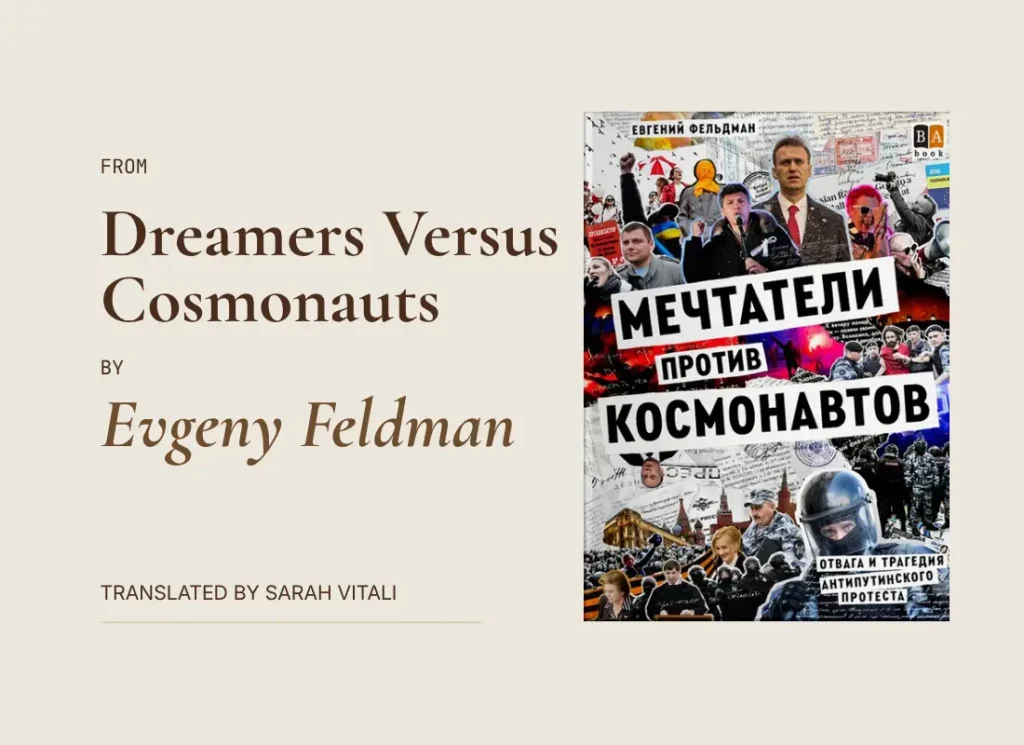
Chapter 8
The Bolotnaya Square Case
Moscow, May 2012-April 2013
The criminal arrests began just a couple of weeks after large-scale protests against the results of the 2011 legislative elections were violently dispersed on Bolotnaya Square.
First to be arrested was the anarchist Alexandra Dukhanina. A photograph of her detention published by RIA Novosti became one of the most widely disseminated images of the protests: it showed a police officer dragging her to a van by the neck. This photograph became a striking symbol of the disproportionate cruelty employed by those dispersing the protests. Dukhanina had the bad luck of becoming the face of the opposition camp, and propagandists eagerly latched onto the idea that the movement’s new hero had thrown plastic bottles at the riot police.
Two others were arrested around the same time as Dukhanina, then more and more after. I developed a new ritual: as soon as the names of new detainees were published, I would look them up on social media, then search for their faces in the photos I’d shot at the protests. I found a carefree Dukhanina in my pictures from Occupy Abai. There had been a sort of library in the encampment, and Alexandra had been handing out books there, Monopoly, leaflets (“…We are surrounded by people living their lives, working, shopping, riding the metro, sitting on benches on this very same boulevard, people who don’t understand why we need new elections…”). On May 6, another detainee, Andrey Barabanov, had been beaten up in front of me.
In June, investigators conducted synchronized searches of the apartments of all the opposition leaders: Dmitry Gudkov, Alexei Navalny, Sergei Udaltsov, and Ilya Yashin and Ksenia Sobchak. It appeared that Sobchak, a television presenter, was only involved because Yashin was living with her at the time; nevertheless, she was not even permitted to get dressed before the search, during which agents seized half a million dollars in cash. I decided to head to Navalny’s.
The entrance to the dreary sixteen-story building on the outskirts of Moscow was flanked by two men bearing assault rifles and surrounded by a crowd of nearly a hundred activists. Someone had stuck protest stickers on the Investigative Committee’s minibus, someone was half-heartedly arguing with the police, someone was saying that Navalny occasionally waved from the window—I was very jealous of the photographer who managed to catch that on film. It seemed that, after the activists, the protest leaders were next in line to be detained. I was certain that Alexei would be taken in for questioning, then put in a detention center; I might not get another chance to photograph him before he appeared in court. A girl with long bangs attached a white rose to the entryway’s window, attempting to squeeze a message to Navalny on the masking tape.
Toward evening, the quiet courtyard began stirring again: a string of investigators wearing balaclavas started filtering out of the building, carrying boxes of seized objects. Aleksei came down to say that the search was over and that he would face interrogation the next morning. His wife, Yulia, called journalists into the apartment several at a time. On the floor, among dresses, a shirt calling for the release of Mikhail Khodorkovsky, a book by the Putinist Nikolai Starikov, and the memoirs of the founder of IKEA, lay their wedding album. I felt horribly awkward and limited my photography to a couple of general shots.
…
On the morning agents came knocking on Sobchak and Yashin’s door, my friend and Yashin’s assistant Misha [Mikhail] Maglov rushed to their apartment. Maglov was one of the most high-profile activists in Boris Nemtsov’s Solidarity movement. On his way into the building, he bumped into an acquaintance of his, a major who served in Center E, the Center for Combatting Extremism—in other words, the political police. The acquaintance informed Maglov that he was also on their list, and for some reason escorted him to Yashin’s apartment. A search ensued, with all the trimmings: the place was crawling with de-miners, dogs, special forces, and cameras from the state television channels. Of course, it quickly transpired that the police had mixed up the apartment numbers and accidentally broken into the home of the politician’s neighbors.
After the search, Misha was taken for questioning to the industrial park where the two hundred investigators assigned to the Bolotnaya Square case had been stationed. The former factory’s enormous shop floors were now filled with desks and computers; the hallways were plastered with screenshots from footage of the May 6 clashes. In the end, after being interrogated and threatened, Maglov was released. For some time afterward, he spent his nights moving between different friends’ apartments and 24-hour cafes, until finally, he disappeared. Like dozens of other activists, Maglov secretly emigrated.
In the span of a few weeks, half my social circle disappeared along with him. I watched poorly lit videos taken from the road: headlights on the highway, or people sprawled out on sheaves of hay in Belarus, or bidding their friends farewell on the border with Ukraine. Everyone was leaving: National Bolsheviks, leftists, liberals. Some were too high-profile, others had actually fought with the riot police, still others had been told by acquaintances that their pictures had been hung in the metro, identifying them as persons of interest. Even if you hadn’t been participated in the May 6 protests, that wasn’t enough to protect you: approximately a third of those thrown in jail hadn’t been on Bolotnaya Square at all.
Many of these emigrants ended up in Kyiv: it was the easiest place to get to, and those who tried to go further afield found themselves mired in bureaucracy. Diplomats of various countries whispered that, any day now, everything would be taken care of; at the same time, the courts were refusing to issue emigrants with papers, while the UN kept demanding more and more documentation; meanwhile, the emigrants were building their lives around the scrap of paper that might offer them asylum.
My wife Natasha [Zotova] and I decided to do a story on the emigrants’ predicament (we even planned to include a checklist: “How to check if you’re being surveilled”), so, in August, we went to Kyiv for several days. We met up with Misha near the Bessarabskyi Market, and the whole time he was scrolling through Twitter, fuming: “Not one message to ask, hey, why have you dropped off the face of the earth?”
Misha was living with a couple of other emigrants, National Bolsheviks, in a secret location. They occasionally noticed surveillance outside their apartment window.
…
The opposition attempted to rebuild, focusing on the long game. One contingent of activists founded the 5th of December Party (named for the date of the first rally at Chistye Prudy). They tried to convince everyone that the path to change lay through local elections, particularly as dozens of independent deputies had been elected to Moscow municipal councils. You couldn’t say they had a mandate, but it seemed like a decent starting point for making inroads to power. The most despairing (and cultured) activists looked to the nineteenth century for inspiration: they believed in ‘going to the schools’ and inoculating the young generation with the ‘values of freedom.’
Meanwhile, in Moscow, large-scale marches were still taking place. These events invariably drew tens of thousands of participants—in the space of a year, the protests had grown by an order of magnitude—but with each rally, the mood grew more desperate. The first one, in June, took place against the backdrop of the raids being conducted in the homes of activists and politicians; to add insult to injury, the rally/concert that had been planned as the event’s grand finale was cut short by pouring rain. The next march, in September, was accompanied by a fresh wave of interrogations and ended with Udaltsov making yet another plea for people not to leave: by that time, only about three hundred remained on the enormous prospect.
The newly-founded Russian Opposition Coordination Council became the focal point for protest strategy. This was a venue where prominent politicians could gather to discuss plans for action. I took the elections for this body very seriously: it seemed as if Russia might end up with a real rival parliament. From the get-go, I titled this file in my archives with an eye toward posterity: “First Elections.”
The voting was organized by Leonid Volkov, an obscure politician from the Urals with a passion for electronic voting. The election commissions included volunteers from across the country; a polling center was even planned for Snezhinsk, a closed town near Chelyabinsk specializing in the development of nuclear weapons. I dreamed of going there for work, and I even started planning the trip—I managed to find a street named after the physicist Yevgeny Zababakhin on the map—but in the end, I didn’t get permission to shoot.
The elections were genuinely competitive, and they were full of twists and turns: the candidates fought among themselves, both left- and right-wing activists demanded concessions, and the protocols eventually put into place were borne of laborious compromise. TV Rain—the only channel that would cover the Opposition Coordination Council—aired several rounds of debates, during which candidates gravely questioned each other about their plans to oppose the regime.
Voting lasted two days. On the evening of the first day, I received an unexpected invitation: TV Rain wanted me to comment on the ongoing elections on a talk show hosted by Ksenia Sobchak.
Once at the studio, I immediately felt out of place. To one side of me, people I’d seen on television since I was a child were serenely preparing to go on air; to the other were odious characters of the likes of German Klimenko, who had called for American social networks to be blocked in Russia. All the other guests were seated on sofas and chairs, while I was directed to a minuscule ottoman that put me at knee-height to everyone else.
Around that time, a new twist had emerged in the Bolotnaya Square case: NTV had published hidden camera footage that seemed to show Sergei Udaltsov organizing the unrest in Moscow with Georgian politician Givi Targamadze. A criminal case had been initiated against Udaltsov and his assistant, Leonid Razvozzhayev. During a commercial break, I went to check the news and froze: apparently, Razvozzhayev had been abducted in Kyiv, where he had been seeking political asylum. Now he had been secretly arrested at Basmanny District Court; as he was leaving the building, he managed to shout that he had been subjected to two days of torture.
I couldn’t focus on anything else, but then the commercial break ended and Sobchak went back to pitting her guests against each other. Klimenko pompously held forth on Volkov’s lack of professionalism, someone expressed sympathy for the grannies who hadn’t been able to vote due to attacks on the website… I didn’t get the chance to speak until the very end when, in closing, Sobchak invited each of her guests to predict five winners. I grabbed the microphone and mumbled, “I’m not much of a prognosticator. I’d like to break the rules and say that, in light of the news, we’ve got to vote for Razvozzhayev. It’s all that we can do.”
Sobchak brushed me aside, turning her attention to more interesting guests. 81,000 people voted in the Opposition Coordination Council elections. Razvozzhayev received fewer than 13,000 votes—and four and a half years in a penal camp.
Until that point, the Federal Security Service (FSB) had seemed far removed from street politics, occupying itself with its own lofty and serious concerns: terrorists, spies, and regional governors. It was rare to hear rumors of FSB surveillance on the protest scene. But, according to his lawyer, it was FSB agents who had abducted Razvozzhayev in Kyiv.
Razvozzhayev told human rights advocates that he had been held in the basement of a private home somewhere in Bryansk Oblast; there, threats were made against his loved ones and he signed a forced confession. The Investigative Committee responded with a press release claiming that Razvozzhayev had turned himself in voluntarily and confessed to all charges against him. To add insult to injury, two other cases were subsequently launched against him: for illegally crossing the border when returning to Russia and for false claims of torture.
That evening, the sidewalks in front of the FSB headquarters on Lubyanka Square became a new key site for protest; the demonstration was a pointedly gentle one, as if to counterbalance the place’s dark history. The asphalt was covered with chalk slogans: “The FSB tortures people,” “They came for them, they’ll come for you.” On a neighboring lawn, there were activists playing pétanque.
A new law restricting public assembly stipulated that one-person protests—which did not require official permission and were therefore the only viable form of spontaneous action—must take place at a distance of at least fifty meters apart. That weekend, in accordance with this law, dissenters formed a four-kilometer-long chain stretching from the FSB headquarters to the Investigative Committee Headquarters. Somewhere on Maroseyka Street, a man in a cap quoted Sartre: “You are always responsible for that which you did not try to prevent.” Navalny appeared on Lubyanka Square with a sign bearing a generic slogan (“I am against repression and torture”), but he was swiftly detained. At the other end of the line, someone placed a sign with this same slogan on a steamroller. This felt symbolic: a terrible feeling of helplessness had begun to take over.
…
In December 2012, the United States passed the Magnitsky Act, named after the tax lawyer Sergei Magnitsky, who, four years prior, had died in Matrosskaya Tishina prison. He had exposed a large-scale corruption scheme perpetrated by Russian police and state officials—who retaliated by sending him to jail for tax evasion. Magnitsky was denied vital medical care for serious health issues; shortly before his death, he may have been assaulted by prison guards.
The Magnitsky Act allowed the US to impose personal sanctions on Russian citizens who had committed human rights violations. The Kremlin immediately moved to retaliate by banning certain Americans from entering Russia or opening accounts with Sberbank.
The new Russian law would have remained largely symbolic were it not for an unexpected amendment that was added to the bill before its second reading: citizens of countries that had joined the US-led sanctions would be barred from adopting Russian children. Journalists immediately identified dozens of children who were about to leave orphanages to go to foreign families, but had now been deprived of that chance.
Many people were outraged by the law’s cruelty: for days on end, picketers stood outside the Duma, and petitions on the subject drew tens of thousands of signatures. Opponents even organized a march specifically in protest of the so-called ‘scoundrels’ law.’ It was very important to me to demonstrate the scale of this protest. Despite the freezing cold—the riot police’s breath left a thin layer of frost on their balaclavas—I walked up and down the route several times beforehand in search of a window that would give me the optimal view. Over a hundred thousand people turned out for the march; I spent an hour ringing the doorbells of the apartments I’d identified, and in the end, I managed to get the ideal shot.
You would think that protests on such a massive scale would have killed this wildly unpopular bill; however, it sailed through every stage of the legislative process and was signed into law by Putin shortly before the new year.
Our illusions were being shattered left and right; meanwhile, in a Moscow detention center, a hunger strike had been declared by a man who vowed to be the next Magnitsky.
…
Sergey Krivov, a 51-year-old Candidate of Sciences, was arrested in connection with the Bolotnaya Square case in October. In the wake of May 6, he had participated in numerous one-person pickets in support of the accused. Now he found himself in jail, ostensibly for taking a club from a police officer during the protests and then beating him with it. When, in December, he was remanded until March, Krivov announced that he was going on hunger strike. His wife and friends wrote that he said he was prepared to die. In the first month, Krivov lost twelve kilograms.
My last chance to see and photograph him would be at his appeal. They had started conducting these hearings by video link: the defendant would be taken to a separate cell in the detention center, where he would be sat in front of a camera; the feed would then be shown on a tiny screen in the courtroom. Krivov’s hearing took place on the thirty-second day of his hunger strike—the day after the march against the ‘scoundrels’ law.’
“Feldman! Your shoot yesterday was inspired!” Boris Nemtsov unexpectedly boomed, having spotted me across the lobby of the Moscow City Court. His tone quickly grew serious as our conversation turned to the situation at hand. “Krivov has said that he wants to be the next Magnitsky. Honestly, my heart dropped. It’s life or death for him today.”
We were taken into the courtroom. Krivov’s wife burst into tears at the sight of her emaciated husband on the screen. Then came a long-winded, impotent speech from his lawyer, who theatrically declared that the country’s power lay with its people, posing the rhetorical question: how else could Krivov voice his protest? The prosecutor responded with a document from the detention center claiming that the defendant had been eating in secret.
During the recess, the sound was turned off, so the activists communicated with Krivov using notes. “END Your HUNGEr strike,” read a sign held up to the camera by Nemtsov, who hadn’t properly accounted for the paper’s width. The three judges remanded Krivov; nonetheless, Krivov ended his hunger strike a week later.
…
The Bolotnaya Square case took up nearly all of my time.
In March, I commuted to Basmanny District Court as if it were my job: for several days on end, the court busied itself from morning to evening remanding twelve of the defendants in this massive case. Outside, spring had sprung, but behind courtroom doors, a pervasive melancholy reigned.
There were very few journalists in the corridors, and only a few people came to support the detainees. Capturing the defendants’ dazed smiles as they were hurried past by the guards was excruciating enough, but seeing their stone-faced loved ones standing in the courtroom was even harder. “The defendant has acquaintances on social media who reside abroad, which renders him a flight risk.” The judicial-prosecutorial machine ground relentlessly forward, issuing remand after remand.
Around the same time, Alexander Dolmatov, a member of the National Bolshevik Other Russia party, died by suicide in a Dutch deportation center. He had fled Russia after the first wave of arrests, but had been denied political asylum. Some of his fellow party members dumped red paint on the snow outside the Dutch embassy, while others took out their rage on Udaltsov, who was attacked while giving a television interview outside Dolmatov’s memorial service.
Later, in April, there was yet another wave of arrests, and it became clear that investigators were preparing for a further trial. Noted anti-fascist Alexey Gaskarov had filed a complaint after being beaten up by the riot police during the dispersal of the crowds on Bolotnaya Square. Now he found himself behind bars, accused of violence against a police officer.
I watched Gaskarov through the viewfinder as the judge, predictably, ordered his arrest. He knew perfectly well how the proceedings would end, so he reacted with no more than an ironic smile. Then, suddenly, a composition came together of its own accord: Gaskarov’s fiancée, Anna Karpova, went up to him, smiling, staring as if she were memorizing his face, while Alexey smiled back at her from behind bars. A disgruntled-looking guard stepped right in front of me, separating them in the shot.
I shot several weddings at the detention center. The prisoners’ brides would come to the outskirts of Moscow, where they would go inside for several minutes for the ceremony; they weren’t allowed even a moment alone with their partners. Indifferent prison employees watched the girls in their beautiful dresses and their bridesmaids through the barred windows.
Parents made desperate attempts to draw attention to their children’s trial. Permission for mothers’ picket lines was granted for the oddest, most inaccessible locations, and their signs bearing messages like, “Give us back our children!” went largely unseen. Near one picket line, someone left a stuffed elephant with a pin reading, “Arrest me, I was at Bolotnaya!”
For those of us following the trial, the only support we had left was each other. New rumors were constantly emerging: one day I’d hear that additional, even more serious charges were in the offing, the next, that an amnesty was just around the corner; the lawyers whispered that Krivov hadn’t really been on hunger strike. The trial was just around the corner, and I was studying the law in an attempt to navigate the proceedings. From the lawyers I picked up slang like musornut’sya (to go running to the authorities) and terpila (a doormat, a victim; also, a political prisoner).
This newly acquired knowledge would serve me well in April, when the trial against Alexey Navalny began in Kirov.