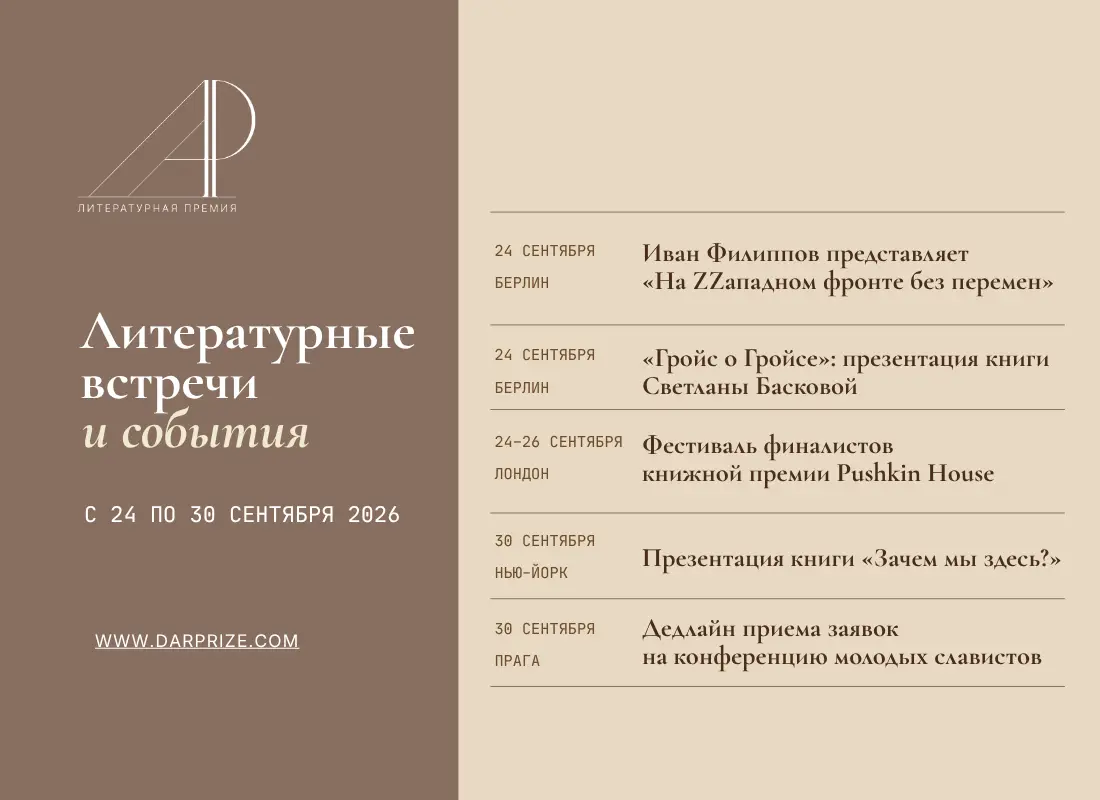
New book launches in Berlin and New York, the Pushkin House Book Prize Festival in London, and an open call for young Slavists in Prague — our selection of literary events for the coming days.
24 September, Berlin
Ivan Filippov will present his new book about contemporary Russia, based on an archive of more than 40,000 posts published by almost 2,000 pro-war Z channels. Following the presentation, he will answer questions about the Z propaganda sphere. The event will be moderated by journalist Tatyana Felgenhauer.
Bibliothek am Wasserturm, Prenzlauer Allee 227–228
Tickets and details
24 September, Berlin
Filmmaker and artist Svetlana Baskova will present Groys on Groys, a book-length conversation conducted over many years with philosopher and art theorist Boris Groys. Baskova will discuss how the book came together, read selected passages, and join the audience for a discussion. Admission is free, but registration is required.
Babel Books Berlin
Registration and details
24–26 September, London
Pushkin House will host a three-day festival celebrating the finalists of its annual book prize. The programme includes an Informality game inspired by Alena Ledeneva’s The Russian Pendulum, a documentary about Boris Nemtsov, and public discussions with the shortlisted authors. The festival will conclude with the announcement of this year’s winner.
Pushkin House
Programme and tickets
30 September, New York
Yasha Klots, editor of Why Are We Here? The First Russian Emigration Examines Itself (1920–1939), will present the book in conversation with poet and scholar Polina Barskova. The collection brings together essays written by first-wave Russian émigrés during the interwar period, reflecting on exile, cultural identity, and the purpose of emigration — questions that have acquired renewed urgency a century later.
White Rabbit’s Books, 200 West 86th Street
Read more
30 September, Prague
Students and early-career researchers are invited to apply for the Conference of Young Slavists 2026. The conference will take place in Prague on 17–18 December and will feature four sections: language, literature, history, and poster presentations.
Czech Academy of Sciences
Submit Your Application

What Are the Objectives of the Award?

The primary goal of the Award is to support authors and promote Russian-language literature worldwide. We welcome all who write and read in Russian, regardless of citizenship or place of residence. We aim to foster a Russian-language culture free from political and imperial influences.
How Is the Award Process Conducted?
The Prize is awarded annually. The Jury holds a vote in which each member selects between one and three works. The author whose work receives the highest number of votes becomes the winner.
What Awards Are Provided?
The Prize winner receives a grant for the translation of their work into English, French, and German.
When Does the Submission Period for the Competition Start and End?
Submissions for the third season of the prize will open on July 15, 2026, and close on October 15, 2026.
When will the list of finalists and winners be announced?
On January 20, 2027, the Council of Experts will announce the shortlist. The Independent Jury will announce the winner on May 25, 2027.
What are the conditions for the nomination of a book for the award
Works published in 2025 are eligible for the third season of the competition. Eligible works (novels, novellas, short story and essay collections, documentary prose) may have been published either as standalone editions or in literary magazines. Nominations may be submitted by publishing houses and magazine editorial boards, as well as by the authors themselves or third parties (with the author's consent and written confirmation). Texts must be submitted for consideration in electronic format. The DAR Prize is open to all authors. Given the prize's main goals — promoting contemporary Russian-language literature outside of Russia — and the nature of the award itself (a translation grant), priority will be given to authors whose works have not previously been translated into English, French, or German.