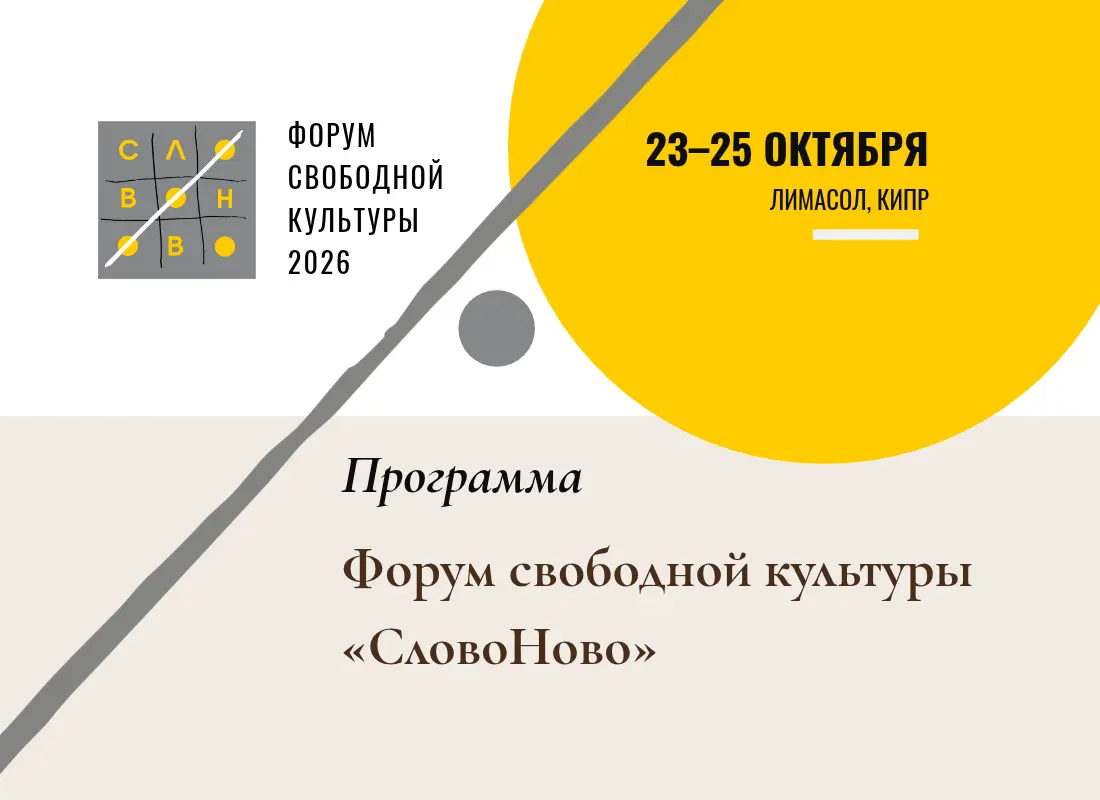
The SlovoNovo Forum of Free Culture will take place in Limassol, Cyprus, from 23 to 25 October. The programme includes talks with writers, discussions, exhibitions, documentary screenings, a staged reading and concerts.
Oleg Radzinsky will present Paper Sun, Sasha Filipenko — Elephant, and Demyan Kudryavtsev — All This Is You Now. Nikolai Alexandrov will host the conversations with Radzinsky and Filipenko. The programme also features a talk with Boris Akunin, a reading by Vera Pavlova and a presentation of new releases from Freedom Letters with Georgy Urushadze.
Roundtable discussions will explore Russian-speaking communities across national borders, new civic institutions, audiences for independent media and cultural projects, children growing up in emigration, and the impact of artificial intelligence. Participants include Mikhail Shishkin, Olga Polevikova, Andrei Kordochkin, Dasha Shamina, Olga Bychkova, Tatyana Lazareva, Anna Mongait, Yuri Lapshin, Alexandra Arkhipova and Pavel Muntyan. The discussions will be moderated by Alexander Morozov, Maxim Kurnikov and Boris Barabanov.
The exhibition programme brings together works by Vladimir Tsesler, the Sorokin Trip project and The World on the Brink of Change, an exhibition dedicated to Boris Efimov. Artdocfest’s film programme includes Alina Rudnitskaya’s School of Seduction, Zhanna Agalakova’s A Little Gray Wolf Will Come and Filip Remunda’s Happiness to All.
Other events include Alexandra Arkhipova’s interactive lecture on the newspeak of dictatorships, a conversation with literary figures from the past hosted by Pavel Muntyan and Marat Gelman, and Marina Ratina’s talk on creating a state as a start-up.
The evening programme features a staged reading of Ivan Vyrypaev’s novel Salyut, with Dasha Shamina and Vadik Korolyov; Tchaikovsky: Myth and Reality, a musical programme by Nikolai Medvedev and Maxim Kurnikov; and a concert by Vera Polozkova.
Events will take place at Carob Mill Complex, NYX Hotel Limassol and Versus Theatre.

What Are the Objectives of the Award?

The primary goal of the Award is to support authors and promote Russian-language literature worldwide. We welcome all who write and read in Russian, regardless of citizenship or place of residence. We aim to foster a Russian-language culture free from political and imperial influences.
How Is the Award Process Conducted?
The Prize is awarded annually. The Jury holds a vote in which each member selects between one and three works. The author whose work receives the highest number of votes becomes the winner.
What Awards Are Provided?
The Prize winner receives a grant for the translation of their work into English, French, and German.
When Does the Submission Period for the Competition Start and End?
Submissions for the third season of the prize will open on July 15, 2026, and close on October 15, 2026.
When will the list of finalists and winners be announced?
On January 20, 2027, the Council of Experts will announce the shortlist. The Independent Jury will announce the winner on May 25, 2027.
What are the conditions for the nomination of a book for the award
Works published in 2025 are eligible for the third season of the competition. Eligible works (novels, novellas, short story and essay collections, documentary prose) may have been published either as standalone editions or in literary magazines. Nominations may be submitted by publishing houses and magazine editorial boards, as well as by the authors themselves or third parties (with the author's consent and written confirmation). Texts must be submitted for consideration in electronic format. The DAR Prize is open to all authors. Given the prize's main goals — promoting contemporary Russian-language literature outside of Russia — and the nature of the award itself (a translation grant), priority will be given to authors whose works have not previously been translated into English, French, or German.