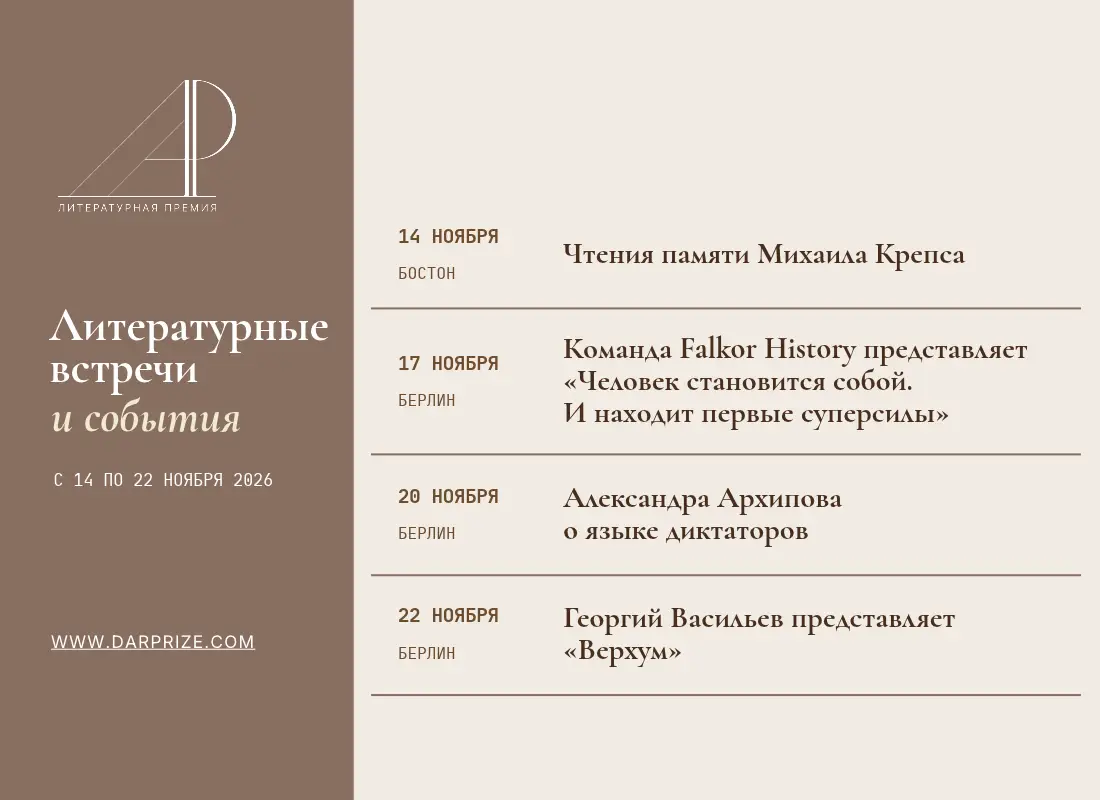
The Michael Kreps Memorial Readings at Boston College, a journey into early human history with the Falkor History team, Alexandra Arkhipova’s interactive talk on Newspeak, and a conversation with Georgy Vasilyev about collective intelligence — here are the literary events taking place in Boston and Berlin.
The Michael Kreps Memorial Readings
Boston College will host the Kreps Memorial Readings, dedicated to Russian émigré literature. Dmitry Bykov, Boris Lanin, Vera Pavlova and Maxim D. Shrayer, the series’ curator and moderator, will read from their work.
The readings were founded in 1997 in memory of poet and literary scholar Michael Kreps, who taught at Boston College. The event will be held in Russian and is open to everyone.
Boston College, Chestnut Hill, Boston
The start time and room are to be confirmed. Admission is free and registration is not required. For details, contact the department on +1 617-552-3910.
The Falkor History team presents “Becoming Human. Discovering Our First Superpowers”
Babel Books Berlin will host a presentation of the first book in the Falkor History series. Its creators will discuss life in the Palaeolithic, what connects us to our distant ancestors, and the making of a book that brings together academic research, comics and infographics.
Filipp Dzyadko, Andrei Zorin, Vyacheslav Rogozhnikov and Anna Sokolova will take part in the event. Actress and theatre educator Alisa Dmitrieva-Shishko will moderate the conversation. Yuri Saprykin Jr.’s participation is still to be confirmed.
Babel Books Berlin, Bernauer Str. 49, Berlin
Starts at 19:30. Admission is free.
Alexandra Arkhipova on the language of dictators
At Babel Books Berlin, anthropologist Alexandra Arkhipova will lead an interactive talk, “The Language of Dictators, Past and Present”. Participants will try to identify where and when official euphemisms originated and what events they conceal.
The conversation will explore how Newspeak shapes our perceptions and where politeness ends and manipulation begins. Afterwards, Arkhipova will present “An Ethnographic Dictionary of War”, co-written with Yuri Lapshin, a study of language and everyday life in the Russian army based on soldiers’ letters.
Babel Books Berlin, Bernauer Str. 49, Berlin
Starts at 19:30. Tickets are sold out.
Georgy Vasilyev presents “Verkhum”
Prachtwerk will host an evening with Georgy Vasilyev devoted to his book “Verkhum”. Maxim Kurnikov will moderate the conversation.
Vasilyev invites us to view a family, a company or a state as a community with a mind of its own. How does collective thinking emerge, why does it lead to mistakes, and can we influence it? These questions will be explored at an event organised by the Echo team. Copies of the book will be available to buy and have signed.
Prachtwerk, Berlin
Starts at 18:00. Tickets are required.

What Are the Objectives of the Award?

The primary goal of the Award is to support authors and promote Russian-language literature worldwide. We welcome all who write and read in Russian, regardless of citizenship or place of residence. We aim to foster a Russian-language culture free from political and imperial influences.
How Is the Award Process Conducted?
The Prize is awarded annually. The Jury holds a vote in which each member selects between one and three works. The author whose work receives the highest number of votes becomes the winner.
What Awards Are Provided?
The Prize winner receives a grant for the translation of their work into English, French, and German.
When Does the Submission Period for the Competition Start and End?
Submissions for the third season of the prize will open on July 15, 2026, and close on October 15, 2026.
When will the list of finalists and winners be announced?
On January 20, 2027, the Council of Experts will announce the shortlist. The Independent Jury will announce the winner on May 25, 2027.
What are the conditions for the nomination of a book for the award
Works published in 2025 are eligible for the third season of the competition. Eligible works (novels, novellas, short story and essay collections, documentary prose) may have been published either as standalone editions or in literary magazines. Nominations may be submitted by publishing houses and magazine editorial boards, as well as by the authors themselves or third parties (with the author's consent and written confirmation). Texts must be submitted for consideration in electronic format. The DAR Prize is open to all authors. Given the prize's main goals — promoting contemporary Russian-language literature outside of Russia — and the nature of the award itself (a translation grant), priority will be given to authors whose works have not previously been translated into English, French, or German.