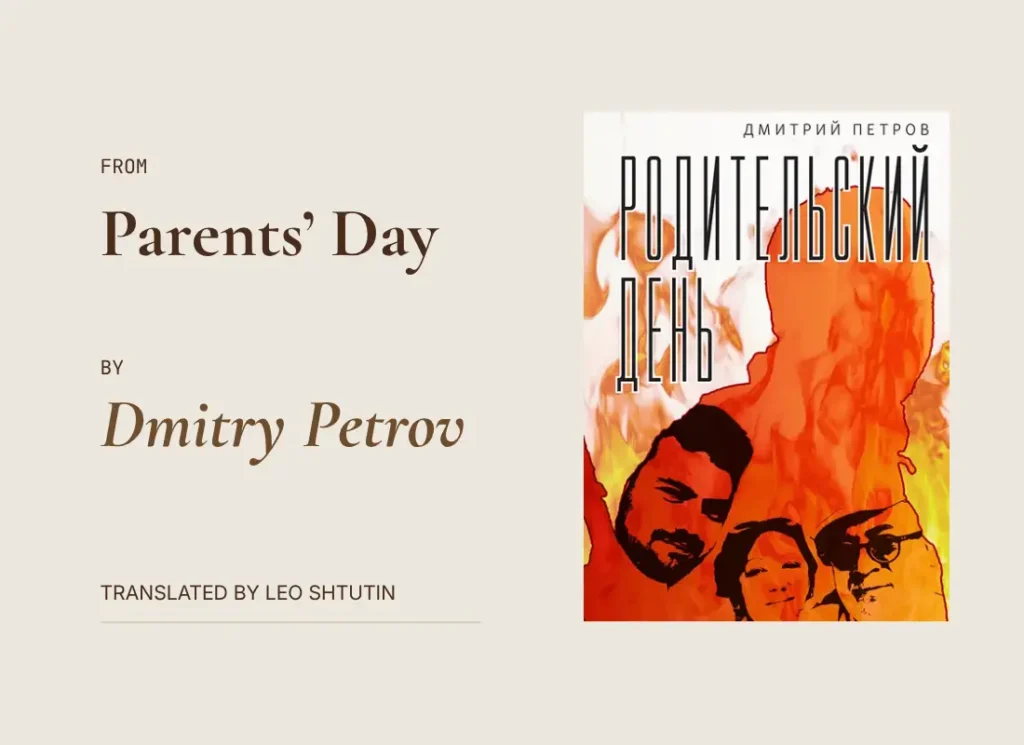
by Dmitry Petrov
translated by Leo Shtutin
The English translations of the excerpts were made possible thanks to the support of the WE EXIST! Foundation
1.
Trams have begun running through town again. There they are, gleaming and ringing as they clatter along the long-silent rails of Dmytrivska Street. And it feels like life is slipping back into its usual groove. Trolleybuses are on the move as well. The war seems to’ve receded. If only for a minute. For a passing instant. As though it were no more. No more…
But now a siren wails again, strained and ragged. Air-raid alert. What is it? A MiG taking off in Belarus? Or missiles bringing more death from the Caspian?
Soon the air defences’ll be thundering again, and debris’ll come pouring down over the City… All that shit coming our way – be nice if they swat it out of the sky. But if they don’t?..
Electric transport was suspended on December twenty-third of last year – that blasted year of t***** t*****-t**. After massive missile strikes on the country’s energy infrastructure. Back then – d’you remember? – some bouncy-permed bedlamite borе blеthеrеd biliously away on RuTube: “…let ’ em just sit there with no light, no gas, no water! Let ’еm shit into bags…”
Electricity, gas and water were restored pretty quickly. Not so trams and trolleybuses: they wеrе left waiting in thеir dеpots. Metro stations, though, were left open as bomb shеltеrs. But the missiles hurtling in from the Black Sea and the Caspian and raining down from the air weren’t just hitting power plants and other technical facilities. They were pounding factories, shopping centres, train stations, residential districts.
“When they hit Artem,” my son says, walking us towards Peremohy Square, “this friend of mine – she lives right nearby – had every window blown out by the shockwave. She was in the kitchen having tea. Made it through in one piece, but only just. She’s got her windows fixed, but now every time the siren goes she heads for the corridor – you know, the two-walls rule…”
The two-walls rule? We know. Of course we do.
In Israel it’s one of the first pieces of guidance given to new olim: if a rocket attack starts and you can’t make it to a shelter, and your building is old, and you don’t have a safe room, you need to take cover someplace with two solid walls between you and the outside. If you can find such a place, the walls’ll protect you. Not from a direct hit, of course. But they’ll shield you well enough from shrapnel, debris and blown-out window frames or balcony doors.
“But look,” I say, “here we are, walking down the street – if the siren goes now, where the hell d’you run? What walls d’you hide behind? What shelter d’you head for..?”
“Well,” my son says, almost upbeat, “it’s kind of hard to imagine a Kinzhal launched from the sea hitting you dead on… We’ve been over this.”
“Yeah, well, it doesn’t have to. If it lands a hundred metres away, that’s plenty close enough, no? I mean, say it hits that house there.”
He frowns.
“Military advice is keep away from buildings. You don’t want bricks, concrete, timber, glass or whatever coming down on you.”
“What, so you’re supposed to just hit the ground in the middle of that park and cover your head with your hands?”
“Yeah. That’s the official line, anyway. But who actually follows the official line? Anyway, things’re very quiet here. Not scary at all. Not like…”
“Like what?”
He looks me square in the face for a few seconds. Then glances round, sees that Mira’s far away, and answers.
2.
Sometimes there is no front line. No one knows where anyone is. No one even knows who you are – soldier, civvy or volunteer. You were transporting supplies – water and pasta – and you took a wrong turn during a lull. And now it begins.
An IFV explodes into the street. And is hit in the flank. Close range. Javelin. Blue smoke, engine-shriek. Spinning. Lurching on one track. Mud sprayed across heaps of earth and concrete. A man rolls out the rear hatch. And is hurled sideways, back slamming into the corner of a well shaft. His legs thrash, frantic, frantic. Then he goes still.
Two more tumble out, screaming, one after the other. Burst of gunfire, God knows from where, and both’re mown down. You’re running now, God knows where to, running and staggering and slipping in the churned-up ruts and falling flat and crawling off and rolling over and leaping up and falling flat.
To your left and behind you is Andrei. He’s running too, and someone’s running with him. He’s shouting something. Then he drops back.
Straight ahead, where the street meets a T-junction, a two-storey school bursts into flames.
Smoke – thick, choking smoke hits you full in the face. You’re down again. You roll towards a fence. Relief, slight relief. Hail-whistle-boom all around.
Your ears’re blocked. Your eyes’re burning. But you still see what comes next: the burning facade collapses, and a Т-72 emerges from the whorl of flame and debris. It freezes at the junction, swings round its barrel and blasts an HE shell down the street. Andrei’s just off to the side. Far off an explosion. Gunfire close by. It slices through him. The tank veers right, vanishes behind a red house. Instants later a column of orange flame blasts skyward from behind its metal-tiled roof.
And now – what’s this? Instant silence, just like that? Or’ve you gone deaf? You nestle up against the fence, trying to figure it out. The mud takes hold. You’re fucked, game over. Nothing matters now. Except Andrei. You crawl his way. Grab the straps of his pack and drag him fenceward, to the gate and through it. On, on, on, along the leaf-strewn path to a rusted iron bed by the wall of a summer kitchen. You haul him onto the mesh. He’s alive.
Breathing. Blinking. Silent. He’s silent, and you’re rummaging. Rummaging, rummaging, rummaging through the mud-smeared pack. Bandages, water, where are they? Fuck! Gone! Hit to the stomach means no fluids.
You’re shaking as you undo his straps and jacket. Fear: what’re you about to see. Hands trembling, vision going. But now strong arms haul you upright by the pits. Move you aside. Sit you down on a step. Three men already working on Andrei, swift, practised. Maltese crosses on their patches. Out-breath. Hospitallers. Out-breath. You sit there, back to the doorframe, and wish you smoked.
Next day you hear: Andrei didn’t make it.
They couldn’t save him. His insides were in pieces.
Your friend.
3.
The road runs downhill. Mira approaches. Streetlights overhead. Where the fissured pavement widens a little stands a white concert grand, its raised lid smashed, its keyboard splintered – a strange, splayed thing opposite a huge grey columned building, one of those Soviet-era “elite” blocks. Night’s coming on fast, but two or three windows are lit.
“Everyone’s upped sticks…”
Whirls of light snow settle over the little park. Roadside trade beneath a heavy yellow lamp: potatoes, cucumbers, tomatoes. The lamp sways. With it sway the stalls, the sellers in their aprons and fingerless gloves, the crates of produce. Red spheres: we buy some, put them in our rucksacks and move off.
Wartime city. Our first time in it.
No, no, don’t get the wrong idea! We’ve been here before. Many times. But back then the city was a peacetime one, its air awash with joy and revelry. Champagne-splish, fountain-splash, bird cherry and chestnut blossom, gentle warmth. And now—
Now it’s nothing like anything.
We’re yet to take this in, get to grips with it, let it move all the way through us.
But you, my son—
It’s a part of you already. You’ve been here since the beginning. Since the first explosions. My best friend. My life. The most precious thing on earth. My son.
4.
“Careful, young man! Your shoelace is undone.”
I’m overtaken by a woman in a dark overcoat and white downy kerchief. She gestures at my shoe and the strips of fabric trailing from it.
I fail to catch sight of her face.
“Mind you don’t trip,” she says over a shoulder as she hurries on.
And yet… And yet! She said this – in Russian! That’s nothing I’d bat an eye at now. But on the way here I kept thinking, How am I going to manage in a shop? In a museum? (If I even set foot in one.) How will I ask a stranger for directions? How will I handle a taxi driver? The police? The military? If it comes to that… (It did.)
Early morning. Behind us: Moldova, black-clad border guards bristling with kit. Ahead: blue-and-yellow flag, stern-faced man in camouflage. He takes our passports.
“Do you have a residence permit?” he says in Russian.
“No,” we answer.
He frowns at us, a little taken aback, then disappears with the papers.
No queues at the checkpoint. On this overcast morning, ours is the only minivan there.
“Now that’s a customs post!” says Roman the driver, in Russian also. He stretches, and his joints crack. “You can work with that.”
“What,” says Mira, “is the Polish border hairier?”
“Total shitshow. Queues for kilometres, both ways.”
“Do many turn back?”
“Loads. Those two, for example.”
He jerks his head to the side. Mother and teenage girl asleep. Suitcase each – bright yellow and green, colour of mimosa and young foliage.
“We’ll see how things go,” the girl says as she wakes. “Might have to leave again.”
Russian once more. Not a trace of an accent.
After that it’s the same story everywhere – in shops, in cafes, out in the street. The one exception is the ticket desk of the history museum.
Російську знаємо, але за правилами на робочему мiсцi зобов’язані говорити українською. Ми ж державні службовці. We know Russian, but workplace rules require us to speak Ukrainian. We’re state employees, you see.
Then: Вийдемо на вулицю. Let’s pop outside, I’ll explain everything there.
State employees? Fair enough, by the book it is. Outside we go, through the heavy doors and onto the entrance steps. We find out everything we need to know, come back in, buy some tickets and wander the echoing deserted halls. Paintings of the baptism of Volodymyr… battle scenes… models of cites… gold and silver… princely raiments… Varangian blades… handwritten scrolls and books… a film about Taras Shevchenko… Then, towards the exit: rockets, shells, ammo crates, military gear, helmets, body armour, camouflage netting – emblems of these sorrowful times, ’fourteen to present. But all that is still ahead of us. In the meantime…
The stern border guard returns with our Israeli passports.
“Who’re you visiting?”
“My son.”
“I have an aunt in Ashdod.”
“Ever get in touch?”
“When I can, you know.”
Roman turns the key in the ignition and presses a button. A low hum fills the air.
Doors closing, please stand clear. The next station is unnamed.
All this is ancient history now. Three days feels like a century here. And then on Bulvarno-Kudriavska Street a kind woman alerts me to a possible mishap. Your shoelace is undone. If you don’t tie it, bam! – forehead, meet pavement.
And, like so many here, she speaks Russian. And I just can’t seem to get used to it.
5.
We begin searching for accommodation in advance. We turn to an old contact – a letting agency we used before the war. The apartments they found for us back then didn’t disappoint: comfortable, central, marble bathrooms, superb top-floor balcony views. Now, though, the process drags and stalls. Mira emails them, to begin with, then ends up WhatsApping them from a Russian number (she has no other).
The reply is instant: “Russian warship, go fuck yourself”. A laugh-or-cry moment: where’s the “Russian warship”, and where are we?! Mira fires straight back: “Take your own advice.”
Hatred of the Red Castle and its savage armada – a hatred ignited by a ferocious invasion, by the killing of civilians, by the destruction of cities, by mass displacement – can extend even to phone numbers. Just like that, you can find yourself lumped in with that armada and treated as though you’re moving along the same course. Especially if the person you’re dealing with fails to realise that a Russian number could well belong to an émigré who’s left the country out of contempt for this vile war and the band of thugs behind it. People often don’t care who you are – Israeli, American, or the holder of a German humanitarian visa. What matters to them is your phone number, symbol and marker of your affiliation with the enemy camp.
A pity – that’s one useful contact lost. Still, we manage to rent a flat easily enough. Liuteranska Street, 21. Diagonally across from the famous church, and a stone’s throw from Bankova Street.
We tell some friends.
“But that’s bang in the middle of the city,” they say. “The centre’s what they’re looking to hit. Be careful. Ask the landlord straight away where the shelter is.”
“Oh,” say others, “but that’s right in the centre! That’s target number one. But it’s also the best defended. Even so, don’t wait – ask about the shelter.”
OK, we’ll ask.
We’ve got a six-hour drive ahead of us, Batumi to Tbilisi, Gia at the wheel.
“I’ll get you there in no time. No problem!”
We set off. Mountains, mountains, mountains. Orchards, orchards, orchards. Mountains again, forests, fields, rivers.
“You still scared?” says Mira.
“No point, is there. We’re already on the road. And anyway, he hammered it home to me – we don’t go now, God knows when we’ll see each other next. It’s already been, what, a year and a half since Tbilisi. Being without him’s worn me out. I’ve missed him so much. So I didn’t take much convincing. He’s very good at talking people round, actually. When he wants to.”
“That’s the way he’s always been. Even as a little kid. He’d be pestering me, you know, ‘Mama, mama!’ And I’d be like, ‘Leave off, lemme think my own thoughts a sec.’ Which’d just astonish him: ‘Your own thoughts? What thoughts could you possibly be thinking?’ Fair question, really.
“And have you noticed, he never asks for things. He offers. Always has done, even way back when. None of the usual ‘Mama, can I…?’ – it was always ‘Let’s go swimming!’ or ‘Who’s coming for a walk?’ or ‘C’mon, it’s forest time!’ Oh, that forest! How old was he then? Four? Five?
“These days you step out the gate and there’s trees down all over. Barely move for fallen trunks. Back then there was space. You could run amongst the firs and not worry you’d trip. Which is what he’d do. Age of five, running tree to tree, wrapping his – his little arms around ’em. He’d go all still, and he’d whisper something, and he’d stroke the bark and kiss it. Gazing straight ahead of him, you know, like he was – boring into the heart of the trunk. Into the secret of life.”
“Did he speak to them?”
“He did.”
“And did they answer?”
“He could hear them, I think.”
She gives me a sceptical look.
“No wonder the other boys dubbed him Leshy…”
“That’s right, they did. Though I don’t think it really stuck, that nickname.”
“What nicknames did he have after that, d’you know?”
“I forget now. But I do remember him marshalling the village kids for a forest clean-up. Off they went, bin bags in hand. Dragged a whole heap of rubbish to the dump. Strutted about afterwards, proper proud of themselves.”
“In year – er, I want to say year eight? – he’d be – turns out he was always going off into the forest after dark. Testing himself, you know: could he make it through till morning out there on his own. Me and you, I mean, we were away so often. It’d just be him and Grandpa or Grandma, so come nightfall he’d slip off into the woods. He’d never tell us – didn’t want us worrying, thought we’d get all worked up. I only found out maybe ten years ago. Out on a hike, sitting round a fire – that’s when he spilled the beans.”
“And could he?”
“Could he what?”
“Make it through till morning.”
“No. He’d come indoors.”
“Still, he was a very brave boy. He was only little then.”
“Brave. Yes. That’s what worries me. I’m nothing like that.”
6.
Gia throws open the doors:
“Well hello-o-o there! Come on then, out you get, my dears. Just as I said – no problem! Tbilisi. Night flight from here to Kishinev, then it’s on to the City. But the flight’s been delayed.”
“How long for?”
“Dunno. No info.”
“Why’re you surprised?” says an elegant elderly lady. “Air Moldova’s always like this. Delays, cancellations… same story every time.”
Ours goes ahead. Calm-voiced announcement: boarding for Chișinău.
We take off. The gifts have gone into the hold.
In Kishinev, the border officer studies my passport with interest:
“And where to next?”
“I don’t know. We’ll stay here a bit. Then maybe Europe.”
“R-i-ight…”
But she stamps it anyway.
The airport’s small and very well kept. An unexpectedly huge plasma screen shows a montage of Moldovan landscapes, costumes, dances, dishes, festivals. Under the screen, people sit on benches waiting for transport to Ukraine. We won’t be here long, maybe three hours. Then on to a Lukoil filling station. Minibus, nine and a half hours to the City. We pass checkpoints, concrete roadblocks, groups of watchful soldiers, armoured vehicles. Lorries, lorries, lorries in both directions.
The road’s not exactly battered, but it gets pretty damn bumpy at times. Less than stellar next to Georgia. Some stretches there are better by far, to say nothing of Israel with its pristine highways.
Already Odessa’s receding behind us, that seaside pearl, city of tuzhurka-wearing Murka and the Greek contrabandists of song and story. A city where a raggedy kid was reckoned a seasoned sailor from the days of his boyhood. Where he swam and went under but was pulled ashore again, thank God. From where he’d head to Kherson to pick up pigeons, his skiff with its gull-white sails flickering in the distance. And where, back in ’twenty-one, the three of us were happy.
So long ago now, all that was… Those placid waters, that wine, the Pryvoz. Pirozhki and vodka. The Dacha restaurant – its garden. Serviettes, meatball sets. Our love, the guileless hopes we harboured.
Hurtling, all of it, into other times, other worlds.
Cityward we go, past the turn-off for Uman, as yet unscathed by missile strikes.
A few more hours on the road. And then – the City.
Checkpoint on the approach. Concrete blocks.
Dug-in position. Firing slits. Soldiers with very serious faces. But they don’t stop us. And so, after all those hours of travelling, here we are at last.
The stretch from the outskirts to the meeting point – the station – vanishes from our notice.
There he is. By the entrance. Waving.
In a khaki jacket. Close-cropped. Robust. Buoyant. Our boy.
He’s met us here before – the pair of us, and me alone. Can’t begin to say what joy it was to see him: that well-knit figure of his, ambling down the platform with an easy sway. Or standing there by the taxis.
Sometimes all of us’d come together.
From Izmail. Where things were sweet beyond telling…
7.
Once, an impossibly long time ago, we packed him off to scout camp. Either we didn’t give it proper thought, or we were swayed by advice from elsewhere. Back then I had friends amongst the camp’s organisers. Mobiles weren’t a thing yet, but somehow we managed to keep in touch. If memory serves, he’d ring us from a payphone. At some point he told us a parents’ day was coming up. We should come, he said: he missed us. So we got in the car and off we went. And what happened? We left as soon as we arrived. With him in tow. Him and the camp just weren’t a good fit.
Now it’s parents’ day once more. If only this one could pan out like the first one did. If only we could take him with us. We’re bringing him various goodies, just as we did then – Georgian delicacies. Wouldn’t say it’s all wholesome, either. Take this homemade chacha, for instance: dark gold, sixty per cent.
“This is the good stuff, genatsvale – trust me!” winks the moustachioed vendor. “Made it myself. Won’t find anything like it out there.”
A beat, then:
“What’s taking you there, anyway? You not scared to go?”
“We are. But we’ve a parents’ day to be at.”
“How d’you mean?”
“Our son’s there.”
“Doing what?”
“Same as everyone else, I’d imagine.”
He makes a sympathetic noise.
“When it began last February we all thought it’d be over in a blink. What a force they went in with! All that tank-and-planes-and-whatever… On TV it was the same blether on repeat: three days and it’s parade time, one raised eyebrow from us and you’ll fold. But no. The city held. Year down the line and it’s still standing. Real fighters they’ve got there. Well, safe journey to you. Take care of yourselves.”
Take care – funny little phrase, that. Whenever you say it, whoever you say it to, it almost feels like you’ve put a sort of spell on them. Yes, take care they will – for sure. And they will stay safe…
God willing.
We pack the chacha and drive to Tbilisi.
Which I’vе alrеady writtеn about. Mountains, mountains, mountains. Orchards, orchards, orchards. Fiеlds, woods, fiеlds. Rivulеts and rivеrs. Bridgеs and crossеs.