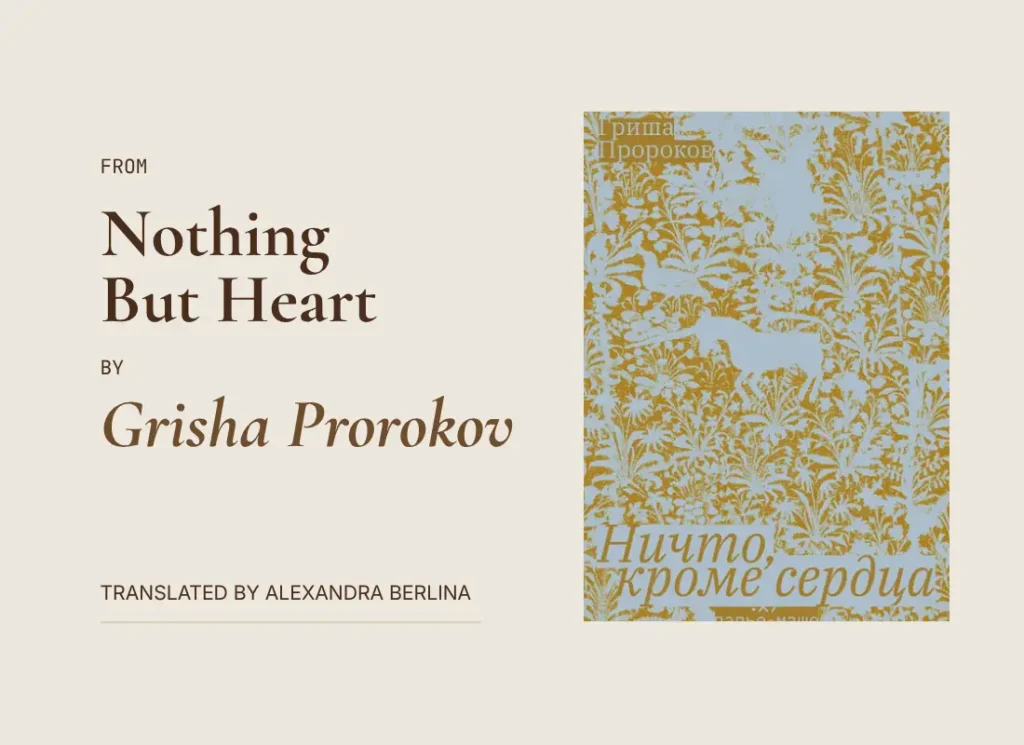
by Grisha Prorokov
translated by Alexandra Berlina
The English translations of the excerpts were made possible thanks to the support of the WE EXIST! Foundation
3
Hetero is about things being the way you want them. You seek possession, you imagine a scenario to strive for, you want to bend reality to your will.
Queer is about coming to terms with what actually is. If we strip away all pretence, who am I? Who are we to each other? What is our relationship? What could we develop it into, without impositions, without framings, without labels?
‘I’ve fallen in love with you’, one person says to another, and hetero puts them on a set track. ‘If you are in love, that means you want x, y, and z. Now you’ll do everything to achieve exactly that,’ hetero dictates. The other person, too, gets drawn into this scenario: if I’ve been told that someone is in love with me, that implies x, y, and z. That’s the culture. That’s common sense.
I often said that I didn’t know what I wanted from people with whom I fell in love. Just to talk, to spend time together? To get to know them? There doesn’t seem to be anything sexual about it, nor an absolute desire for a relationship – leaving what exactly?
The feeling I recognised as being in love often arose towards female friends with whom I simply got on well. Not knowing what I wanted from people often got me into trouble: for some reason, I felt I should share what was inside me with them. Sometimes I’d confess, they’d start thinking about these x, y, and z, and our relationship would go sour.
I had a friend called Lyuba, being with her, talking to her was intense, just like it was with you, bordering on the unhealthy. The war had just started, she and I were stranded in Moscow and spent a lot of time together. I remember we went to an exhibition of mummies and all sorts of Egyptian stuff at the Pushkin Museum – and I realised I was falling in love. I was walking along the rain-soaked street of my dacha village and recording a message for one of my friends about how I felt. It’s like a cold, when you suddenly realise that something in your body has changed, and you know exactly what’s coming next: your nose will run, you’ll start sneezing, you might get a fever. A premonition, a first sign of the inevitable. All that’s left is to surrender to the flow, turn on your back, and let it carry you.
What was going on between me and Lyuba was not friendship. I don’t know what it was. We were writing to each other all the time, telling each other everything about our lives, sharing the details that mattered. I tried to describe the beauty I saw around me. Life outside the city lent itself to this: I lived some of the time in my Moscow flat, but some on the suburban dacha, and saw plenty of greenery, all kinds of beasties, beetles on the road, wet tarmac, things that brought joy to my heart.
I told her I was in love – and immediately felt how hetero began to suffocate us. Lyuba distanced herself and started avoiding me. Perhaps she assumed me to follow that track. To pursue her. To demand ordinary, reciprocal love. To try embarking on a traditional romantic relationship. I’m not sure I wanted any of that. In the end, we stopped talking to each other.
Thing don’t always end badly, though: I confessed my love to Karina, and we’re still friends.
When I wrote to you that I’d fallen in love, you asked me what I meant. It was four in the morning, I was lying in bed looking at my phone. And it was as if I had discovered a flower inside me. No one had ever asked me about it so directly before.
I managed to put together some sort of a reply, and you agreed and said you understood that definition. I won’t quote it here, it isn’t that important. Definitions can change, desires can change, feelings can change. What mattered was that you asked the question at all. That a confession isn’t followed by x, y, and z, that mutual expectations can be discussed and clarified.
It was as if something had been maturing inside me for a long time; now it was slowly emerging from the ground, pushing its way through the thick grass of my soul. And no, it hadn’t fully blossomed – I knew there was still a long way to go – but I had finally glimpsed it. A tiny flower was growing amongst the grass.
Queer, you said back then, grows within a person like a seed.
It was the night of 3/4 June. Summer was just beginning.
4
By the third of June, I had spent seven months in Georgia. I had fled the war. I don’t know how to talk about it, but I have to. It feels as though other people have the right to speak of the war, not me. I can only describe my own experience, how the war affected my life and the lives of my friends: we moved to another country, lost our roots and reference points, our hopes for any kind of stability. And yet the war was far away from us. That is the bitter truth. Russians in Tbilisi followed the news, donated money, wrote about the war, talked about the war, some of us volunteered locally and helped as best we could – but it was still far away. Even just physically.
I had left Moscow because, for me, it had become a phantom city. You stayed there, and later, when we started writing to each other, we talked about it, about the phantom city and you inside it.
Sure, I had left because Moscow had changed after the war began, because there was a danger they’d take me away to kill people, because it had become difficult for me to live in a state that was waging such a senseless and brutal war. But these are rationalisations. What actually happened is that on one of my last days in Moscow, I went to see some of my favourite places, and they seemed like shadows to me. Like ghosts. The Black Cooperative coffeehouse. The Make Culture bar. The Forest café by the Moscow Museum – I used to love coming there to work. Now, it’s home to a mobilisation centre. Even the Maybe Coffee café in a suburb, where Dasha and I would sometimes pop down in the mornings, was a ghost.
I didn’t like writing down this explanation: it’s an embarrassing truth and not the whole truth, either. Things are more complicated. I still have friends in Moscow, and for them, life has gone on, they are not among the ghosts and shadows. These words will hurt them.
But that’s what happens when your feelings for someone cool off – suddenly you see them in another light. Different people have different perspectives, and sometimes it’s hard for us to understand one another. It’s still the same city, sure, but for me, it’s a ghost. That’s the disconnect.
[…]
23
The title of the song ‘Lovers Are Losers’ says it all. I like the word ‘loser’, it doesn’t strike me as offensive. Who ever said you have to win in life? That’s just another hetero thing. ‘Winning’s not why we’re playing, that’s the kinda neo-liberal bullshit that they’re saying “losers”’, sings Molly Nilsson.
I’ve often been a loser in life. There’s nothing shameful about that. I was a loser when my relationship with Dasha fell apart. I was a loser when I went to Georgia simply because I was tired. I was a loser when I fell in love with Tbilisi, where I had no chance of staying. I was a loser when I made close friends here and let them into my heart. I was a loser when I started getting to know you.
If you love, you’ve already lost. Love can only end in a broken heart or death.
Honestly, I think there’s a great truth in this: if you live life to the full, if you open your heart, if you feel, if you need other people – you’ve lost. Because life contains sadness, entropy, incongruity, a yearning that’s hard to nail down but that remains ever-present in the shadows, that you can only overcome for a moment by acknowledging it and living in defiance of it.
At the Dogtown in Tbilisi, amidst plastic beer cups, plates of chips, and young Georgians out to have some fun, ‘Lovers Are Losers’ sounded delightfully out of place. Every few weeks, when we made our way to that restaurant, I’d pop a lari into the jukebox. That was my declaration: I love and I’m a loser.
[…]
25
What kind of love did St. Peter feel for Jesus? Jesus’ love for us is impossible to imagine, to grasp, to comprehend. Peter is easier to understand – he was a human being, just like us. My favourite moments in the Gospels are when the emotions break through. You have to look for them between the lines, of course: ancient language doesn’t speak of feelings the way we do.
In the twenty-first and final chapter of the Gospel of John, the risen Jesus visits his disciples. Peter, who’s been fishing, rows to the shore, they share a meal, and afterwards they talk.
Jesus asks Peter: ‘Simon, son of John, do you truly love Me more than these?’ ‘Yes, Lord. You know that I love You,’ Peter answers. In reply, Jesus says: ‘Then feed my lambs.’
Then Jesus repeats his question, and Peter answers again that he loves Him. ‘Then feed my lambs,’ says Jesus.
When Jesus asks him a third time, Peter is saddened and replies with anguish: ‘Lord, you know everything; you know that I love you.’ And for the third time, Jesus says: ‘Feed my lambs.’
This is a complex moment of emotional uncertainty. Shortly before this conversation, Peter betrays Jesus, denying him three times – it’s hard not to see a parallel in Jesus demanding three confirmations of love. But on whose side should our feelings be? Does Peter deserve such treatment, or is Jesus being cruel?
The passage is full of mysteries. In the original Greek text, the dialogue goes like this:
When Jesus poses the question for the first time, He says: ‘Do you truly ἀγαπᾷς Me more than they do?’ Peter replies: ‘I φιλέω You.’ The same thing happens the second time. Finally, the third time, Jesus asks: ‘Do you φιλεῖς Me?’ And Peter replies: ‘You know that I φιλέω You.’
The first verb, ἀγαπάειν, is derived from ἀγάπη, agape, meaning the highest, divine love – the love of God for man and of man for God. The second verb comes from φιλία, philia – brotherly love, the love found in close friendship. This is the love shared by best friends, generous and caring, striving to make one another happy. Does Jesus demand self-sacrificing divine love from Peter, yet on the third occasion stoops to his level and accepts his brotherly love and friendship?
When it comes to earthly, human love, the Bible is often confusing.
I tried to think about being aroace through the prism of Christian love. Is this not the ideal of Christian love – a space without gender or boundaries, where everyone is equal and you demand nothing but only give? Is this not what complete liberation from hetero looks like? I love you, God’s creation, you are special to me, but I need nothing from you.
Real human interactions turned out to be more complicated.
[…]
46
My favourite work of art is The Lady and the Unicorn, a series of tapestries from the late fifteenth century, housed in the Musée de Cluny in Paris.
These are six tapestries in the mille-fleurs (‘thousand flowers’) style, on a pink-and-red background dotted with flowers. All the tapestries depict a noble lady surrounded by animals or servants, and in each one, she is engaged in another activity. There are many animals: a lion cub, a panther, a cheetah, a wolf, a fox, a dog, a goat, a rabbit, a monkey, and others. A unicorn appears in all the tapestries, hence the title.
The tapestry room is quiet and cool. The lighting is subdued, and visitors cast long shadows. For me, this room is a room of mystery. Something we cannot name aloud. Art always takes us out of the everyday and places us in another reality. The reality of The Lady and the Unicorn is a space of refined beauty, whispers, nuances, and mystery.
The origin of the tapestries is mysterious, too: there are various theories as to who made them and when, and no clear answer. For some time, they languished in obscurity. In 1841, they were discovered by Prosper Mérimée at Château de Bussac, where they had suffered due to poor storage conditions. In 1844, the writer George Sand saw and described them. Incidentally, she was one of the first people to realise, because of the heroine’s clothing, that The Lady and the Unicorn must have been created in the fifteenth century. Until 1863, this is, until they were purchased by the curator of the Musée de Cluny, the tapestries continued to be stored in a damp and mouldy room.
The Lady and the Unicorn is undoubtedly an allegorical work, full of medieval symbols. But what exactly does it mean? The most common interpretation is that five of the six tapestries depict the five senses.
The unicorn is looking into a mirror held out to him by the lady – this represents sight. The lady playing the organ stands for hearing. The lady taking a sweet out of a box is taste. Then smell, the lady weaving a wreath of carnations, whilst a monkey nearby is sniffing a flower. Finally, the tapestry in which the lady touches the unicorn’s horn symbolises the tactile sense.
Which leaves us with the sixth and largest of the tapestries. In it, the lady stands in a garden before a tent bearing the inscription ‘à mon seul désir’, flanked by a lion and a unicorn. She is placing a necklace, which she wears in the other tapestries, into a jewellery box. This is the only tapestry in which she smiles.
What about ‘à mon seul désir’? This medieval motto is deliberately obscure and ambiguous, translatable in various ways. For instance, as ‘to my only love’ or ‘according to my sole desire’.
The sixth sense, the feeling to which the tapestry is dedicated, is love. But what kind of love? Divine or human? Perhaps the lady is renouncing the other senses, the earthly pleasures depicted in the other tapestries of the series – and this is why she is putting away a precious ornament? Or is she actually taking it out of the box rather than putting it in? Is there a difference between désir as desire and désir as love? Perhaps love transcends all other emotions and is the only thing her soul desires?
To me, The Lady and the Unicorn defies straightforward interpretation. These tapestries of unearthly beauty speak to us, but they do so in their own language. Any attempt to translate the message into the language of concepts is bound to lose something.
Every time I found myself in Paris, I would go to the Musée de Cluny as if spellbound. I’d stand there and contemplate The Lady and the Unicorn, even though I knew it so well that I could simply conjure it up in my mind. But that’s not the same, of course.
The lady’s and her maid’s exquisite costumes, the graceful interweaving of plants and animals, the rich, extraordinary colours – all frozen in reverent silence, an unspoken question hanging in the air, and no understanding ever comes, there is no moment when you comprehend love or find an answer. À mon seul désir is à mon seul désir.
[…]
70
Low have a song called ‘Nothing But Heart’, which lasts eight minutes. Most of the lyrics consist of the repeating refrain ‘I’m nothing but heart’.
Low were a Mormon couple from Minnesota, Alan and Mimi. They played minimalist, slow music, often with distorted guitars. They tended to address Christian themes in their songs – though not as in-your-face as what Americans tend to expect from ‘Christian rock’. But they mentioned God as well as the themes of love and the transcendent, viewed through the prism of Christianity. Sometimes, they were quite direct: for instance, they have a Christmas song, ‘Long Way Around the Sea’, which is wonderful at capturing the mystical, quiet, sacred essence of the holiday.
‘Nothing But Heart’ is my favourite song by Low, I guess. I remember hearing it at a concert in a Lutheran church in the Swedish city of Gothenburg over ten years ago. The audience sat on wooden benches; the lights were dimmed so that the musicians were barely visible – and the church’s vast acoustic space was filled with the sound of guitars.
For me, this song is about blurring the boundaries between romantic love, Christian love, and the love between friends, about these loves all being one and the same. Alan Sparhawk repeats the words ‘I’m nothing but heart’ meaning that all we are is love. At the end, his wife, Mimi Parker, joins in, singing ‘All we are is what we love’. The song’s final lines are on an altogether new, sacred level: ‘And as you wear the gown that’s made of gold and white, may we someday be assured as we walk into the night’.
These lines mean a lot to me. They clearly refer to death and the Last Judgement, to the end of everything. The image is unmistakable – people dressed in heavenly garments are striding toward A Place Beyond the Boundaries, beyond the horizon of Bruegel’s Hunters in the Snow, and all that will remain to give us hope and faith is love.
Because every love contains this joyful and terrifying, innermost, unfathomable, unnamable thing. The thing that lifts the veil of reality.
Two days after I arrived in Georgia, Mimi Parker died. Alan Sparhawk disbanded Low. I tried and couldn’t imagine what it must have been like: to have a partner for many years, to play in a band with her, to lose her, and be left alone with songs saying that our world is temporary, that everything that matters awaits There, and that we will carry our love with us.