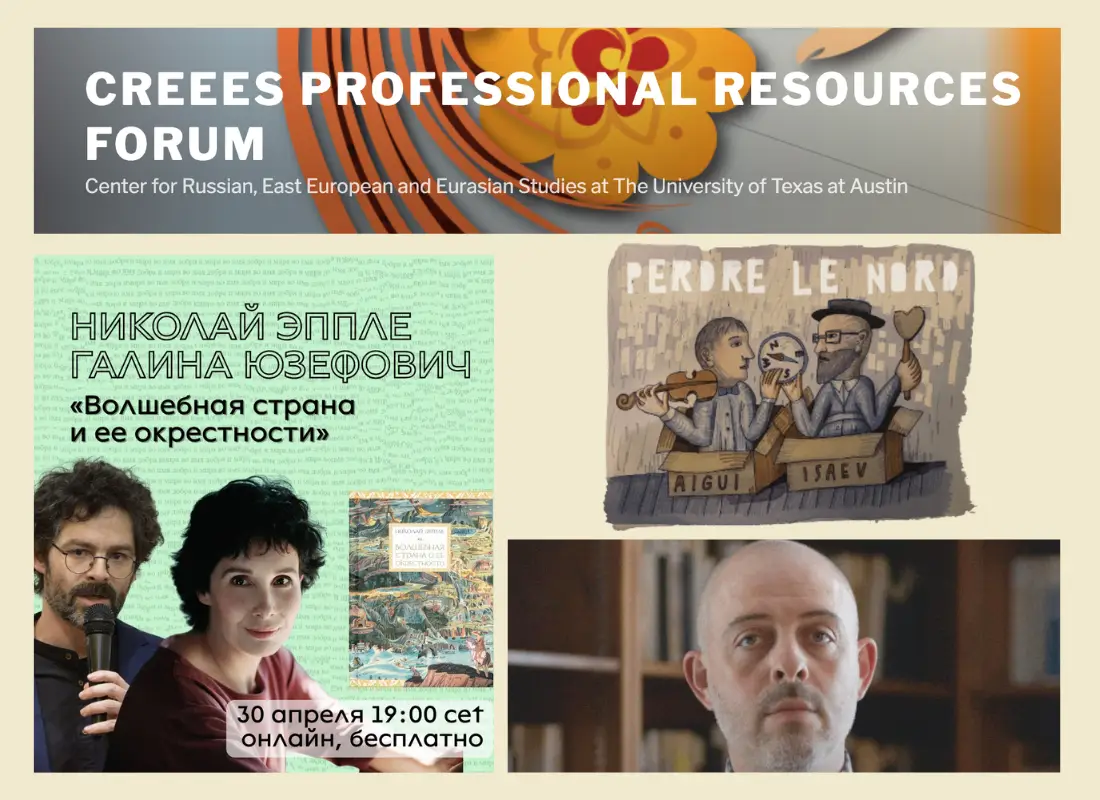
On April 30, events at the intersection of literature, art, and academic knowledge will take place in European cities and online.
n Berlin, at Immanuelkirche, the musical performance Perdre le Nord / Losing One’s Bearings will be presented, a collaborative work by artist Maxim Isaev and composer Alexey Aigui. The project is conceived as an improvisation based on French idioms, in which visual images and music become a way of deciphering hidden meanings. The performance opens the cultural program of the second Berlin Book Fair.
In London, at Pushkin House, an evening from the series Libris with Liberov, will be devoted to Joseph Brodsky. Director and literary scholar Roma Liberov will speak about the poet’s influence and his presence in contemporary culture. The event will take place in an intimate format and in Russian.
Online, on the same day, a meeting from the #vidim_talks series will take place: a conversation between Nikolai Epplee and Galina Yuzefovich about the book The Magic Land and Its Surroundings. The participants will discuss how fairy tales change, why we return to them, and what role they play today. The event will be held on Zoom.
Also on April 30, the deadline falls for submitting applications to the international conference GLECC2026,which will take place in Manchester on July 28–30. The conference brings together researchers in the fields of language, education, culture, and communication, and is devoted to the impact of globalization on these disciplines.

What Are the Objectives of the Award?

The primary goal of the Award is to support authors and promote Russian-language literature worldwide. We welcome all who write and read in Russian, regardless of citizenship or place of residence. We aim to foster a Russian-language culture free from political and imperial influences.
How Is the Award Process Conducted?
The Prize is awarded annually. The Jury holds a vote in which each member selects between one and three works. The author whose work receives the highest number of votes becomes the winner.
What Awards Are Provided?
The Prize winner receives a grant for the translation of their work into English, French, and German.
When Does the Submission Period for the Competition Start and End?
Submissions for the third season of the prize will open on July 15, 2026, and close on October 15, 2026.
When will the list of finalists and winners be announced?
On January 20, 2027, the Council of Experts will announce the shortlist. The Independent Jury will announce the winner on May 25, 2027.
What are the conditions for the nomination of a book for the award
Works published in 2025 are eligible for the third season of the competition. Eligible works (novels, novellas, short story and essay collections, documentary prose) may have been published either as standalone editions or in literary magazines. Nominations may be submitted by publishing houses and magazine editorial boards, as well as by the authors themselves or third parties (with the author's consent and written confirmation). Texts must be submitted for consideration in electronic format. The DAR Prize is open to all authors. Given the prize's main goals — promoting contemporary Russian-language literature outside of Russia — and the nature of the award itself (a translation grant), priority will be given to authors whose works have not previously been translated into English, French, or German.