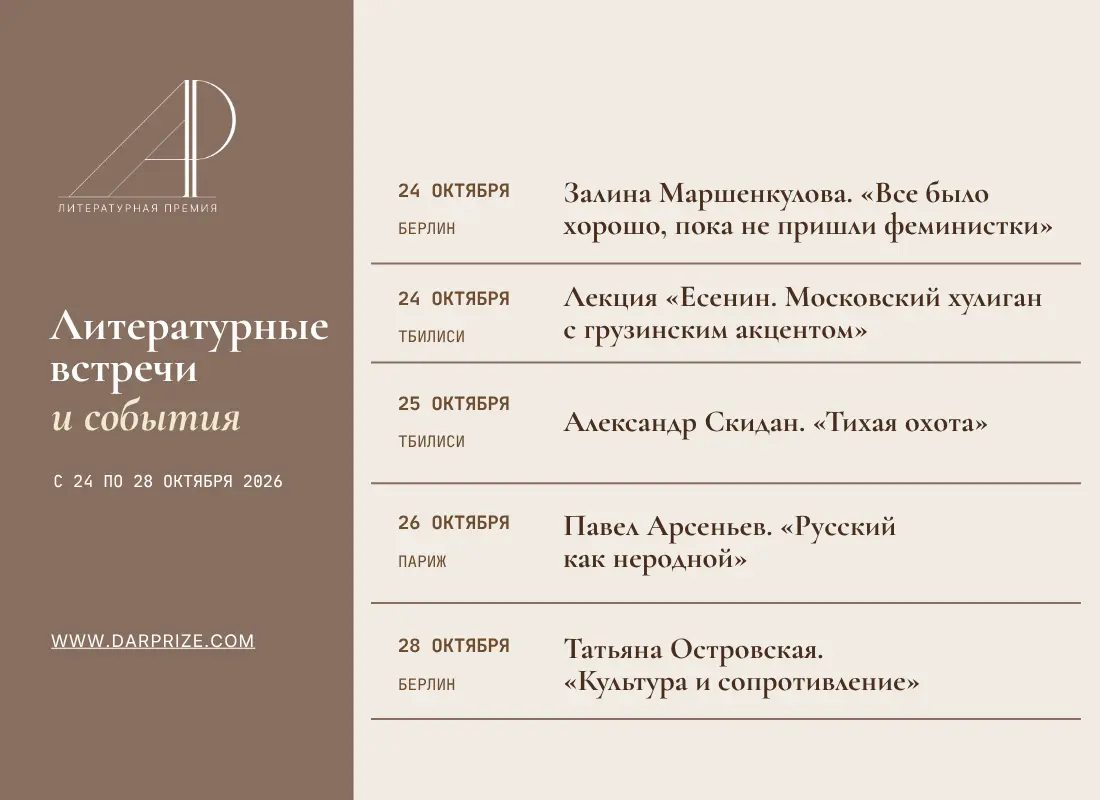
Russian feminism through the lens of Zalina Marshenkulova's new book, Sergei Yesenin's years in Georgia, a poetry evening with Alexander Skidan, Pavel Arseniev's reflections on his native language in exile, and cultural resistance in Soviet Belarus. We've rounded up literary events taking place over the next few days in Berlin, Tbilisi, and Paris.
Zalina Marshenkulova Presents Everything Was Fine Until the Feminists Came Along
Reforum Space Berlin will host a presentation of Zalina Marshenkulova's book Everything Was Fine Until the Feminists Came Along, which explores the history of the Russian feminist movement since 2010.
From Pussy Riot and #MeToo to the harassment of feminist activists, the book examines the events that have shaped perceptions of feminism in contemporary Russia. After the event, visitors will have the opportunity to purchase the book and have it signed by the author.
Reforum Space Berlin, Wiener Straße 31, Berlin
Vitaly Kibitlevsky: "Yesenin: A Moscow Hooligan with a Georgian Accent"
Auditoria continues its lecture series Writers and Georgia. This time, tour guide, poet, and researcher Vitaly Kibitlevsky will explore the life and work of Sergei Yesenin.
Special attention will be given to Yesenin's time in Georgia in 1924–1925, including his performances in Tiflis, encounters with local literary figures, and the months he spent in Batumi, which became one of the most productive periods of his creative life.
Auditoria, S. Janashia 22–26, Tbilisi
"Quiet Hunting": An Evening with Alexander Skidan
Auditoria will host a literary evening titled Quiet Hunting with poet, prose writer, and literary critic Alexander Skidan.
Skidan is a recipient of the Andrei Bely Prize and the author of several poetry collections and books of essays. He is one of the prominent voices in contemporary Russian-language poetry.
Auditoria, S. Janashia 22–26, Tbilisi
Pavel Arseniev Presents Russian as a Non-Native Language
Les Éditeurs Réunis / YMCA-Press will host a presentation of Pavel Arseniev's book Russian as a Non-Native Language, featuring the author and publisher Polina de Moni.
Following publications in French, German, Italian, and Greek, this collection of poetry and essays is finally being released in the language in which most of its texts were originally written.
Over the years of exile, the author's relationship with the Russian language has changed, becoming a subject of poetic exploration in its own right. Documents such as diplomas, arrest records, excerpts from the Constitution, and linguistic assessments are transformed into poetry. How does a native language become foreign, and is it possible to free oneself from it?
Les Éditeurs Réunis / YMCA-Press, Paris
Tatiana Ostrovskaya Presents Culture and Resistance
Babel Books Berlin will host a presentation of Tatiana Ostrovskaya's book Culture and Resistance: Intellectuals, Dissent, and Samizdat in Soviet Belarus (1968–1988).
The study explores cultural resistance under strict state control. At its center are the intellectual biographies of Vasil Bykov, Ales Adamovich, poet Larysa Heniush, and Zianon Pazniak.
The discussion will examine how the struggle for cultural and national autonomy became a form of dissent, how the legacy of these figures contributed to the Belarusian cultural revival during perestroika, and why it remains relevant today.
Babel Books Berlin, Bernauer Str. 49, Berlin

What Are the Objectives of the Award?

The primary goal of the Award is to support authors and promote Russian-language literature worldwide. We welcome all who write and read in Russian, regardless of citizenship or place of residence. We aim to foster a Russian-language culture free from political and imperial influences.
How Is the Award Process Conducted?
The Prize is awarded annually. The Jury holds a vote in which each member selects between one and three works. The author whose work receives the highest number of votes becomes the winner.
What Awards Are Provided?
The Prize winner receives a grant for the translation of their work into English, French, and German.
When Does the Submission Period for the Competition Start and End?
Submissions for the third season of the prize will open on July 15, 2026, and close on October 15, 2026.
When will the list of finalists and winners be announced?
On January 20, 2027, the Council of Experts will announce the shortlist. The Independent Jury will announce the winner on May 25, 2027.
What are the conditions for the nomination of a book for the award
Works published in 2025 are eligible for the third season of the competition. Eligible works (novels, novellas, short story and essay collections, documentary prose) may have been published either as standalone editions or in literary magazines. Nominations may be submitted by publishing houses and magazine editorial boards, as well as by the authors themselves or third parties (with the author's consent and written confirmation). Texts must be submitted for consideration in electronic format. The DAR Prize is open to all authors. Given the prize's main goals — promoting contemporary Russian-language literature outside of Russia — and the nature of the award itself (a translation grant), priority will be given to authors whose works have not previously been translated into English, French, or German.