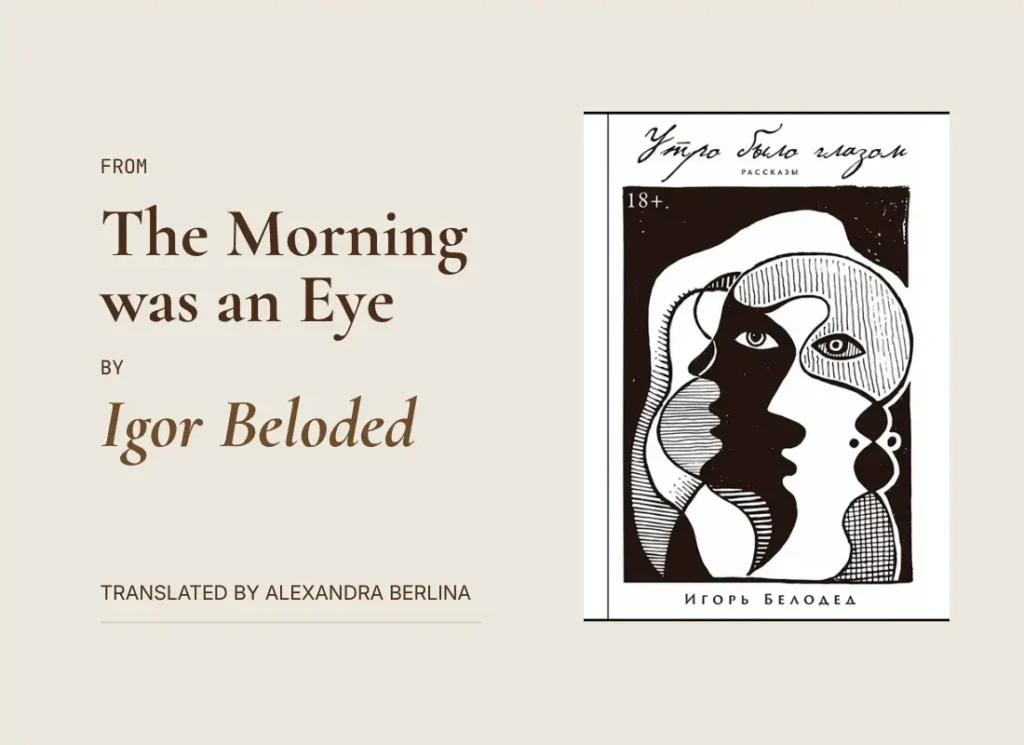
by Igor Beloded
translated by Alexandra Berlina
The English translations of the excerpts were made possible thanks to the support of the WE EXIST! Foundation
Opacity
It seemed to be the same enormous paws, scooping her up and carrying her through the ransacked past onto crumpled bedsheets, the same burr in his voice, mellifluous and methodical, so at odds with his epaulettes – and yet it was all wrong. Outwardly, he had hardly changed, only his eyes had grown quieter, he spoke less, and when she approached him from behind and laid her hands on his shoulders as he sat in the kitchen beneath a flood of spring sunshine, squinting at the window like a cat, he’d shudder and say: ‘Only enemies creep up on you like that.’ The horror of the change lay in its near-imperceptibility: while he stared at something, seemingly at the streaks left by a cloth on the mirror or at the reflected sunbeams in the corner by the skirting board, she’d let her eyes glide over his back, wondering: ‘Is this really him?’ All at once, the very thought seemed blasphemous to her – of course it was him, who else? – and she walked towards him across the creaking parquet floor and embraced him, as if he were a tree stripped of its bark, she wanted to dissolve into him in that embrace and at the same time was afraid to look into the mirror, which she had once adorned with shells and pebbles: what if he had no reflection?
What if his reflection was that of a stranger?
She didn’t ask what he’d been through during the three months of his absence; she knew that
questions would unravel what he had firmly resolved to forget, but curiosity burned her more than love, so that on the fifth day after his return, at lunch, she looked at him as if she was about to propose, and then she did ask:
‘It was very hard over there, right?’
He sighed and said nothing, merely clenched his jaw – and then she realised how geometric his face was and how deceptive the simplicity of his features, behind which a vast brain was pounding, experiencing joys and horrors unknown, experiencing feelings whose names she couldn’t fathom – and once again she imagined: what if the man sitting before her was not her husband but someone who looked exactly like him, a dead ringer, a man who had killed her real husband, having found out everything about his wife before the murder to make sure the switch would go smoothly and she wouldn’t suspect a thing.
Huge hands were gripping the knife and fork, just as they had gripped her neck on the night of his return: just a little more, and he’d strangle her to death, and she would no longer be plagued by silly ideas, and it was so tempting to envision him, darker than darkness, towering over her and wheezing, whilst she lay beneath him and thought her last thought, knowing full well that it was her last – and thus was compelled to carry on living, for just as it is impossible to fall asleep when you feel the line separating dreams from reality, it is impossible to die when a thought beats like a heart within you, pushing death beyond the edge of all existence.
He rose with a creak, walked over to the window, which consisted of nothing but sunshine, and began clicking his lighter. Shielding her eyes, she asked him to step out onto the balcony; shuffling his feet heavily, as if wearing boots lined with iron, he walked across the yellow triangle of light in the living room without even glancing at her, as if she were a maid assigned to him, and then she knew that something was wrong with him and that this wrongness would now spread through their home like a blight spreads through poplar leaves, that the barely perceptible displeasure reflected on his simple face was directed not at her but at something greater. And once more, she became agonisingly jealous – not of a woman, no, but of those events she had not been privy to, events that had changed him forever, filling their house with a repeating piano chord that pierced the ear, played clumsily, unexpectedly, and undeniably loud, just like now.
That evening, his parents arrived, frightened by his return, hesitant to ask how he’d fared there, but he didn’t listen to them, he didn’t listen while his father – aged by centuries in those three months, reduced to skin and bones – was saying that his son was a hero, that he was proud to have raised a real man, and other such drivel gleaned from political instructors, and his mother just sat there, dejected, crushed and shy before her daughter-in-law, so unlike before, when she came over, uninvited, with a thick notebook of old recipes, worn thin, yellowed by time, so unlike when she texted her with vulgar singing cards. Now she seemed infinitely old, though still younger than her husband, deserving of pity, for the man who came back was even further removed from his mother than from his wife, and her happiness was over, and she would bear no more children until her death, and all that remained for her was to consider her son through the reverse binoculars of the past, stubbornly failing to notice the rivers of wrinkles on his forehead and the mature lines taking shape beneath his nose.
When his father, with awkward bravado, swung out a bony arm for a ridiculously exaggerated handshake, hugged him and ran his hands down his back, when his mother pressed a checked handkerchief to her rapidly blinking eyes by the open door of the yellow taxi, only then did she realise that they too had sensed the change in their son, but instead of all of them rallying together, gathering in the kitchen to decide what to do next, they bid her farewell with a silent hostility, as if she didn’t exist at all, as if their son had become a widower – and only as, that evening in bed, he said to her ‘they’d better not have come’ was her rage toward them replaced by bafflement, and as she embraced him, her hands on his back involuntarily mimicked those of his father’s as seen that day, and the reality of his body stifled the bad feelings creeping up on her, like the ceiling shadows cast by passing cars, drawing near, then slipping past with a soft rustle.
Over the following days, she tried to lose herself in her work, churning out one bridal bouquet after another – lilies nestled against white roses, crumpled prickly grass alongside dried physalis, ribbons pulled together, cut-off bits of stems thrown out with the torn-off leaves – but she no longer took pleasure in her craft as she once had: working with her hands couldn’t drown out the anxiety growing within her. Why was she anxious in the first place? He had returned, after all, safe and sound; she knew several women in town who had lost their husbands, so what did she have to complain about? Was this not a futile resentment against God, a woman’s awkward, almost capricious grievance? Had she been asking too much, for him to return just as he had left? Surely such a thing never happens… And she pictured the charred bodies he’d seen lying beside him, and the smouldering earth, and the carcasses of cats hung from branches, and the overturned cauldron from which steam rose quietly and peacefully – and all the while, her hands arranged one flower beside another, her fingers feeling the thornless roses – pictured the ground pitted with shells, a kind of ground she had never walked upon, save perhaps as a child on a building site, where a friend had taken her, bending back a fence board, ‘I’ll show you something’, and the something turned out to be a boundless, muddy gurgling puddle that spoke to them like a ventriloquist, and then a sharp whistle blew behind them, and they ran, ran so hard that she saw neither the reinforcing bars nor the forlorn piles sprouting from the ground like giant mushrooms, she saw nothing but the lilac clouds overhead and her friend ahead of her, her friend who didn’t even turn around when she plonked down in the mud, so that she had to get out on her own: the guard hadn’t run after them, of course, she’d got her knee-highs and her long satin skirt, tailored from her grandmother’s dacha dress, all muddy. And just like then, it seemed to her now that no one would turn to look at her, only instead of her friend leaving her behind, her husband with his geometric face was, contrary to their former custom, not joining her for lunch.
But the nastiest thing happened on Friday, when he came home around nine, quietly and clumsily fumbling with the key in the lock like a thief, passed through the hall, and was about to sneak into the living room, but there she was, the clay of her face looming above him, looking at him and understanding it all – or rather, pretending to understand; in truth, she had no idea what to make of his scratched face, the cloud of cotton in his nostril, his half-closed eyes, and all he replied to her puzzled, insistent gaze was ‘I met Artem.’ Artem was the name of his best friend, with whom he always found something to do in the garage: changing the oil, or the brake pads, or simply opening a can of beer and talking about the news and eternity, though mostly about the news – and now he walked into the bathroom without an explanation, without hugging her hello, though she stretched out the branches of her arms towards him; he chose not to notice, he had shut himself off from her so completely that it seemed he would remain silent forever – and on Saturday night, he lay in bed as still as a corpse, not even the slightest snore, and a slanted streak of blood from his nose on the pillow unsettled her: what if he’d really killed people? The thought terrified her, and at the same time, she felt desire stir, and she took his cold hand and placed it on her breast.
The next day he perked up, though you could still hear the hinges of his soul creaking, and told her how he’d had that fight with Artem over a stupid thing: Artem had said Russia was being an idiot, he decided to let the matter slide, but Artem was seething, and he had to punch him in the shoulder – that’s how it started. He sat in the kitchen, his face yellow, scooping up soup that his parents had brought, like some wild idol tasting the offerings, as if his life was made entirely of wood; but when they went out into the street, he suddenly seemed to fade, and all that she saw were the remains of those few months, their weariness, the self-absorption about which you couldn’t say ‘oh, the depth of the human soul’: not one but many human souls were lost in the hollows of his eyes – and she was terrified that she wouldn’t be able to bear it, that her love would vanish into his inner abyss, that all the feelings she was capable of feeling for him would disappear and never see the light of day again, even though he was smiling now, albeit lifelessly, and wearing the t-shirt with a print of a Spartan helmet that she’d bought for him in Rhodes in those distant days when they used to travel in Europe together instead of him going away on military assignments and her waiting for him at home. The scratches on his face had healed overnight, only his nose was swollen, and it seemed to her that this was the end, that he would devour not only her soul but her very bones and flesh, and they walked through the park, passing human silhouettes, and she suddenly cried out when she saw a pigeon sprawled on the tarmac with its entrails spilling out, colourful, as if decorated with markers. He laughed, found a branch under a poplar tree, pushed her aside, flung the bird’s corpse along with the branch into the bushes, and said to her smugly, smiling: ‘See?’ Then she knew beyond a shadow of a doubt that this was not her husband.
They were returning home, disappointed in one another; the air was the same spring city air, everything was in its place, but the touch of his fingers was cold, as if something tiny, unnoticeable, an imp, had crept into her husband and filled out his body completely while he was over there. She was frightened, and so, embracing him that evening in bed beneath the old-fashioned canopy – silken sighs and the weight of woven whispers – which they never lowered, she told him that she would be sleeping in the living room that night. He accepted her words with detachment, like something of little consequence. His calm infuriated her. If things were like this, if they really were, then why on earth should she stay with him? But the furious thought transformed not into a scandal but into a surge of passion, and then, walking away from him, crawling through the shadows of the trees across the parquet floor like a beetle – why did they never close the curtains? – she gathered all her resolve, turned to him, stood at attention like a little polypropylene soldier, and said:
‘I have this feeling that you are a stranger. Is it all because of what you’ve been through?’
Instead of an answer, he smiled blissfully, just as he’d done on that walk when tossing the pigeon’s carcass into the bushes, and she thought: ‘Does this mean that he’s not taking me seriously? Can’t he even imagine that I’m capable of understanding his pain?’ The night, spent on tenterhooks, ended with an early, milky dawn, which made everything seem unfamiliar; it felt as if she had woken up in her husband’s dream and was now moving through his mind, and if she were about to peek behind the shimmering curtains, and memories of the war would leap out, and she’d catch one by the legs and understand what had changed her husband so much that he had become a stranger.
From then on, she slept in the living room, on the sofa next to the table where she arranged the dead flowers, and her husband kept disappearing for days on end, until she woke up to the same milky dawn a few days later and realised that she was definitely not in his dream now, for there he stood, towering over her, naked as the day he was born, giant and smiling – yet his body seemed so empty and rigid, so devoid of passion, that this alone should have been enough to frighten her, had she not been too drowsy for fear. Instead, she rubbed her eyes and considered his frozen figure for a moment: the slight moulding of fat on his sides, the darkness of his groin, the unblinking eyes glimmering in the gloom. Only then did she sense that something was amiss and leapt out of bed, convinced that the dénouement of a two-week farce was upon her, that her husband’s doppelganger would finish her off because she’d guessed it all. There was a kind of triumph in her fear, a recognition of female intuition’s superiority over reality: yes, it would all end badly, but she had loved rather than thought and that had given her the right answer – but instead of pursuing her, he just stood there, motionless, without even turning. When the pale objects took on their morning clarity, she threw on a short robe decorated with herons, peered into the living room again, puzzled, spoke his name, and he blinked, and collapsed onto the couch, and began to wrestle with the empty sheets. She screamed at the top of her voice; a pillow flew off to the corner of the room, right into a bunch of vases, one of which reeled, fell, and rolled across the parquet floor, and her husband was still thrashing about, and then she realised how foolish she had been, and rushed toward him, and began to stroke his hot head, and when he finally quietened down in her arms, she asked him, ‘what happened, darling?’ And then, opening his wide mouth, he confessed that he had killed her there two months ago, that he didn’t know how to go on living with that sin on his conscience, and she, continuing to stroke his aching head, feeling his hot tears trickle ticklishly down her thighs, replied, outwardly calmed but inwardly having suddenly ceased to exist: ‘I’ve already forgiven you, I really have…’