by Ilya Danishevsky
translated from the Russian by Anne O. Fisher
The English translations of the excerpts were made possible thanks to the support of the WE EXIST! Foundation
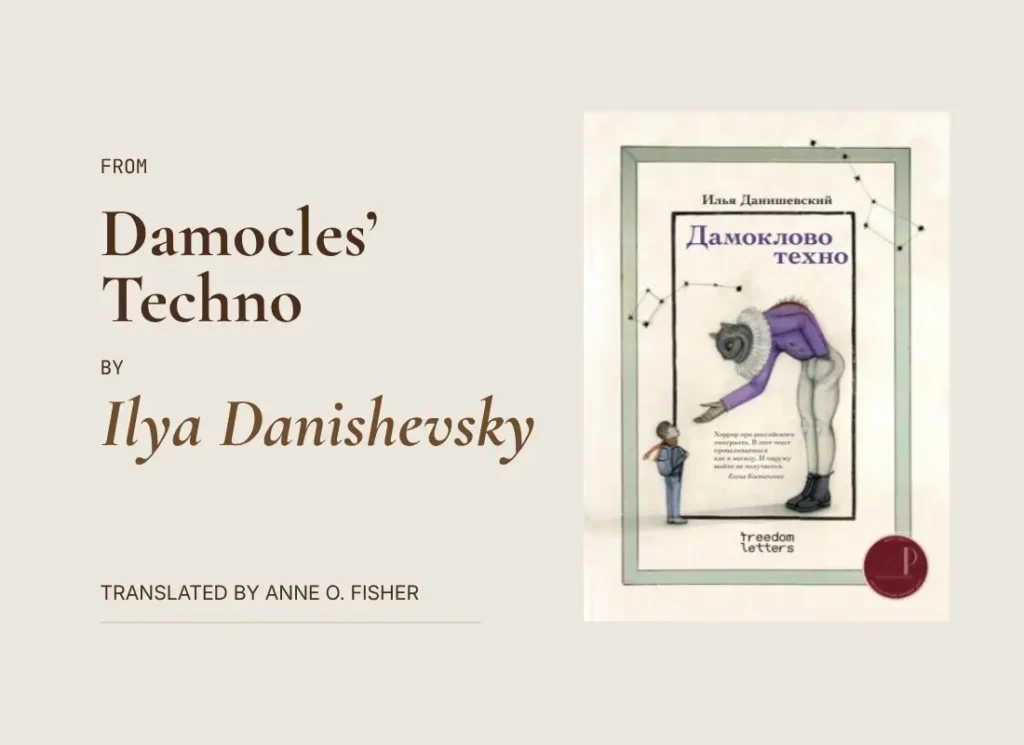
The Pockets of Fear and Hunger.
Act One. The House of Noise
How could it get any worse? And that’s just it: it couldn’t get any worse. “A fresh batch of political correctness has been served,” Tanya said. The face of a martyr who’s fucking sick of strolling in green meadows, feeding ponies, and posing for sexy sunrise, who’s sick of talking to strangers every breakfast, lunch, and dinner, who’s sick of English. Yeah. It couldn’t get any worse. No energy left to spend on expressing yourself in the language of correctness instead of your own internal language. Ten more people got here today, the sounds of Spanish, Hebrew, something else (who cares?); three of them are going to write texts, three others are going to use AI to help them write trombone music, and the rest of them are curators.
“Because some pockets are oh, man, so deep, if you get what I’m saying, you could get lost in them. You’ve probably read the fairy tale about that, about the girls who got lost in a rabbit’s pocket—and let’s be politically correct here: a few boys who did, too.” Of course he shouldn’t drink so much, but that strange whisper was seemingly unrelated to what he’d drunk. It was like getting a DM directly to the brain. Max tried to break the connection: he took a shower, went out into the yard, the pale daffodils in the grass brought the temperature of his apprehension down a little. The day before yesterday he hadn’t drunk, but even so, he occasionally had visions of checkered trousers with their big pockets sticking out. “Oh, man, they’re deep, sometimes deep as arteries, there’s no stopping the flow of blood; but another girl who I let have a good feel of my insides stuck her arm into that dark pocket all the way to the elbow, and oh, man, it bit her arm off at the elbow.”
“Good morning?” Max asks as he walks into the kitchen. Olaf is scraping the plate with his fork in a disgusting way. He can’t catch hold of the kumquat. Max hears it again, he feels that intonation inside him, all silky-smooth, like cat fur or the drunk chapters from Meyrink’s Golem. Like Tanya’s eyes when she’s looking at the cook, like their kisses, Max doesn’t look, but oh, man, their kisses are so deep (judging by the sound). Living in the dull castle is a little similar to being imprisoned, but only if you see it from that angle; from another angle, it’s an invitation to travel.
“Yep,” replies Olaf dully.
Three weeks of living together. Some of the days here were almost good, and others were basically like deep pockets; a faraway castle three hours from Leipzig, ten artists (until the politically-correct replenishment) locked inside together. Max always slept through breakfast and barely got up in time for lunch and walked a loop around the main building (washed-out light-blue walls covered in metal scaffolding handy for putting out cigarrettes) and looked out at the dry reeds by the small pond and then came back to the front entrance where he dropped his butt into the receptacle by the door. Sometimes he got the impression he was dawdling so he could get away with less talking in the kitchen. Less discussion of the wonders of being vegan, of how and when you/he/she met your/his/her girlfriends and boyfriends, and so on. A slippery, very slippery sensation. After lunch he’d go back out to the pond and look at the pond scum and answer text messages, but he did that in a disinterested way too, diffidently: “how are you?” “how’s it going?” “what are you up to?” “what are you doing?” “great” “fine” “fine” “fine”… And although some “fines” can also be deep, they weren’t in this case. Every day of those three weeks brought Max closer to Cipramil’s promised cumulative effect. Or at least he could hope so. He especially hoped for it in the evening, when Melanie talked about mephedrone, yes, that was especially when he’d think, well, his life wasn’t the only one that seemed like yesterday’s news, at least there was that, and it was exactly those moments of social bullshit when got the most sick of himself and the world around him. It’s not nice for Melanie to hear Russian, because NOW it’s offensive, even when Tanya the Ukrainian speaks it. Melanie’s well educated, doesn’t spend a lot of money on clothes, makes art, but the kind of art you can make by the hour, to match the subsidy, exactly as much as measured out by the grant and no more. She likes to talk about nice appropriate things. No personal stuff.
Yesterday when Max got another message about pockets sent directly into his skull, he was drunker than everyone else, even drunker than Olaf, although that was who it usually hit first; the words were yielding, like gravel licked by the tide; yes, sometimes you can stick your hand into your pocket and feel the smooth stones inside (probably because there’d been seaweed with dinner), but also you can stick your hand in someone else’s pocket on a dark path in the Tiergarten and feel the blood rustling underneath the soft fabric. That day Melanie was wearing a pink sweater and, inexplicably, a scarf with a Disney princess on it. Max doesn’t believe she actually works on environmental issues. He’s asked how she can be a vegan but love mephedrone, but she just laughs. She spends less money in one area but more in another, she transfers her health from her left pocket to the right one. “She’s a fucking asshole,” says Tanya coldly. That small castle’s secret language, Russian: universally shunned, and unwanted, and violating; for two people here it becomes a sort of camera obscura, a chamber of distortion and memory, it turns into something slightly special in that space, where only they can decipher its secret symbols. “Fucking hallo” is what Tanya says every morning, at first they asked what it means, but she said “old Russian tradition.” The morning the politically correct replenishment arrived, she was wearing a sweater with Bambi on it.
Last night it had been just the three of them in a little hut tucked away at the edge of the property to play ping-pong, smoke weed, play ping-pong, listen to Tanya and the cook’s hot make-out session, smoke weed, and play ping-pong; Max had finally found a body in that 100% LGBT-free zone, where apparently nobody used apps to find sex, Tanya was intensely playing ping-pong, the way usually only academics play (with her green sweater tucked into her faded jeans), and time had begun to just drift a little—expanding, like with poppers, and contracting—and sometimes the sound of the ball falling on the concrete floor distracted him.
“Hello, how a u?”
“Hallo,” wrote the person with a cat as his avatar (in the description: arrogant bro, only relationships, prefer deutsch). Max doesn’t really care—not now—what’s hiding behind the feline face; prolonged abstinence makes that secondary. He uses a translator on his phone to tell the catman that he’s at a residency in an artists’ colony, apparently not far, and why don’t they go ahead and meet up, as early as, say, tomorrow? Yes, as early as tomorrow will be perfect. So, replies the catman in German, you’re an artist, that’s interesting, very interesting, is yours big? Picture? Max says he doesn’t have any pictures, and his is average, same as everybody else’s. “I don’t know what everyone else has,” the catman responds. “Some pockets are deeper than others, isn’t that right? One kind of art is slightly different from another kind.” “Pocket? What do u mean?” “Holes, wounds, holes and wounds in the heart? It’s a joke ☺ Where r you from?”
Tanya peeks over his shoulder and says, “Ah, somebody’s going to play some pocket pool,” Max answers “Russia,” the catman is slow to respond, it even starts to feel like he’s disappeared, or else it’s the joint slowing time again, and then finally, “Kein problem, see you tomorrow?”
They decided to meet at the summer pavilion a forty-minute bike ride from the residency, during the day it was packed with people who liked puddle-jumpers, beers with lunch, the monument to the Soviet bomb, and horseback rides, but by evening it should be sleepy and deserted, there wouldn’t even be any lights, it would be like a romantic walk in the woods, just with bathrooms. They’d all visited the place once already, with a couple bottles of wine, so they could take pictures of Tanya riding the bomb, Tanya feeding the black horse, Tanya lounging on a red and yellow chaise with a cigarette squinting in the sun. Since she’d started riding the cook’s bomb, they’d started spending much less time together, exactly like kids who are friends until one of them starts a relationship, but even that little time was used exclusively for maintenance and discussion of the relationship; for Max this prompts thoughts of Slava, short and dull, who was always secondary, but who never forgot his uniform for phys-ed, for whom Max had felt something that was poorly defined; thoughts of when Slava got his first girlfriend and the three of them hung out every day, because Slava wasn’t quite able to bring himself to be alone with her, which Max took as an eroticized response to his own secret feelings. Where was that guy Slava? As the ping-pong goes on in the background, Max hunts for Slava in social media, finds him, but is unable to find any adequate answers to what Slava ended up doing, where Slava is, what keeps Slava going. While some pockets may be quite deep, others—not so much. For example: Max’s current life, which consists of daily sedate emptiness at the residency and nightly alcotrash hanging out with Tanya and her German cook, who is faintly reminiscent of Slava. Max writes “Good night,” the catman replies “ok ☺,“ but it somehow seems apprehensive.
Olaf finally succeeds in spearing the kumquat with his fork, he’s saying he’s going to go work. Work. It’s a word from a magic spell; in the deserted silence of the residency, where firebugs are all over the place mating busily, it was used every time somebody started feeling awkward about the previous night which had again ended in delerium and oversharing in a mix of all languages. Work, here, meant sort of going back to the purpose you’d been assigned, but Max didn’t really know what had been assigned to him; the kind of work where you try to birth a boy from raw, unprocessed wood seemed doomed from the start, the boy will be stillborn. During the day he sat in Tanya’s studio and watched her set up old works, or reconfigure things that had been created many years ago, with the energy of the past; pretend work; but even to her he lied that yes, of course, he was doing his thing too, every night, one word after another. “Good,” Tanya would reply, “It’s really good that you’re busy too.” At summer camp, in kid prison, people can get tied up in the same kinds of knots, and for Max his “working as an artist” was very similar to working in kid prison, things like washing dishes or drying laundry. The quiet fields and quiet villages around him seemed strongly reminiscent of a distancing from life, a small pro-forma communion that doesn’t bring solace. Two months before he got there, the Moscow streets, pretending nothing had changed, had seemed the same way, and a month before that, he himself had been in a very deep pocket, where the sound of the news couldn’t reach him: his father was dying, slowly and painfully. One day Max was going to the hospital with him, and the taxi dropped them off on the wrong side of the building, and they slowly walked all the way around the building to the entrance, and his father walked so slowly, and everything tired him so much, that Max knew this might be their last visit (or next-to-last); at the entrance his father said he’d wait while Max had a cigarrette, and seeing as how he couldn’t smoke himself, he’d watch the smoke coming out someone else’s throat. A week later Max got the message: “Father died, come home”; but apparently even that wasn’t what had ended up deciding everything, his seclusion in silence had occurred earlier, before the cancer diagnosis; the silence was such that the news, the sight of the mating firebugs, the sight of Russian soldiers, the knowledge that right now new soldiers were being born from a bloody pocket—all of it was rendered meaningless. He was conceptually disgusted at himself. At his imitation of work. At the drunk stoned people playing ping-pong. At the sound of Tanya and the cook making out. At the person with the cat avatar. At the fact that he’d agreed to meet, just like that, without caring what happened, hand job or anal, made no difference. Had his father already died, or would he not die until tomorrow?
One evening they were all hanging out together, a record was playing raspily, the cook was telling a story, with Tanya translating, about how last session there’d been an Austrian artist at the residency who wanted plastic surgery to turn himself into a sperm whale. Why a sperm whale? Because that’s the picture on paper bags from Aldi—a sperm whale. Max understood that desire. When he was sitting next to Slava while Slava was making out with his girlfriend—at the movies, for example—Max also felt that he was now a sperm whale, one that was just drifting through; neither movies nor making out have anything to do with sperm whales. He remembered that he and Slava would often ride along the fields right up until the first snow, sometimes racing each other but more often just going along, in order to, say, not talk. That’s the purview of children’s friendship. Right now he was in a field of yellow flowers. The flowers resembled Facebook likes. Soon it would get completely dark, the likes would go out, and the only thing left would be the kittyman, who Max was thinking about more and more intensely as he pedaled; he’d like for their meeting to go a little differently than usual, somehow, he’d like them to talk about some kind of other things, and why shouldn’t they, because it is such a demanding road along these flowers, along the news feed, a secretive meeting in a night-time field for fans of flying, something out of a European Stephen King, but Max has no fuel for riding astride the bullet, he’d like to ride astride the kittyman, of course, but for it to be a little more different than usual. He’d already gotten tanked so he wouldn’t worry if they didn’t vibe, so he wouldn’t be shy about making out with a stranger as soon as the conversation in bad English starts to wind down (and what was he hoping for, going out to meet someone armed with his two condoms and bad English? What was his father hoping for when he sat down on the bench, and Max smoked, and his father watched the smoke coming out his throat?). After he’d ridden through the village next to their castle, the streetlights vanished completely. It was getting dark, nothing but the windmills on the horizon, they kept on turning, they looked like spectators, Max rode underneath their empty gaze, under the dark empty sky, and Ursa Major overhead reminded him of a child’s wheelchair. There was time to think about his father, and about Slava, and then about Pasha, and Lyosha, and about Miguel (Sicily, once), about two weeks with Berndt in Potsdam, and about his father again, about that time in the church when the moment had come for him to kiss his father’s forehead, and Max thought that he mustn’t lean on the coffin too hard, to avoid knocking it over, and he even thought about what would happen if he did knock it over, and what sound his father’s body might make as it fell onto the floor of the church, and what sound it might make when everything inside Max exploded.
He turned left off the main road and continued for about fifteen minutes along a narrow stream, and then across a small clearing, and then parked by a private hangar for private planes. He knew one of them had a plane named “Anastasia” (he’d seen it on his last visit) with a naked lady painted on the right side. Max got that story ready for telling to the catdude, and then (he squeezed his English into a fist) he got the story of how he left Russia ready, as well as his thoughts about the feeling of Russian guilt, and also (thanks to Tanya) he stocked up on a few pretty phrases that should help guide the conversation toward using those condoms. For example, “I want to find out how deep your pocket is.” He hoped that at some point he’d be able to relax and talk without feeling what language he was speaking, which had happened to him before; he hoped that at some point the catdude would take things into his own German hands.
This place looked totally different during the day, but in the dark, the garishly painted and decorated hangars with their private planes felt looming and oppressive; Max leaned against the door behind which the “Anastasia” slept, and waited. Very soon it started to feel like a failure and that it was time for him to cut his losses and head back, which would’ve been par for the course for meeting no-names, but then Max saw the lights glowing in the dark the way people’s eyes do in movies. He watched the lights approach him from out of the darkness, and a minute later realized it was just the lit end of a cigarette; he walked over and asked, “Hallo?”
“Fucking hallo,” replied the person-cat, imitating Russian, imitating Tanya. Max couldn’t tell what was going on, or in what language, or in what order; afterwards, when recounting the events, everything turns into German porn dialogue. POCKETCAT: Was it far? Did you get tired of pedaling?
MAX: Good, what about you?
POCKETCAT: I’m tired, to be honest. You’re shorter than I thought. That’s bad. MAX: Why?
POCKETCAT: Have you heard about the Tiergarten turtles? This one Humboldt professor was telling me that one time they escaped from the zoo, and now they live in the Tiergarten. That’s why it’s bad.
MAX: What do turtles have to do with anything?
POCKETCAT: Because if we stand by the wall, if you stand by the wall, it’ll be fairly difficult to hold you. But there really are turtles there.
MAX: Are you drunk?
POCKETCAT: Aren’t you drunk?
MAX: A little. We can have a drink.
POCKETCAT: Why, so you won’t be apprehensive? Better not.
MAX: Why not?
POCKETCAT: Didn’t you get enough of drinking with demons in Russia? Better if you stop doing that.
Then, as Max told Tanya, which was hard, it was like everything he didn’t want to say was dragged out of him; everything he wanted to keep tucked away in his pockets was, somehow, spoken aloud. “Did you know that before men, I had women?” Tanya had also had women before the German cook. She asked what happened next. Max didn’t fully remember, it was like that date he had at the Ponte delle Tette in Venice, which was called that because the Venetian doges had fucking had it with the gay,s so they assembled the prettiest whores on that bridge for display. And? And nothing. Max remembers strolling languidly along an empty runway, it was totally dark, the drunk Russian took the arm of the German wearing a handsome thrifted vintage jacket, they talked in bad English, drunk, and their heads were spinning, seemingly from each other, but really from the alcohol. They they stood at the monument to the Soviet bomb, and that man—fuck, he’s so tall—asked, “You haven’t ridden the bomb, right?”
“What about you?”
“I don’t have anybody to ride it with,” Pocketcat replied sadly.
Max looked at him for a long time, but afterwards his face was wiped from his memory. It seemed he was wearing a dark blue denim shirt and trousers with big pockets. And a black vintage jacket, right, the thrifted one, also with pockets.
POCKETCAT: And you? How deep have you swum?
MAX: Been married?
POCKETCAT: You haven’t been married, I know that, but deeper? How’d you lose your virginity?
MAX: With a boy and a girl at the same time. You?
POCKETCAT: I haven’t, obviously. All that is still to come, if you get what I mean. So you loved the boy, but it was the girl who sucked?
MAX: What? What language are you asking in?
POCKETCAT: Esperanto. She sucked, he watched, but then his dad came into the room, and everything broke. The boy left, he was led away, and later she kept on sucking. You came. What was it like for you, stuffy or nasty?
MAX: I don’t know.
POCKETCAT: [Pause] It hurts a little to be that close to someone you want to be close to.
MAX: And you?
POCKETCAT: Me? Yes, there have been times when it was a little stuffy or nasty. But you can’t talk about that in any language. What’s your name?
MAX: Doesn’t matter. Talk about it.
POCKETCAT: About myself? They cut me in half when they brought the wall down, do u understand my english?
MAX: Cut in half?
POCKETCAT: Yes, from vagina to cock.
MAX: I see.
POCKETCAT: Yeah, sure you do. But it’s like an art; it’s like pockets: some are different than the rest. Same with bodies: some can grow together again. But yours—no way.
MAX: Now you’re just talking nonsense.
POCKETCAT: I warned you not to drink with demons anymore. But now you’ve gotten me drunk, my head is spinning from you, from your night eyes. Can I kiss you? Max told Tanya that he said yes. Big hands with thick veins held him close, Pocketcat sat on the Soviet bomb and buried his face in Max’s solar plexus. He had the huge hands of a physical laborer, Max liked his mental weakness, Pocketcat asked, “Would you want to lose your Russian citizenship and become a Lichtensteinian national?” as Max stroked his head (behind his ears, right behind his ears), kissed his smoothly-shaved cheek, and asked, “Why do you ask?” but Pocketcat also asked, “What about you? It’s so obvious. Your great-grandmother died from German guilt, you’re afflicted with Russian guilt, but what am I supposed to do? I’m tired of drinking other people’s guilt,” and Max pulled off his strange jacket and denim shirt and kissed his back and replied “Eh?” and Pocketcat was sitting on the Soviet bomb with his back to Max and he probably felt awkward. “Hey, want to pretend you’re a citizen of Lichtenstein?” Max moved away to look at his back, to see the bloody welts and bruises manifesting on the muscles, like on a shroud. “What’s that?” And in reply Max heard Pocketcat really laughing for the first time, a shaky, vibrating laugh, Max had never heard one like it before, a laugh that was so deep, and so eroticized, but painful at the same time. Then Pocketcat replied that “I also have guilt, and I choose to punish myself for it; but still, let’s pretend you’re a citizen of Lichtenstein…”
MAX: In what language?
POCKETCAT: In the language of Lichtenstein. Is it Ukrainian or Russian?
MAX: No way it’s Russian these days.
Translator’s note: As the title of the first section implies, the horror video game Fear and Hunger is used metaphorically in this book; Pocketcat is a character in that game. The “monument to the Soviet bomb” is a reference to an actual (hollow) Red Army bomb on display in what was once a Soviet army garrison in East Germany. A note on language: The original Russian text, of which this is the English translation, includes words in languages other than Russian, such as English and German. Sometimes those words are in those languages, other times they’re in Cyrillic transliteration. To retain the sensation of multiple languages in multiple modes, this translation uses Century Gothic where the original text has non-Russian words and italics where the original text has non-Russian words transliterated into Cyrillic.