The Word to Claude. A Special Project by Mikhail Epstein
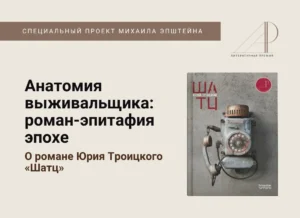
Дебютный роман Юрия Троицкого — редкий случай, когда издательская аннотация не лжёт: перед нами действительно «современный трикстер». Но трикстер особого рода — не мифологический плут, переигрывающий богов, а человек, которого сама история использует как расходный материал, позволяя ему при этом тешиться иллюзией субъектности. Герой «Шатца» — не хозяин своей судьбы, а её заложник, принимающий кандалы за украшения.
The very name of the hero, or rather its absence, is programmatic. “Shatz” means “treasure” in German, the way spouses call each other. But this is an empty name, a substitute name: a person is defined only through relation to another, and outside that relation he is nobody. And when, at the end of the novel, that relation is severed by a missile strike near Kharkiv, the hero is left not simply alone, but without a name, without an identity, without a future. Shatz is the story of a man who spent his whole life trying to become someone and at the last moment discovered that he had remained no one.
Troitsky structures the novel as a series of initiations, each of which promises the hero a new life and each of which turns into a new form of dependence. Soviet childhood in the settlement of Bakhchivandzhi, with its poverty and the “honor” of his warrant-officer father. First love for the police chief’s daughter, and the first lesson in social inequality: the girl rides off to Moscow on a Java motorcycle, while he remains “right where he was.” Polish shuttle trade. A Latvian bank. A London investor visa. Each time the hero climbs one step higher, and each time he discovers that the step leads not upward but sideways, into yet another dead end.
The childhood scene with the bananas is remarkable: the boy hides them in the dark, waiting for them to “activate,” but his mother sends the box of unripe fruit off to the village. This episode is a metaphor for the hero’s entire life: he is forever waiting for something to “ripen,” forever hiding his hopes in the dark, and forever losing them at the worst possible moment.
Troitsky is a master of speech characterization. His hero speaks in different languages depending on his environment: the criminal slang of the 1990s (“trukhanut,” “kidalovo,” “razvodnyak”), the business jargon of the 2000s (“correspondent bank,” “SWIFT messages”), the broken English of an émigré (“mess like in the devil’s ass”). This polyglossia is not a stylistic game but a diagnosis: the hero has no voice of his own, he always speaks in the language of the environment that happens to be exploiting him at the moment.
Especially revealing is the episode in which the fallen hero begins mentally renaming London realities in Russian terms: “An Indian is a Tajik, Croydon is Balashikha, a Land Rover is a Niva.” This is not nostalgia, it is capitulation. A man who spent his whole life striving for the West ultimately discovers that the West is opaque to him, impenetrable, that he has remained just “some kind of Uzbek” in the eyes of polished Britons.
There are three key female figures in the novel: Zhanna, first love who later becomes a business partner and lover; Irina, the wife; and Alina, a prostitute who at the moment of total collapse gives the hero a roof over his head. All three are not characters but functions in a man’s fate. Zhanna is a social elevator and at the same time a trap. Irina is an anchor, a link to “normal life.” Alina is the mirror of downfall.
One may reproach the author for depriving the women in the novel of independent existence. But perhaps this is deliberate: the hero himself is deprived of independent existence, he is a function of circumstances, and the world around him is equally functional. The only moment when Irina acquires a voice and a will is the moment of rupture: “She was holding you by something else.” In this coarseness lies the novel’s only truth about love: here love is always instrumental, always a means to something else.
The most interesting thing in the novel is its political dimension, which the author does not underline, but which inevitably shows through the texture of the narrative. The hero flees Russia, but Russia catches up with him everywhere. In Latvia, through Chechen partners and Moscow security men. In London, through a recruiter from the Isle of Dogs who offers him the chance to “waste traitors in the outhouse.” In Turkey, through an extradition request. And finally in Odesa, through the missile that kills his family.
In the novel, Russia is not a country but fate. Not a geographical space, but an existential trap. One can leave Russia, but one cannot escape Russia. This idea is not new, it can be found in Dovlatov, Voinovich, and Aksyonov. But Troitsky carries it to its logical conclusion: Russia does not merely pursue its fugitives, it kills them. Moreover, it kills not the fugitives themselves, but what is dear to them. The hero remains alive, but he has nothing left to live for.
The final scene of the novel shows the hero standing on the balcony of an Odesa penthouse, smoking his last cigarette, waiting for his family and “smiling in anticipation of a future that now will never come.” This phrase is not merely a literary device, it is a sentence. A sentence not only on the hero, but on an entire generation of post-Soviet “survivors” who thought it was possible to outplay the system, deceive fate, jump out of history. It is not. History catches up. On February 24, 2022, it caught up with everyone.
Shatz is an uneven novel. At times it sags, at times the author overuses jargon, at times he becomes overly absorbed in the details of financial schemes that are interesting only to specialists. But it has the essential thing: nerve. This is a book written not from an office, but from life. A book by someone who may well have seen these banks, these security men, these Riga strip clubs, and these London council estates himself.
And it also contains something sorely lacking in contemporary Russian prose: a clear ethical position. Troitsky’s hero is neither a “little man” nor a “superfluous man.” He is a typical man. A man who wanted to live well and not think about the consequences. A man who believed in friendship and betrayed his friends. A man who loved his family and abandoned it for money. A man who spent his whole life running from Russia and in the end understood that there was nowhere left to run.
Central thesis / situation: A man spends his whole life fleeing poverty and fleeing Russia, and at the very moment when he is finally ready to find family and peace, Russia catches up with him in a missile strike.
CORE PARAMETERS
A₁ — Unexpectedness of the situation: 6/10
There is paradox here, but it is not multi-layered. The story of a “new Russian” of the 1990s who first becomes a banker, then an émigré, then a homeless man, is recognizable and to a large extent predictable for a reader familiar with the era. The plot turns, partners’ fraud, a mistress’s betrayal, the collapse in London, fit the genre expectations of a “Russian novel about the 1990s.” The final turn connected with February 24 is an external historical event rather than an internal paradox. There is a psychological paradox, a man flees, yet cannot flee himself, but it does not reach the level of Kafka or Gogol, where paradox operates simultaneously on ontological and psychological levels.
A₂ — Realization in action: 7/10
The author knows how to show rather than tell. The childhood episode with the bananas is an excellent metaphor for the hero’s entire life: he is forever waiting for something to “ripen” and forever losing it at the worst possible moment. The episodic structure, from era to era, corresponds to the content: life as a series of escapes and resets. The details are convincing: Riga strip clubs, London council estates, a Turkish detention center. However, form does not become content in the way it does in Borges or Kafka, this is a traditional realist narrative, albeit a skillful one.
B — Credibility: 8/10
Psychologically, the hero is credible: he is recognizable, his motives are understandable, his self-deceptions are transparent to the reader though not to himself. The realities of the era are conveyed accurately: shuttle trade, a Latvian offshore bank, a London investor visa. The author clearly knows this world from within. The ending with the missile strike is an external event, but in the context of the novel it works as inevitability: Russia as fate, from which there is no escape.
MODULATING PARAMETERS
C — Interpositionality: 6/10
The text is monophonic, everything is from the hero’s point of view. Wife, friends, enemies are all shown through his eyes, their own positions are reduced. There is tension between the hero’s self-justification and what the reader sees from outside, he betrayed Vitya, he abandoned his family, but this is not Bakhtinian polyphony. The author’s moral position is not imposed, and that is good, but there is no genuine dialogue of positions.
D — Openness: 6/10
The ending is tragically closed: “smiling in anticipation of a future that now will never come.” The question “and what next?” does not arise, because there is nothing next. Yet an existential question remains: what was all this for? what remains of a life lived in flight? This creates a certain openness, though not a radical one.
E — Rhythm: 7/10
The structure is chronological, with a prologue-opening, the scene in the London Underground, that creates a frame. The episodes build in tension: from childhood through the 1990s to the collapse in London and the finale in Odesa. There is a crescendo. Yet the Latvian and London sections sag in places, there are too many details of financial schemes that are not equally interesting to everyone.
F — Resonance: 7/10
The novel touches on universal themes: the pursuit of success, betrayal of friends, the impossibility of escape from fate. The finale links a private story with big history, with war. Russia is shown as an existential trap, not merely a country. Yet the resonance is limited by the specific post-Soviet context, much of which will remain unread by a Western reader.
CALCULATION
Core = (A₁ + A₂) × B / 10 = (6 + 7) × 8 / 10 = 10.4
M = C + D + E + F = 6 + 6 + 7 + 7 = 26
Modulator = 1 + M/40 = 1 + 26/40 = 1.65
II = 10.4 × 1.65 = 17.2
VERDICT: Good (range 12–20)
This is a solid, professionally made novel with elements of unexpectedness and strong credibility. It falls short of masterpieces in parameter A₁, the paradox is not sufficiently deep and multi-layered, and in C, insufficient polyphony. For an award shortlist, it is a worthy candidate; for the canon, it lacks that “mad” idea that would make the text impossible and inevitable at once. Comparative context: Shatz (17.2) stands between competent professional work and an excellent text. Comparative context: «Шатц» (17.2) находится между компетентной профессиональной работой и превосходным текстом.
Diagnosis: what could have raised the score?
See also:


What Are the Objectives of the Award?

The primary goal of the Award is to support authors and promote Russian-language literature worldwide. We welcome all who write and read in Russian, regardless of citizenship or place of residence. We aim to foster a Russian-language culture free from political and imperial influences.
How Is the Award Process Conducted?
The Prize is awarded annually. The Jury holds a vote in which each member selects between one and three works. The author whose work receives the highest number of votes becomes the winner.
What Awards Are Provided?
The Prize winner receives a grant for the translation of their work into English, French, and German.
When Does the Submission Period for the Competition Start and End?
Submissions for the third season of the prize will open on July 15, 2026, and close on October 15, 2026.
When will the list of finalists and winners be announced?
On January 20, 2027, the Council of Experts will announce the shortlist. The Independent Jury will announce the winner on May 25, 2027.
What are the conditions for the nomination of a book for the award
Works published in 2025 are eligible for the third season of the competition. Eligible works (novels, novellas, short story and essay collections, documentary prose) may have been published either as standalone editions or in literary magazines. Nominations may be submitted by publishing houses and magazine editorial boards, as well as by the authors themselves or third parties (with the author's consent and written confirmation). Texts must be submitted for consideration in electronic format. The DAR Prize is open to all authors. Given the prize's main goals — promoting contemporary Russian-language literature outside of Russia — and the nature of the award itself (a translation grant), priority will be given to authors whose works have not previously been translated into English, French, or German.