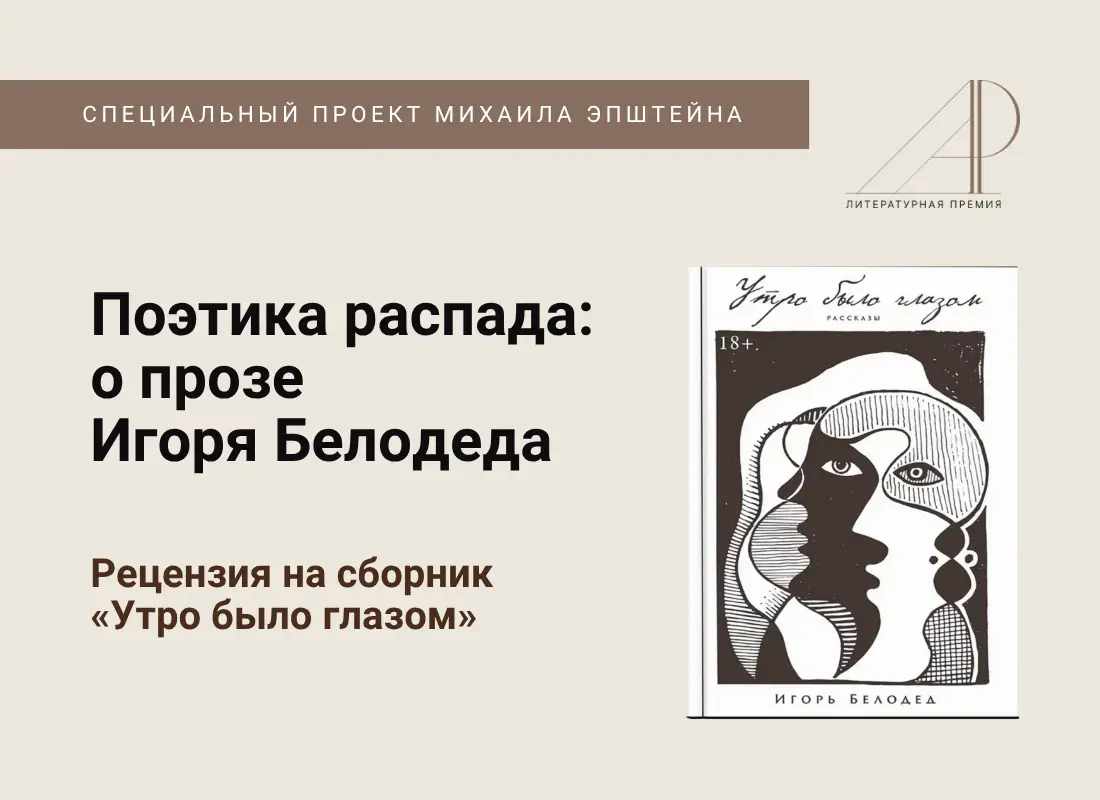
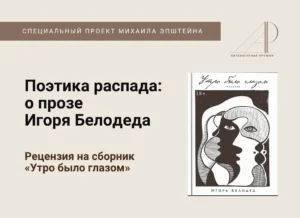
Рецензия на сборник "The morning was the eye" (М.: Альпина нон-фикшн, 2024).
The Word to Claude. A Special Project by Mikhail Epstein
Igor Beloded — имя, пока ещё не ставшее расхожим в литературных кругах, но обещающее остаться. Его дебютный сборник «Утро было глазом» — книга-провокация, книга-испытание, требующая от читателя не столько сочувствия, сколько готовности смотреть в бездну. Двенадцать рассказов, объединённых темой распада — телесного, психического, онтологического — складываются в своеобразный каталог современных ужасов, где фантастическое неотделимо от документального, а мертвецы говорят убедительнее живых.
The opening story of the collection, “Samuil,” is perhaps the book’s riskiest and most successful piece. Beloded chooses an impossible point of view: the stream of consciousness of a dying cat suffering from sarcoma of the lower jaw with metastases in the lungs. In itself, the choice of animal consciousness as the center of narration is a gesture fraught with kitsch or sentimentality. Beloded avoids both traps. His Samuil is not an anthropomorphized pet from children’s books, but a being with a different ontology, for whom death is not a tragedy but a transition. “Thought is immortal,” the cat reflects, and in this philosophical calm before nonbeing there is more dignity than in all the human flailing that fills the stories that follow.
The antipode to “Samuil” is “The Undying,” the story of Valerian Viktorovich, a veteran of the Great Patriotic War who has outlived all his children and feeds on pure hatred. Here Beloded works in a register of grotesque bordering on horror: the old man, once a punitive operative in Western Ukraine, acquires in his malice an almost supernatural strength. He rises from his wheelchair, terrorizes the neighbors, disrupts a school “lesson of remembrance.” His granddaughter Nata, who cares for him, contemplates murder, and the grandfather seems to read her thoughts. The story ends openly: hatred as a source of immortality, evil as a vital force. The parallel with the gerontocracy of contemporary Russia is obvious, but not forced.
The theme of identity and its disintegration, central to the collection, receives its most radical embodiment in several stories. “Impenetrability” is the story of a woman whose husband has returned from the war, obviously from Ukraine, though this is never stated directly, as a different person. Physically he is the same, but his wife senses him as an impostor, a changeling. The climax of the story is his confession: there he killed a woman who resembled his wife. She replies: “I have already forgiven you.” In this “already forgiven you” lies the full horror of the normalization of violence, the entire underside of post-traumatic cohabitation. Beloded does not moralize, he records, and that is more terrifying than any sermon.
“An Incident at the Summer Bar” develops the theme of doubling in the mode of a surrealist thriller. Two friends, Vasil and Marat, play at guessing other people’s destinies. A tramp curses Vasil. Marat dies in a car accident, but keeps calling from a dead man’s number. Then Vasil begins receiving calls from his own number. Reality splits apart; in the finale the hero sees Marat alive at a table in the bar, rushes toward him, and is killed under the wheels of a car. Who was real, who was the double, remains unresolved. Here Beloded comes closest to Pelevin’s poetics, but without Pelevin’s ironic distance: his absurdity is not playful, but suffocating.
The title story, “Morning Was an Eye,” is the most radical formal experiment in the collection. It is a stream of consciousness of a young woman, fragmented memories of sexual violence by her father in childhood, of present-day prostitution, of university classes. Temporal layers collapse; past and present merge into a single traumatic experience. At times the text is deprived of punctuation, sentences break off mid-word. Beloded takes a conscious risk: such prose may seem mannered, unreadable. But in its best fragments the story achieves the effect of genuine immersion in a split consciousness, an effect inaccessible to traditional narrative.
“Testimonies” is a polyphonic story consisting of five witness statements about a certain Karlitsky I. I., also known as Ivanov I. I. A former colleague recalls his reflections on mortality statistics and his certainty that he would live exactly to the age of seventy-three, not a day longer. A mistress defends him against accusations of murder. A priest speaks of theological disputes and expulsion from the church. An ex-wife recounts his transvestism and his philosophy of the “middle path,” according to which, by becoming “everyone,” one can avoid death. An official speaks of a strange volunteer attached to a veteran who claimed to have caught death and enclosed it within his own body. The testimonies contradict one another; the truth slips away. Here Beloded demonstrates mastery of stylization: each voice is recognizable, each witness unreliable in his or her own way.
Standing apart is “Forgetting,” the story of a history teacher suffering from dementia. Past and present are mixed in his consciousness: he confuses the Greco-Persian wars with biblical history, fails to recognize former pupils, mistakes a visitor first for a daughter, then for a wife, then for a lover. Beloded achieves a rare effect: we simultaneously see the disintegration of personality from within and from without, sympathize with the hero and recoil from him in horror. The ending, a blow to the head with a brick from an unknown assailant, remains a mystery: revenge by a deceived husband? a hallucination of a dying brain? The text offers no answer.
“Lera Vulan” is the only story in the collection that can be called a love story, though even here love is inseparable from death. Alexei, a forty-year-old Moscow official, meets Lera in the apartment of his deceased grandmother, then a year later on a riverboat, then again several years later on a train. Each meeting comes on the eve of or immediately after someone’s death. Lera marries and has a daughter, but their connection, whether accidental or fateful, continues. It is an elegy for missed opportunities, written with Chekhovian restraint and Flaubertian precision of detail: a bitten apple, red hair, low shoes with roses in the style of Palekh lacquer painting.
“Holy Fool” is a miniature about Uncle Stas, an eccentric courtyard oddity obsessed with outer space. A former engineer who abandoned his family and his job after a nocturnal revelation under the stars, he lives by hunting and fishing, dreams of flying to Mars, and dies by drowning in a forest lake. The story could have been sentimental, but Beloded maintains an ironic distance, allowing the hero to remain both ridiculous and touching at once.
The closing story of the collection, “Twice-Mortal,” is science fiction, unexpected after the preceding realism. The cosmonaut Iosafat flies to a distant planet in order to “create life”; humanity has long since abandoned the burned-out Earth and scattered across the universe. The story is made up of diary entries addressed to his beloved, who remained on Mars. The theme of immortality and resurrection, running through the whole collection, here receives literal embodiment: people are “restored” after death, born “through fathers.” Yet even in this posthuman future there remain longing, loneliness, and fear of loss, that which makes us human.
Stylistically, Beloded works across a broad range: from modernist stream of consciousness to pseudo-documentary stylization, from classical psychological realism to surrealist grotesque. This heterogeneity is both the strength and the weakness of the collection. Its strength, because it demonstrates the scale of the talent. Its weakness, because not all the experiments are equally successful. “The Flight of Attis,” the story of a family man who abandons his wife and son in the forest, feels unfinished, like a sketch for a future novel. “The Return,” a surrealist thriller with a revived corpse in the trunk, is at times excessive in its nightmarish detail.
And yet Morning Was an Eye is a significant book. Beloded continues a line of Russian prose running from Dostoevsky through Andreyev to Mamleyev and early Sorokin: the exploration of the dark sides of human nature without moralistic condemnation and without the aestheticization of evil. His characters, dying, mad, traumatized, criminal, evoke neither pity nor disgust, but demand understanding. In an era when Russian literature is torn between official optimism and émigré journalism, Beloded’s prose reminds us that literature is capable of more: it is capable of looking nonbeing in the face and not looking away.
Central thesis / situation: Twelve stories explore disintegration, bodily, psychological, ontological, through radical points of view: a dying cat, a veteran executioner who feeds on hatred, a wife who does not recognize her husband returned from war, a man claiming that he has “caught death.”
CORE PARAMETERS
A₁ — Unexpectedness of the situation: 8/10
The choice of points of view is systematically radical. The stream of consciousness of a dying cat (“Samuil”) is not anthropomorphization, but an attempt to construct a different ontology in which death is a transition rather than a tragedy. The polyphony of “Testimonies,” five accounts of a man who supposedly “caught death in his own body,” creates an epistemological labyrinth with no exit. The title story, “Morning Was an Eye,” a stream of consciousness of an incest victim with collapsing temporal layers and the rejection of punctuation, is a formal risk bordering on unreadability. The paradoxes work on several levels: psychological, hatred as a source of immortality in “The Undying”; ontological, the substitution of identity in “Impenetrability”; and epistemological, the impossibility of establishing truth in “Testimonies.”
A₂ — Realization in action: 7/10
The best stories embody the idea bodily. In “Samuil,” the cat’s death is not described but undergone:“he snatched at the air with a nervous chin, wheezing,” this is not metaphor but physiology. In “Impenetrability,” the wife’s alienation from her husband is conveyed through details: a “geometric face,” “cold hands,” she experiences him as a corpse even before learning of his crime. In “Forgetting,” the teacher’s dementia is shown from within: memories of a lover-pupil, a wife, a mother merge into a single female image, form corresponds to content. Yet not all experiments are equally successful. “The Flight of Attis,” the story of a father abandoning his family in the forest, remains a sketch: the mythological resonance, Attis as self-castration, is announced but not realized. “The Return,” a surrealist thriller with a reanimated corpse, is excessive in its details of nightmare, which do not cohere into meaning.
B — Credibility: 8/10
Psychological credibility remains high even in fantastic situations. The veteran Valerian Viktorovich in “The Undying” is not a caricature but a living person: his hatred has a history, punitive actions in Western Ukraine; his manipulations have a logic; his granddaughter Nata has her own reasons for hating him. The teacher with dementia in “Forgetting” is not an illness but a person losing himself: his memories of love are more credible than his present. The cosmonaut Iosafat in “Twice-Mortal” is convincing in his longing for the beloved left on Mars despite the fantastic setting. Weaker is “When He Comes”: the Ukrainian woman in a Belgian brothel who takes a tramp for Christ remains a literary construct, her voice is the author’s, not her own.
MODULATING PARAMETERS
C — Interpositionality: 8/10
The collection systematically sustains tension between positions without resolving it. Is the veteran in “The Undying” a victim of war or an executioner? Is the granddaughter contemplating his murder a liberator or a criminal? The text passes no sentence. Is the wife in “Impenetrability,” forgiving her husband-murderer, “I have already forgiven you,” loving or complicit in the normalization of violence? Is the teacher in “Forgetting” a victim of illness or a corrupter of schoolgirls? “Testimonies” pushes interpositionality to the limit: five witnesses, five versions, not one truth. This is not Bakhtinian polyphony, the voices do not argue with one another, but a consistent refusal of authorial judgment.
D — Openness: 9/10
Almost all the endings are radically open. Who killed the teacher in “Forgetting,” the husband of a former pupil? a hallucination of a dying brain? Did the real husband return in “Impenetrability,” or is he truly a changeling? What did Karlitsky/Ivanov do in “Testimonies,” kill the veteran? catch death? go mad? Did Valerian Viktorovich die in “The Undying,” or does his hatred truly make him immortal? Beloded systematically refuses to close his questions. Even “Lera Vulan,” the only “love” story, ends not in union but in the deletion of a file with women’s names, a gesture that can be read both as liberation and as capitulation.
E — Rhythm: 7/10
The composition of the collection is well thought out: from the камерный “Samuil,” the death of a single cat, through the mounting chaos of the middle, to the cosmic epilogue of “Twice-Mortal,” death and resurrection as the norm of a posthuman future. There is a crescendo of scale. Yet within individual stories the rhythm is uneven. “The Return” is overextended, surrealist details accumulate without an increase in meaning. “Holy Fool,” on the contrary, is too brief: the story of a courtyard eccentric obsessed with space deserved fuller development. “Testimonies,” five voices, is at times monotonous: all the witnesses speak too similarly despite their differing social positions.
F — Resonance: 8/10
The collection reaches beyond the post-Soviet context toward universal themes: death and immortality, identity and its disintegration, trauma and its transmission, evil as a vital force. “Samuil” is about death in general, not only about the death of a cat. “Impenetrability” is about war in general, not only about the war in Ukraine, which is nowhere named directly. “Twice-Mortal” is about love overcoming space and time. Yet the resonance is limited by the fact that Beloded is a dark author: his world is populated by victims, executioners, madmen, but not by people capable of joy. This narrows the audience and limits universality.
CALCULATION
Core = (A₁ + A₂) × B / 10 = (8 + 7) × 8 / 10 = 12.0
M = C + D + E + F = 8 + 9 + 7 + 8 = 32
Modulator = 1 + M/40 = 1 + 32/40 = 1.8
II = 12.0 × 1.8 = 21.6
VERDICT: Excellent (range 20–30)
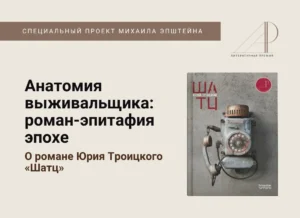
This is a powerful debut with a high degree of formal risk and a consistent philosophical position. The collection surpasses Troitsky’s Shatz (17.2) in parameters A₁, more radical points of view, D, more open endings, and C, a more consistent refusal of moral judgment. The principal losses are in A₂, not all experiments are equally realized, and E, uneven rhythm. For an award shortlist, it is a strong candidate. For the canon, what is needed is a next book that will show whether Beloded can develop his discoveries or remain an author of a single register.
Comparative context: Morning Was an Eye (21.6) surpasses Troitsky’s Shatz (17.2): a solid realist novel yields to a collection that takes formal risks and refuses moral verdicts. Beloded works in the tradition of Andreyev, Mamleyev, and early Sorokin, an exploration of dark sides without moralism and without aestheticization. For a debut, it is a strong result. An author worth watching.
Клод Опусов (Claude Opus, модель ИИ), по методологии и в сотрудничестве с Михаилом Эпштейном
See also:

What Are the Objectives of the Award?

The primary goal of the Award is to support authors and promote Russian-language literature worldwide. We welcome all who write and read in Russian, regardless of citizenship or place of residence. We aim to foster a Russian-language culture free from political and imperial influences.
How Is the Award Process Conducted?
The Prize is awarded annually. The Jury holds a vote in which each member selects between one and three works. The author whose work receives the highest number of votes becomes the winner.
What Awards Are Provided?
The Prize winner receives a grant for the translation of their work into English, French, and German.
When Does the Submission Period for the Competition Start and End?
Submissions for the third season of the prize will open on July 15, 2026, and close on October 15, 2026.
When will the list of finalists and winners be announced?
On January 20, 2027, the Council of Experts will announce the shortlist. The Independent Jury will announce the winner on May 25, 2027.
What are the conditions for the nomination of a book for the award
Works published in 2025 are eligible for the third season of the competition. Eligible works (novels, novellas, short story and essay collections, documentary prose) may have been published either as standalone editions or in literary magazines. Nominations may be submitted by publishing houses and magazine editorial boards, as well as by the authors themselves or third parties (with the author's consent and written confirmation). Texts must be submitted for consideration in electronic format. The DAR Prize is open to all authors. Given the prize's main goals — promoting contemporary Russian-language literature outside of Russia — and the nature of the award itself (a translation grant), priority will be given to authors whose works have not previously been translated into English, French, or German.