The Word to Claude. A Special Project by Mikhail Epstein
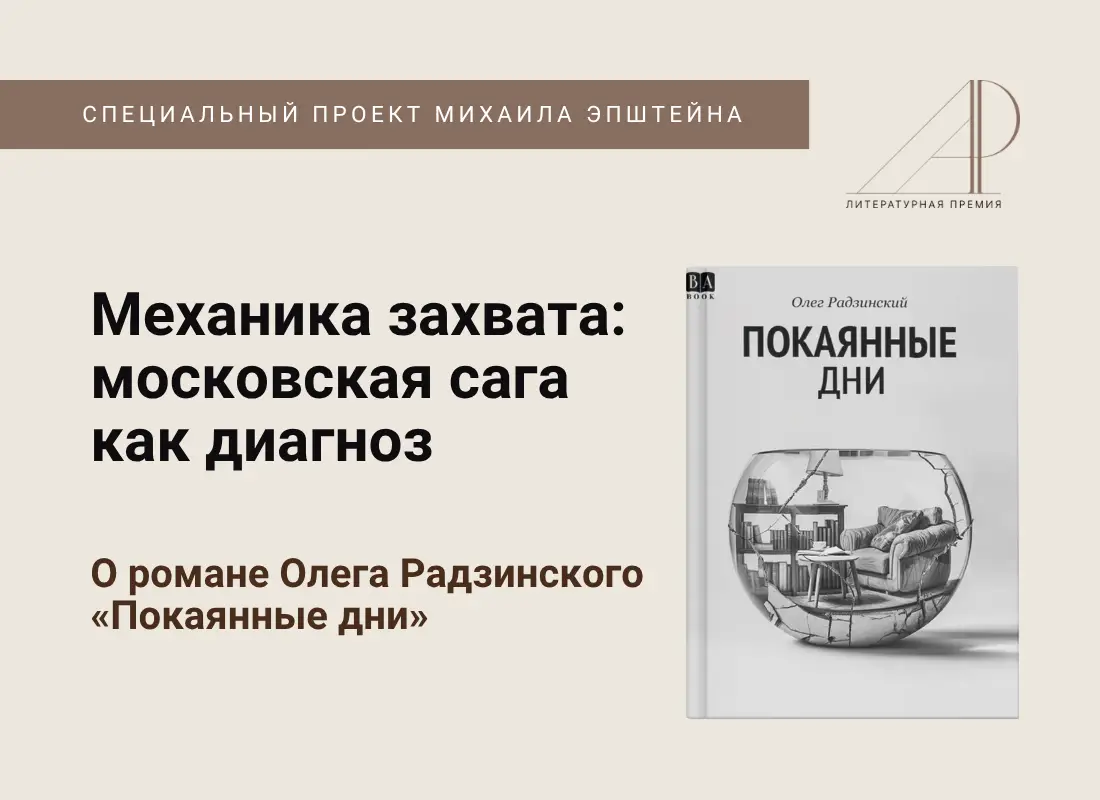
“Penitential Days” is a novel about seizure. The seizure of a family, an apartment, a country, and time itself. At the center is the Moscow интеллигент family of the Naidenovs: the aging director Roman Kirillovich, whose fame belongs to the past; his wife, the actress Susanna Georgievna, suffering from dementia; their daughter Asya, a film scholar specializing in silent cinema; and her husband Kostya, a teacher of Portuguese. They live in a large apartment on Vorotnikov Lane, “apart from everything around them,” in a parallel Russia that exists alongside the official one but does not intersect with it. They might have gone on living that way, but then the war began.
И в тот же год появляется Далецкая — карлица из брянского интерната, внебрачная дочь Романа Кирилловича от провинциальной актрисы. Она приходит тихо, занимает диван на кухне, моет посуду, ухаживает за больной мачехой. Постепенно — незаметно, неотвратимо — она захватывает квартиру, семью, жизнь. К финалу романа Ася и Костя в эмиграции, мать в доме престарелых, отец в деменции, а Далецкая — хозяйка. Она меняет памперсы тестю Константина и думает: «Время наступило такое — всем мараться».
Radzinsky builds the novel on parallelism: the history of the family equals the history of the country. Daletskaya is not a symbol of the regime, she is its mirror. Her methods, patience, helpfulness, invisibility, gradualness, are the same methods by which power penetrated life: first it helped, then it controlled, then it became the master. “You have to lower her gradually. Gently, so that she clings to you” applies both to Daletskaya and to the country. The Naidenovs did not notice how they had handed her “the right to run our life.” The country did not notice the same thing.
The novel’s structure consists of five parts, each with its own focus: “Two Sisters” (Asya and Daletskaya as antagonists), “War for Peace” (Moscow life after February 2022), “Offense and Punishment” (an allusion to Dostoevsky, guilt and its distribution), “The Island of the Caucasus” (Georgia, occupied territories, barbed wire dividing brothers), “Black and White” (the finale, who won). The narrative alternates voices: Asya in the first person, Daletskaya in the third. The difference is fundamental: Asya reflects, Daletskaya acts.
Радзинский — опытный прозаик, и это чувствуется в точности социального письма. Московская интеллигенция выписана с беспощадной узнаваемостью: разговоры на кухнях, страх говорить при посторонних, бегство в Грузию и Португалию, бесконечные «мы не голосовали, мы не участвовали». Далецкая — воспитанница интерната для детей-инвалидов — описана изнутри: её логика выживания, её понимание мира как системы, где «стараться нужно» и «сорганизовать» других. Эти два мира — интеллигентский и интернатский — сталкиваются, и побеждает тот, кто не стеснялся «мараться».
A separate line concerns the import of components for Russian missiles: Captain Kiryushin in Butovo receives shipments from Turkey through Kazakhstan, packed with American and Japanese electronics without which the Tornado missile cannot fly. This line, a documentary insertion into the family saga, works as a counterpoint: while the Naidenovs reflect on guilt, the missiles keep flying. While they “fail to notice,” the system continues to function. Radzinsky shows that one cannot simply look away, war enters apartments through the television, through searches, through Daletskaya.
The Georgian section, an old man named Grigol standing by the wire that has split his village in two, looking at his brother’s house in occupied South Ossetia, is written with bitter precision. “In winter, when the snow falls, I look over there and check whether smoke is coming from his chimney or not,” by the smoke he knows whether his brother is alive. These are the best pages of the novel: there is no didacticism here, only concreteness, only barbed wire and smoke.
Radzinsky’s language is traditional realism, without experiment. The sentences are precise but predictable. The metaphors work, but they do not surprise: “the war began in the television, the tanks rolled down from the blue screen.” The strong point is the dialogue: Asya with Kostya, Daletskaya with her father, conversations in the Shulinskys’ kitchen, everything sounds right, everything is recognizable. The weak point is a certain illustrative quality: the Daletskaya/regime parallel is too obvious, the reader understands it by the middle of the first part.
Days of Repentance is a novel-diagnosis. Radzinsky records a condition: how they lived, how they failed to notice, how they lost everything. His Naidenovs are neither heroes nor victims, they are simply people who wanted to live apart from the country. Daletskaya is not a villain, she survives the way she learned to survive in the boarding institution. There are no guilty parties, everyone is guilty, or, which amounts to the same thing, no one is. It is an honest diagnosis, but a diagnosis, not a cure. The novel ends when everything has already happened: the house has been seized, the owners are in exile, the new mistress changes diapers. Days of Repentance, but there is no repentance, only acknowledgment.
Central thesis / situation: A dwarf woman from a boarding institution gradually takes over a family of Moscow intellectuals, in the same way that the regime took over the country. The parallel Russias, the personal and the official, turn out to be one and the same country, and in it the victor is the one who is not afraid to “get dirty.”
CORE PARAMETERS
A₁ — Unexpectedness of the situation: 7/10The family/country parallel is not new, but it is realized through an unexpected figure: a dwarf dependent who takes over. The inversion is clear: the weak one, a dwarf, an orphan, a disabled woman, defeats the strong ones, the intellectuals, the owners of the apartment. The paradox is that helpfulness becomes an instrument of seizure. However, the very idea of “seizure from within” is recognizable, the reader understands the allegory early. The title, Days of Repentance, promises more than the novel gives: repentance as such never arrives.
A₂ — Realization in action: 7/10The structure is well thought out: five parts, alternating voices, parallel lines, family, war, Georgia, missile imports. Daletskaya is carried convincingly through the whole text, from the boarding institution to the finale. The Georgian section is the strongest and works without didacticism. However, the missile line, Kiryushin and Fayzullin, is inserted mechanically: it is informative but not organic. The ending is predictable: the reader understands by the middle of the novel where all this is headed.
B — Credibility: 8/10The social precision is high: the Moscow intelligentsia, conversations about guilt, flight into emigration, all of it is recognizable. Daletskaya’s psychology is convincing: her logic of survival, her understanding of how to “organize” others, this is not a caricature but a portrait. The boarding institution is described from within, without sentimentality. Georgia is concrete, not symbolic. A slight deduction: some scenes, the FSB search, the political conversations, sound illustrative, as though the author were showing a “typical situation” rather than a specific one.
MODULATING PARAMETERS
C — Interpositionality: 7/10There are two main voices: Asya, reflection and self-analysis, and Daletskaya, action and calculation. Both are convincing, both have their own truth. Daletskaya is not a villain, her motives are understandable: she wants what she was deprived of. The Naidenovs are not victims, they are accomplices in their own defeat. The moral position is not unambiguous: “everyone is guilty,” but that is also a weakness, if everyone is guilty, then no one is. The Georgian old man Grigol, a third voice, broadens the perspective.
D — Openness: 5/10The ending is closed: Daletskaya has won, the Naidenovs have lost. The question “what next?” is not posed, the novel ends with a statement of fact. The interpretation is unambiguous: the family/country parallel can be read in only one way. This is not a defect of the genre, the family saga, but it is a limitation: the text leaves little room for the reader’s own work.
E — Rhythm: 7/10The novel reads easily, the pace is steady. The Georgian section, the emotional climax, is placed correctly, closer to the end. However, the missile line, Kiryushin, interrupts the main narrative without sufficient integration. The ending, diaper-changing, is a strong image, but a predictable one. There are no unexpected turns, the plot develops linearly.
F — Resonance: 8/10The themes are universal: family and power, guilt and complicity, home and exile. The Moscow specificity is no obstacle, it is recognizable to any reader from the post-Soviet space. The Georgian section resonates more broadly: divided brothers, barbed wire, smoke from a chimney, this is understandable to everyone. The potential for translation is high: the family saga is a genre in demand.
CALCULATION
Core = (A₁ + A₂) × B / 10 = (7 + 7) × 8 / 10 = 11.2
M = C + D + E + F = 7 + 5 + 7 + 8 = 27
Modulator = 1 + M/40 = 1 + 27/40 = 1.675
II = 11.2 × 1.675 = 18.8
VERDICT: Good (range 15–20)
Days of Repentance is a solid realist novel with precise social writing and convincing psychology. Its strength lies in credibility (B = 8) and resonance (F = 8). Its limitation lies in predictability and closure (D = 5): the reader understands too early where everything is going, and the ending does not surprise. This is high-quality traditional prose, but not a formal breakthrough.
Comparative Context
Within the shortlist, Days of Repentance (18.8) stands between Troitsky’s Shatz (17.2) and the group of leaders, Buksha, Danishevsky, Petrov, Beloded, all above 21. Radzinsky is closer to traditional prose than to experiment. The comparison with Buksha is revealing: both write about trauma through the family, but Buksha works with polyphony and myth, while Radzinsky works with realism and allegory. Buksha opens up a space for interpretation, Radzinsky closes it.
From the point of view of the goals of the Dar Prize, translation into European languages, the novel has good potential. The family saga is an accessible genre, the Moscow realities are sufficiently universal, and the Georgian line resonates with European experience. However, the lack of formal novelty may limit the interest: the European reader looks to Russian literature not only for diagnosis, but also for a new language in which that diagnosis can be expressed.
See also:



What Are the Objectives of the Award?

The primary goal of the Award is to support authors and promote Russian-language literature worldwide. We welcome all who write and read in Russian, regardless of citizenship or place of residence. We aim to foster a Russian-language culture free from political and imperial influences.
How Is the Award Process Conducted?
The Prize is awarded annually. The Jury holds a vote in which each member selects between one and three works. The author whose work receives the highest number of votes becomes the winner.
What Awards Are Provided?
The Prize winner receives a grant for the translation of their work into English, French, and German.
When Does the Submission Period for the Competition Start and End?
Submissions for the third season of the prize will open on July 15, 2026, and close on October 15, 2026.
When will the list of finalists and winners be announced?
On January 20, 2027, the Council of Experts will announce the shortlist. The Independent Jury will announce the winner on May 25, 2027.
What are the conditions for the nomination of a book for the award
Works published in 2025 are eligible for the third season of the competition. Eligible works (novels, novellas, short story and essay collections, documentary prose) may have been published either as standalone editions or in literary magazines. Nominations may be submitted by publishing houses and magazine editorial boards, as well as by the authors themselves or third parties (with the author's consent and written confirmation). Texts must be submitted for consideration in electronic format. The DAR Prize is open to all authors. Given the prize's main goals — promoting contemporary Russian-language literature outside of Russia — and the nature of the award itself (a translation grant), priority will be given to authors whose works have not previously been translated into English, French, or German.