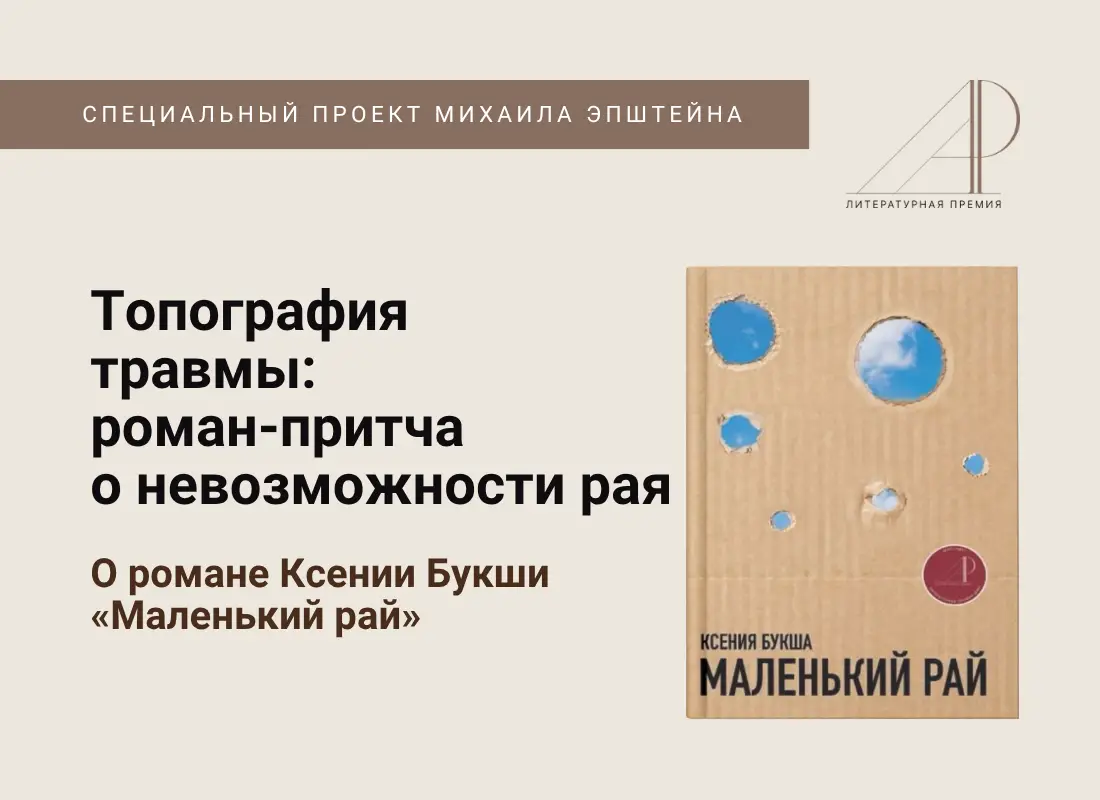
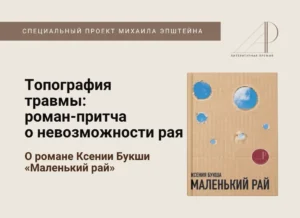
There are books that masquerade as detective stories in order to speak about something greater. "A Little Paradise" Ksenia Buksha is exactly such a book. Its premise is simple: in the fictional town of Rayok, where a war ended fifteen years ago, a fourteen-year-old schoolboy named Aron disappears. He is searched for by an investigator, a mathematics teacher, a journalist, and his friend Dede. They search, and what they find is not the boy but something else: frozen time, unforgiven guilt, the impossibility of purification.
Rayok is not Sarajevo, not Mariupol, not Grozny, though all three are recognizable in it. Buksha creates a phantom geography that works like a magnifying glass: “Stronghold and glory, Empire without Paradise, a bride without a veil.” These are advertising billboards with which the Metropolis lures the autonomy back under the imperial canopy. The poet Adam, who wrote these lines a hundred years ago, could not have known that his romantic image of the “phoenix” would become the tattoo of neo-Nazis who shot children in a school. In Rayok, literature is not an ornament of life but its curse: words detach themselves from their authors and begin to live a dangerous life of their own.
The central image of the novel is mold. It is everywhere: in Aron’s mother’s apartment, on the walls of houses, on the books that were never taken away from the home of the murdered literature teacher. “You fight the mold, and everything washes away” could serve as the epigraph. Mold is trauma that cannot be eradicated. Demining will take 780 years, someone says in the novel, and this is not merely about mines in the ground. It is about mines in people’s heads. About the way war continues after the war: “After the war, you yourself are the war.”
Buksha constructs the novel like a cathedral with many side chapels. Each chapter is a separate point of view: Investigator V., whose wife was once led out of the seized school by the mathematics teacher. The mathematics teacher, who still cannot forgive herself for not saving everyone. The journalist, who comes from the Metropolis and discovers that her professional cynicism does not work here. Mayor Pelmen, a man who is “cheerful precisely because he is dead inside.” The literature teacher, in love with the dead poet Adam. The children, Dede and Aron himself, who appears rarely in the text, but with weight.
This polyphony is not merely a technical device. It conveys the essential thing: in a post-conflict society there is no single truth. There are victims who are at the same time executioners. There are guilty people who are at the same time innocent. There is love that is at the same time hatred. The Prime Minister of the Metropolis, who comes to threaten Pelmen, once himself “sympathized with the imperialists.” The veteran who remembers how people were dressed in peacekeepers’ uniforms and how those who came out of the forest were shot lives next door to those who dressed them that way. And everyone walks the same streets.
Aron does not disappear for no reason. He goes into the mountains, into a cave where the terrorists once had their headquarters. He wants to understand “how people become like that.” There he spends two weeks, though it seems to him that only a few hours have passed. And there he dreams of one hundred and thirteen dead children. They entrust him with messages for their relatives.
This turn is the riskiest in the novel. Buksha introduces an element of miracle into a text that until then had been consistently realistic. Aron could have been the victim of psychosis, hallucination, dehydration. But the text offers no such rational escape hatches: the messages he brings back contain “personal details” that he could not have known. A miracle, or madness, but a madness that heals: “They personally asked that many things be passed on to their families. In general, they all speak of the joy that we are already there together with them.”
Here Buksha comes closest to the genre of parable. A Little Paradise is not a political novel, though it contains politics. Not a psychological novel, though it contains psychology. It is a book about whether forgiveness is possible after catastrophe. And if it is, who grants it? God? The dead? The survivors themselves, to one another?
The ending of the novel is open and тревожный. Pelmen blows up the tunnel together with the Prime Minister of the Metropolis, and the literature teacher dies. Easter service: Aron’s mother is in church with a little basket, “tears of joy and sorrow in her eyes.” On the back bench sits a man “for whom no one rose again today, and the war did not end.” Who is he? Guilty? Victim? Both?
The final lines are in italics, like all the testimonies in the novel: “They dressed us in peacekeepers’ uniforms taken from their warehouse and ordered us to shout to our loved ones to come out of the forest. When the people came out of the forest, fire was opened on them.” This is not closure, but an opening of the abyss. The past does not pass. The dead do not remain silent. Paradise remains little.
Stylistically, Buksha works in a register of restrained lyricism. She is not afraid of beauty, “stripes of light yellow, stripes of shadow bright violet,” but she does not overuse it. Her prose is transparent, at times almost sparse. This is the right choice for such material: excessive stylization would have turned tragedy into an aesthetic spectacle. Buksha maintains the balance: enough beauty for the text to breathe, enough asceticism to keep it from drowning in itself.
A Little Paradise is a book that asks questions rather than gives answers. Is it possible to live after catastrophe? It is. But how? Buksha has no recipe for that. There is only a precise, painful, honest description of what it is like to live in a minefield where the mines are in the ground, in memory, in words. Do your work without looking back and without looking too far ahead, one of the characters says. Perhaps that is the answer. Or at least a way of living long enough to reach one.
Central thesis / situation: A boy disappears in a town where fifteen years ago a war killed 113 children. He searches for the roots of evil, the symbolism of the terrorists, and instead receives messages from the dead. The search for the missing boy becomes a search for impossible forgiveness.
CORE PARAMETERS
A₁ — Unexpectedness of the situation: 8/10 The paradox is multilayered. On the surface: a detective intrigue, where did the boy go? Deeper: an inversion of expectations. Aron searches for the “phoenix,” the symbol of the terrorists, not out of sympathy but in order to understand the mechanism of evil. But he does not find what he was looking for: the dead children find him. He went toward the executioners and met the victims. Deeper still: the title itself. A Little Paradise is the place where catastrophe occurred. Rayok is a diminutive of “paradise,” but also of rayok, a peep-show or fairground booth. A victim-city, a farce-city. The toponym itself is a trap of meaning. Finally, there is a temporal inversion: the past does not pass, the future does not arrive. Aron spends two weeks in the cave, but it seems to him only a few hours. Time in Rayok is broken.
A₂ — Realization in action: 7/10 The form corresponds to the content, though not always with maximum force. The polyphonic structure, each chapter from a new point of view, conveys the fragmentation of post-conflict society. This works. The image of mold is recurrent but not excessive. The italicized insertions of testimony are an effective device: the voice of collective trauma. However, the detective plot at times distracts from the deeper themes: versions of the disappearance multiply, suicide? abduction? blackmail? and this creates genre tension with the parabolic nature of the text. The mystical ending, the messages from the dead children, is a bold move, but it risks seeming like a deus ex machina: instead of resolving contradictions, Buksha transfers them into a transcendent dimension.
B — Credibility: 9/10 The credibility of the details and the psychology is exceptionally high. Buksha creates a convincing mythology of place: poets, Tertius, Arius, Adam, dictator Dede the Great, topography, the bridge, the tunnel, the waterfall, the Heavenly Carousel. It is an invented world, but it feels real because it is built according to the laws of the real: it has a history, a culture, a language, and wounds. Psychologically, all the characters are credible. The mathematics teacher with her survivor’s guilt. The investigator whose wife owes her life to the mathematics teacher. Pelmen, the mayor who is “cheerful because he is dead inside.” Even the episodic figures, the literature teacher in love with the poet, the journalist who came for a sensation and found something else, are not cardboard.
MODULATING PARAMETERS
C — Interpositionality: 9/10 Polyphony is not decoration here but a structural principle. There are no absolutely right or guilty parties. The Prime Minister of the Metropolis is a villain, yet he himself once “sympathized with the imperialists.” Pelmen is a hero of resistance, but he also blows up the tunnel and becomes a “terrorist.” The mathematics teacher saved children, but not all of them, and lives with that guilt. The veteran recalls how people were dressed as peacekeepers, but we do not know whether he was victim or perpetrator. The text systematically refuses moral judgment. This is not relativism, but a recognition that in such a situation any judgment would be a simplification.
D — Openness: 8/10 The ending is open, but not empty. Aron has returned, but what next? Pelmen has blown up the tunnel, but what has that changed? Aron’s mother is in church, but has she been healed? The man on the back bench, who is he, and where will he go? The final lines, testimony about a war crime, do not close the novel but tear it open. The past invades the present. The only thing partially closed is Aron’s fate: he returned, he delivered the messages. But even here the question remains: will they believe him? will it change anything for the relatives of the dead?
E — Rhythm: 7/10 The composition is carefully built: from disappearance through the unfolding of versions to return and explosion. There is a crescendo. The alternation of voices creates rhythmic variety. Yet there are uneven places: the political line, Pelmen and the Prime Minister, is at times excessive, and the detective versions accumulate without sufficient tension. The best scenes are those where the rhythm slows down: Pelmen’s conversation with a friend at the wind farm, Aron’s interrogation, the Easter service at the end.
F — Resonance: 9/10 Although Rayok is an invented place, the resonance is universal. Any post-conflict region will recognize itself: Bosnia, Rwanda, Ukraine, Chechnya. The themes, trauma, memory, forgiveness, the impossibility of purification, extend far beyond the post-Soviet context. The novel is translatable not only linguistically but culturally: a Western reader can read it without loss. The only limitation is that the specifically Christian, Easter, ending may be less transparent to a non-Christian audience, though Buksha uses it more as a cultural code than as a doctrinal message.
CALCULATION
Core = (A₁ + A₂) × B / 10 = (8 + 7) × 9 / 10 = 13.5
M = C + D + E + F = 9 + 8 + 7 + 9 = 33
Modulator = 1 + M/40 = 1 + 33/40 = 1.825
II = 13.5 × 1.825 = 24.6
VERDICT: Excellent (range 20–30)
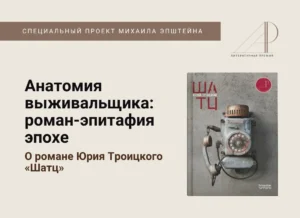
A Little Paradise is a mature work by a strong author. The novel surpasses Troitsky’s Shatz (17.2) in all the key parameters: a deeper paradox (A₁), greater credibility (B), radical polyphony (C), and universal resonance (F). It is comparable to Beloded’s Morning Was an Eye (21.6), but works in a different register: where Beloded explores darkness, Buksha searches for light, and that is all the more valuable because she finds it not by bypassing darkness but by passing through it.
Comparative Context
The three books on the shortlist form a spectrum. Shatz (17.2) is a single-voiced novel about a specific era, in which paradox operates on the historical but not the ontological level. Morning Was an Eye (21.6) is a radical formal experiment with multiple points of view, but its dark vision limits its audience. A Little Paradise (24.6) is a synthesis: Beloded’s polyphony, Troitsky’s credibility, but with the addition of something neither of them has, hope. Not naive hope, not cheap hope, but hard-won hope: “they all speak of the joy that we are already there together with them.”
For the Dar Prize, it is a strong candidate. The novel meets the criteria: it is a work about “the meaning of modern catastrophe, seen from the side of freedom and resistance to totalitarian power.” But Buksha does more than that: she shows that resistance is not only a political act, but an existential one. One may resist not only an external enemy, but also inner darkness. And sometimes resistance takes the form of forgiveness.

What Are the Objectives of the Award?

The primary goal of the Award is to support authors and promote Russian-language literature worldwide. We welcome all who write and read in Russian, regardless of citizenship or place of residence. We aim to foster a Russian-language culture free from political and imperial influences.
How Is the Award Process Conducted?
The Prize is awarded annually. The Jury holds a vote in which each member selects between one and three works. The author whose work receives the highest number of votes becomes the winner.
What Awards Are Provided?
The Prize winner receives a grant for the translation of their work into English, French, and German.
When Does the Submission Period for the Competition Start and End?
Submissions for the third season of the prize will open on July 15, 2026, and close on October 15, 2026.
When will the list of finalists and winners be announced?
On January 20, 2027, the Council of Experts will announce the shortlist. The Independent Jury will announce the winner on May 25, 2027.
What are the conditions for the nomination of a book for the award
Works published in 2025 are eligible for the third season of the competition. Eligible works (novels, novellas, short story and essay collections, documentary prose) may have been published either as standalone editions or in literary magazines. Nominations may be submitted by publishing houses and magazine editorial boards, as well as by the authors themselves or third parties (with the author's consent and written confirmation). Texts must be submitted for consideration in electronic format. The DAR Prize is open to all authors. Given the prize's main goals — promoting contemporary Russian-language literature outside of Russia — and the nature of the award itself (a translation grant), priority will be given to authors whose works have not previously been translated into English, French, or German.