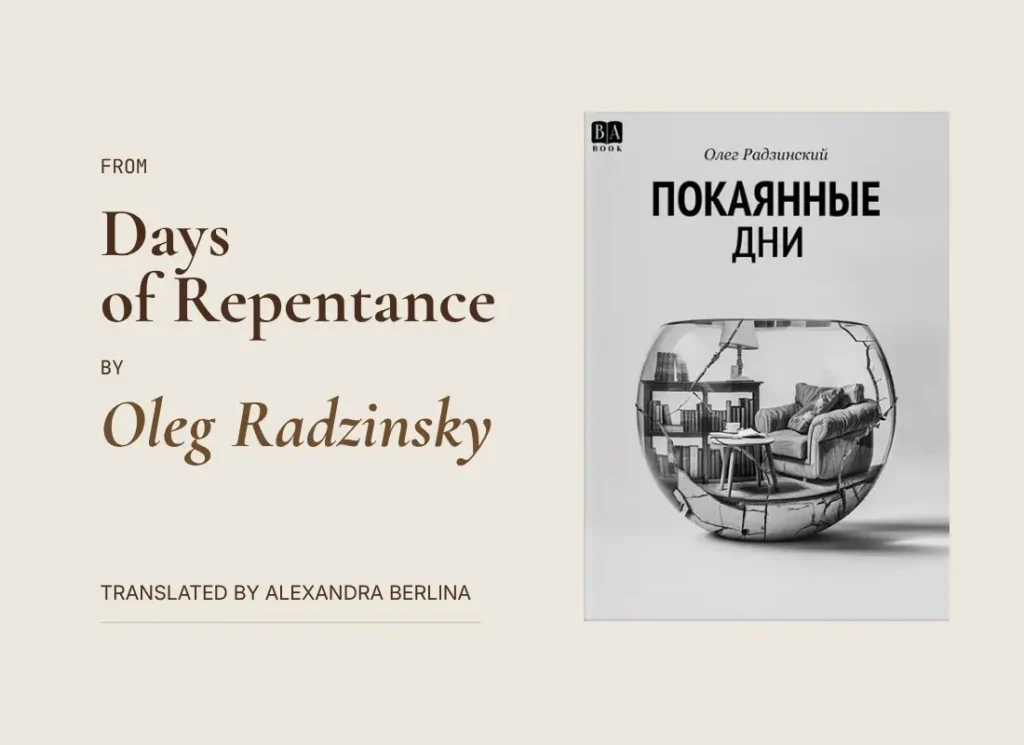
by Oleg Radzinsky
translated by Alexandra Berlina
The English translations of the excerpts were made possible thanks to the support of the WE EXIST! Foundation
Two Sisters
[…]
4
Went to see the Shulinskys yesterday. Adik has put on even more weight, and Marina has dyed her hair again. It suits her. Shall I dye mine, too? No, probably not.
We talked about what everyone’s talking about these days: how bad things have got, how they’re bound to get worse soon, very soon indeed. Marina was talking about how happy she was that their son Boris was finishing school somewhere in England: he’s only just turned eighteen; here, he might have been snatched into the army. They’re hoping he’ll enrol at a university there and not come back. Adik was explaining about the sanctions, and Marina said that the Nazarovs had left. Just like that: Misha had left without saying goodbye to me. As if there’d never been anything between us.
Kostya complained about the pay cuts at the language school. It has a grand name – State Foreign Language Courses, but the pay is poor. He used to earn fifty thousand at 75% of a full-time position. They cut it to forty as the war began. Another thirty thousand as a PhD bonus, the only reason he’d wrote his PhD thesis on Castelo Branco, an utterly irrelevant 19th-century Portuguese writer, known, but only in his native country, as ‘Camilo’. I read him in Kostya’s translation and couldn’t see anything remarkable. The man’s life was more interesting than his work, though: scandals, affairs, prison, a big name at the Portuguese court of his time… At the end, he went blind and shot himself out of despair. Must have realised that nobody cared about him.
Nobody cares about the Portuguese language, either: those who speak it no longer come here. Russians used to go to Angola, and Angolans used to come to Moscow, meaning that Kostya made some extra cash interpreting. There was plenty going on in Angola – oil, diamonds, uranium, some other stuff, can’t remember. He’d told me about it, but I never really understood why we’d need resources from there if we have them ourselves. Admittedly, I didn’t particularly try to understand: it was an alien life, an alien world. Outside my windows. Outside the windows of me.
We lecturers used to get extra pay for publications but now we hardly ever do. I don’t get anything for film reviews anymore, either. I write columns for two online publications, but I don’t really feel like writing, what without pay and with the new films not being worth watching.
At least they haven’t cut the rates at the University of Cinematography yet, I’m getting paid as before. I don’t have a full-time position, either; still, I make more than Kostya. For now.
The Shulinskys are lucky: Adik’s advertising agency keeps him going. Keeps him fed. Keeps their son at a boarding school abroad. Kostya and I never really made any money. Then again, we’re better off than Nina: she works as a museum curator, and things are dire there. Really dire.
But Nina found Jesus five years ago, and life’s troubles no longer bother her. Nina, Nina… How much fun we had together! Any day, anything could happen. And did happen. My best friend, she was.
Nina dresses ‘modestly’ now – calf-length skirts, high-necked blouses, long sleeves. On Sundays, a headscarf: she puts it on for church and keeps it on, walks about all day with her head covered. As for her legs, they are covered all the time. Even though she’s got legs like a model, the stupid thing! A shame to hide them under these skirts.
I’ve always wanted legs like Nina’s: shapely, long, slender, like those of a mannequin in the window of an expensive boutique. Chiselled legs. Now always concealed under a skirt.
My legs are my weak point. I mean, they’re straight, but not very long. Proportional. Nina’s are like a fawn’s – a bit out of proportion, which is where the beauty lies.
My legs are classic, like those of ancient statues. Only my ankles aren’t slim. I’d like them to be slim, like Nina’s.
I know her legs like my own. We used to fool around back in the day, just for fun, to try it out. With women, it’s always only about pleasure for me, I don’t expect a relationship: I expect sensations. But men – I aim to get them hooked, to make them need me. As if I was afraid that I had no other kind of worth. That I wasn’t interesting. It’s because my parents didn’t need me. Nobody ever needed me, except Kostya.
Mark once explained this to me, a long, long time ago. When I was sleeping with all of his friends, and all of mine. With everyone, really. As if I were building an army, recruiting. Every guy – another box checked, another recruit made. Another friend. Now he needs me. Stupid, of course.
I don’t need me. That’s what’s scary.
The war began on the telly, and for a long time, there it stayed. I mean, we all understood that something terrible had happened, that they had started a war. But it was their war. Their war, for them to fight. Outside our windows.
We should have realised that our windows had long since been smashed. I saw it before the others: when Daletskaya appeared.
August in Moscow is a time of waiting for another life to begin. Life will restart in September; in summer, the city stands empty, hushed, weighed down by the dusty heat. Everyone’s at their dachas, but we had none: Dad didn’t like country life. The money from his films first went to buy a flat on Vorotnikovsky, and afterwards, simply spent on living. Then it ran out, and the possibility of a dacha vanished all by itself. Kostya and I used to visit friends’ dachas. I went to my friends’ dachas without him, too.
The possibility of a dacha. Inspired by Houellebecq. Unattainable, just like an island. And just as illusory.
It was a Thursday. Why should that matter? No idea, but I remember: Daletskaya turned up on a Thursday. I forgot the date, sometime in late August, but I definitely remember it having been a Thursday. A summer morning, the flat filled with shadows from the early Moscow sun seeping through the light tulle curtains. The windows were shut against the nighttime chill and the daytime flies.
I waited for the lift to stop on our floor and peered through the peephole: no one there. Though the lift doors had opened and closed, I’d heard the rubber smacking. Then, the doorbell rang. Still, no one in the peephole. I opened the door and didn’t see her at first, looking straight ahead. I should have looked down.
Daletskaya has a beautiful voice: rich in overtones, soft, captivating. Makes you want to listen. She must have got it from her actress mother. Then again, my mother is an actress too, but I inherited neither her ballet shape nor her purring voice, the voice of an affectionate big cat just before it devours you. I wonder what she was like with men. They must have gone mad over her: a beauty, an actress. Exotic looks – dusky complexion, black hair, dark eyes.
That’s all I got from her: the duskiness, the eye colour. But I’m not olive-skinned like her, my complexion is sort of grey. Not as beautiful. Dad’s blood had diluted Mum’s exotic looks to produce my greyish skin.
At first I thought it was a child at the door. Then I realised: she was a dwarf. Standing there, smiling. Her head too large for her body. Somehow she seemed to meet me at eye level rather than from below. To this day I don’t know how she, with her height, manages to look at people this way.
You must be Asya? I nod. I’m Polina Daletskaya. I’m here to see Roman Kirillovich.
I was about to say he was still asleep but for some reason didn’t. Please come inside, I’ll call him.
She came in, followed by her little red plastic suitcase. It now stands behind Dad’s desk in the study. Her things are laid out in the cabinet beneath the bookshelves, where we used to keep albums of family photographs – of Grandma, Grandad, me as a little girl, Dad on film sets. Now the cabinet is home to Daletskaya’s things, small just like herself.
It’s okay, Asya, I’m used to people staring at me, I don’t take offence. What can you do if you were born like this? I don’t mind. It doesn’t hurt me.
Her head and neck look quite normal, it’s as if her body had been squeezed from the shoulders down. Daletskaya is a hundred and thirty-seven centimetres tall: once, when we were standing side by side, I noted where she came up to on me, and later measured it on myself. Maybe it wasn’t right to do that, but I did. I needed to for some reason.
[…]
5
I graduated the year Putin decided to come back. On 12 June, I was defending my thesis on silent cinema, whilst the March of the Millions from Pushkin Square to Bolotnaya was trying to make itself heard. They had their words, I had my silence. That was all.
Lots of students from our year went. I asked Mark, but he only laughed. He sat me down on the sofa in front of him, made himself comfortable on the floor the floor the way he liked, and gave me a speech about the Age of Enlightenment and its culmination, the French Revolution.
Asya, he said, you must understand: when the Enlightenment emerged as a reaction to the calamities of the 17th century – the plague, the Thirty Years’ War, the schism in Europe – and replaced God with man, it did not solve humanity’s problems. Society’s problems. Liberty, equality, fraternity? Liberty transformed into liberalism, capitalism, the dictatorship of money. Equality ended in Marxism and the dictatorship of the proletariat. And fraternity turned into nationalism, which soon evolved into Nazism as its purest, unadulterated form, and gave rise to a third dictatorship, that of a single, chosen nation over all others. Three fine words and good intentions – liberté, égalité, fraternité – created three dictatorships, putting an end to all liberty, equality, and fraternity. Those at the roots of these projects lost control, and the projects took on a logic of their own, a course of their own, one that ended in catastrophe. When you participate, you have to answer for the outcome. That is why I chose not to participate. Not in anything. You can choose what you want but remember: you will have to answer.
I didn’t join the Bolotnaya protest in June, nor in September. I chose not to participate in something I couldn’t control. What could I control? Myself, my life. Even that, not entirely.
What was outside my windows stayed. Dad, Mum, and I lived apart from what was happening there. Mark’s friends – my lovers – lived for themselves and for each other. Back then, I didn’t realise then I was only a lover to them. I thought they were my friends, too. That they needed me.
Sweet little Asya. Free to do anything. The time to answer for it all would come later.
That’s how we lived – quite apart from everything that wasn’t us. Life went on, life happened, raged in the squares and on TV, but we didn’t go to the squares and didn’t turn on the telly. We didn’t participate. And didn’t realise that this was also something we’d have to answer for.
Once I asked Mark why he hadn’t emigrated. Sure I have, laughed Mark. Straight away. At birth. I left and never came back. I live in my own country, which I built for myself.
What’s the name of your country, Mark? Its name is MARK GELFAND. Population: one person. No entry permitted, no visas issued. The border is sealed.
I hoped, prayed almost, that Mark would open the border of his country for me. That he would meet me at the checkpoint and lead me into our shared home. I told myself I was already there, inside. That I’d been issued a new passport, that he would take me into his life. Forever.
Asya, darling, Mark laughed, you must understand, baby, my country is a country for one: for me. Build your own country and live in it. Or you’ll end up like your mother, in a foreign country – your father’s.
I didn’t want my own country: I wanted to live in MARK GELFAND. It wouldn’t let me in. Or it did, but on a tourist visa, not for permanent residence. Because it only had room for one.
Kostya Muromtsev, my future husband, was a gift handed over to me by Nina. She’d been sleeping with him for a couple of months, their relationship going nowhere because the only relationship Nina wanted was with someone else, and that one wasn’t going anywhere, either: the man turned out to be hopelessly married. Two children, still at school. Nina kept hoping that the children would grow up, and then… The children were growing up, and ‘then’ kept getting pushed back – until they started university, until his wife recovered from a sudden illness, until his next poetry collection was published. Things were always just about to happen. But they never did. While waiting for ‘then’, Nina would start affairs to soothe herself, choosing the most handsome and most pointless men she could find. Of all the handsome and pointless men at that time, the most handsome and pointless one was my future husband, Kostya Muromtsev.
He really was handsome, still is, indecently handsome for a man. Why isn’t he gay with looks like that? No idea. As I said: the world is full of riddles. Sometimes they try to pass themselves off as mysteries.
Kostya looks like the Soviet actor Kostolevsky, only completely different.
Do you want him? Nina asked. Take him. I have no serious intents. And he, does he have serious intents?
Are you for real? Nina laughed. Asya, you are the one he’ll have serious intents for. Have you seen how he looks at you? In two months, he never once looked at me like this.
A few years later, I asked her if she regretted giving him away. She didn’t even understand what I was asking at first, she’d forgotten all about it. Forgotten the married man, too.
Now, Nina lives with her god. She married him. Like a nun, a bride of Christ. Her long skirt concealing her amazing legs, her head covered with a black scarf on Sundays, modest clothes for every day and fasting on Wednesdays and Fridays. Hoping for salvation. Salvation from what, Nina? From whom? Eyes downcast, a prayer on her lips. She prays for me. That I might see. That I might find salvation. No sense in that, I won’t be saved.
Fasting instead of feasting – that’s Nina now. The horror of it.
I love Kostya. Very much. He needs me. He is mine.
I love Mark. Very much. He doesn’t need me. I’m not his.
Dad didn’t wake up straight away when that Thursday – but what was the date? – I came into his bedroom, leaving the little woman with the red suitcase in the hallway. I didn’t invite her into the living room. But did it help, not inviting her? It didn’t: that day, she settled in our kitchen, taking over Glasha’s sofa, and now she lives in Dad’s study. I shouldn’t have let her in at all.
Dad was wearing his pyjamas. I don’t know anyone else who actually wears pyjamas to sleep. Dark blue, with a sheen. I don’t remember where he got them, two identical pairs. When one pair is in the wash, he sleeps in the other. Sometimes he walks about the house in them all day, late into the night. Sits in his study in his dark blue pyjamas. Works on a new film in his dark blue pyjamas. What sort of film can you make wearing pyjamas? One that puts the audience to asleep.
Dad, someone’s here to see you. Who? From the studio? No, not from the studio. A woman. With a red suitcase.
He spent a long while washing his face, trying to wake himself up. Then he stepped out into the hallway, bright with the sunlight spilling in from the living room windows. There he stood. He didn’t realise straight away.
‘Hello, Roman Kirillovich’, said the little woman. ‘I’m here to see you. I’m from Bryansk.’
Dad nodded. And suddenly shuddered, ran a hand over his face. He does that when he’s nervous. But why would he be? So there was some woman from Bryansk. A fan, probably. Though too young to be a fan of his. Younger than me. Or maybe not, perhaps dwarves look younger than they are.
‘From Bryansk? You said you were from Bryansk?’
‘Yes’, Polina the dwarf nodded. ‘Mother died. It’s been about a month.’
She said it simply, without sadness, as if her mother had not died but gone away on holiday.
Dad was silent. I was silent too. The sunlight on the walls was silent with us.
‘What happened – ’ Dad faltered. ‘She isn’t… she wasn’t old at all.’
‘A blood clot. She didn’t suffer, died in her sleep. I found her one morning. She wasn’t coming out of her room for the longest time, so I went in to check. And she was dead.’
At the sound of the voices, Kostya peered out from our bedroom, his wavy hair falling to his shoulders beautifully, as if he wasn’t fresh out of bed, as if he’d only just had it styled at the hairdresser’s. Some people are lucky this way. He’d only stuck his head out, his body was still behind the door, so he wasn’t even wearing underpants yet.
‘Hello’, Daletskaya nodded in greeting. ‘I’m Polina Daletskaya. From Bryansk. I’m Roman Kirillovich’s daughter.’