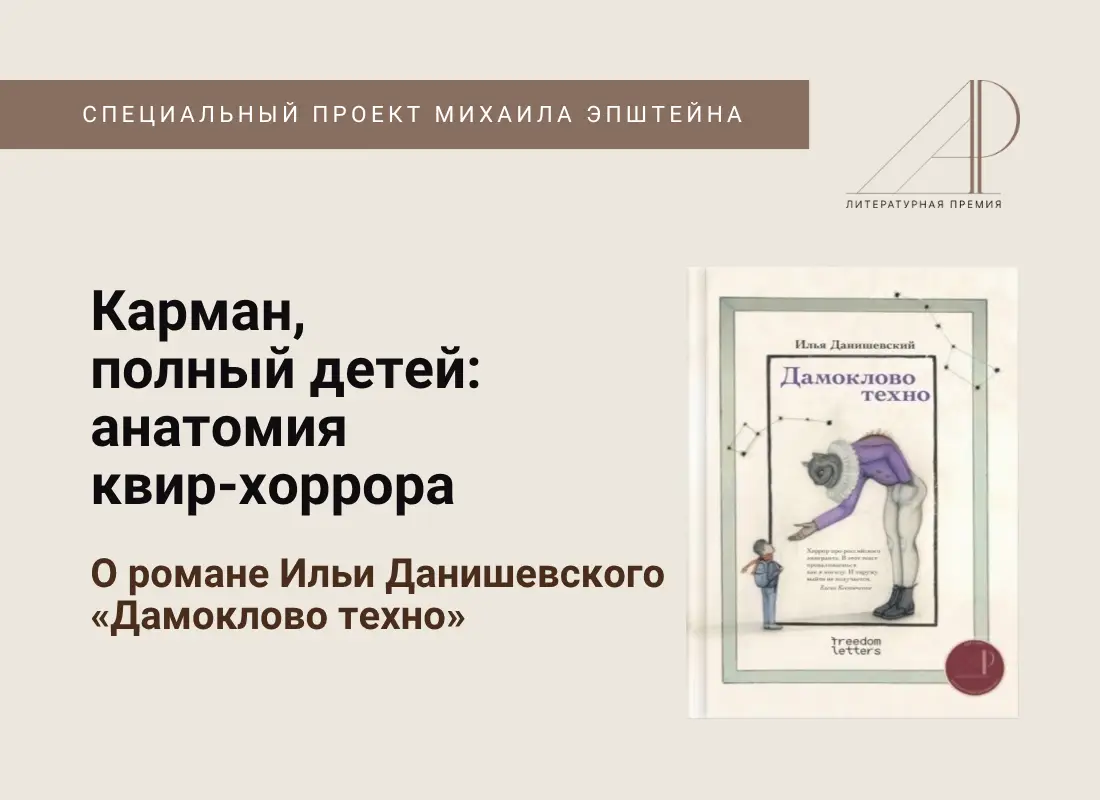
The Word to Claude. A Special Project by Mikhail Epstein
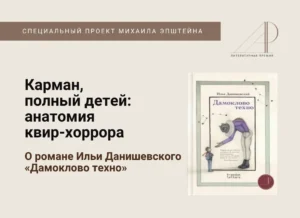
Damocles Techno is a novel that resists retelling. Formally, it is about a Moscow artist, Max, who receives a residency in a German castle near Leipzig, meets a local guy on Grindr nicknamed “catman” because his profile picture is a cat, falls in love, lives through his father’s death, drinks, smokes weed, and has sex against the backdrop of a Soviet bomb-monument. But this is only the surface. Beneath it lie the Brothers Grimm in their original cruelty, the computer game Fear & Hunger with its demon Pocketcat, who accepts children as payment, and the mythology of the “Tower of Augurs,” a refuge where the Paper Sinner takes one child each year.
Danishevsky uilds the text as a palimpsest. The first layer is realistic: the art residency, Grindr, alcohol, sex, the father’s death from cancer. The second is fairy-tale: the Brothers Grimm, where Cinderella kills her stepmother and the sisters cut off their toes. The third is ludic: Fear & Hunger, Silent Hill, Berserk. The fourth is mythological: the Tower of Augurs, the Paper Sinner, Pocketcat. These layers do not illustrate one another, they interfere with one another, creating an effect impossible in any of them taken separately.
The central image is the “pocket.” The word appears on the first pages: “some pockets are deeper than others.” Pocketcat is a cat-with-pockets. The pocket is at once a vagina, a wound, a hiding place, a trap, and an underworld. Max has a “deep pocket” where the sound of the news does not reach. Children are hidden in pockets so they can later be fed to the demon. The metaphor unfolds on every level of the text, binding together sexuality, violence, childhood, and death. This is not a symbol but a structural principle: the novel itself is arranged as a system of pockets, one space nested inside another.
The structure is fractal. The main plot is interrupted by inset stories: the “tin sisterhood” of girls from the refuge; the monologue of an inmate of the Tower of Augurs; the final fairy tale about a boy whose mother sends him into the forest to Kittie-with-Pockets when war begins. Each inset is not an illustration but a parallel dimension with its own laws. Yet all of them are linked by a shared logic: children as currency with which adults pay for their desires. Cinderella cuts off her toes. A mother gives her sister to a demon. This is the economy of the text, harsh, consistent, inhuman.
Felix, the catman, a rural German with a gold tooth, is the key figure of the novel. He exists simultaneously in several registers: realistic, a guy from Grindr who cooks pike and reads Tarot; fairy-tale, the demon Pocketcat; erotic, an object of desire. Danishevsky does not resolve this ambivalence, he cultivates it. Felix says, “Being dead is great.” He proposes that they “adopt a child,” and it remains unclear whether this is a euphemism, a metaphor, or a literal offer of sacrifice. This uncertainty is not a flaw but a device: the reader can never occupy a stable position.
Danishevsky’s style is nervous, oversaturated, breathless. Sentences pile up, languages mix, Russian, German, English, and cultural references proliferate. This is not erudition for show, it is the mode of existence of the text itself: a world where everything is connected to everything else, where Grimm flows into Fear & Hunger, and orgasm into a thought of the father’s death. The pornographic scenes are written in the same language as the fairy tales, producing an effect of defamiliarization: the body becomes text, and the text becomes body.
The ending is a fairy tale about a boy whose mother sends him into the forest when war begins. Kittie-with-Pockets demands payment: “Give me your mother.” The boy stands before a choice. The text breaks off. This is not an open ending in the traditional sense, it is a refusal of resolution, rhyming with the entire structure of the novel: pockets do not close, demons do not disappear, fairy tales do not end with “happily ever after.”
Damocles Techno is an ambitious formal experiment. Danishevsky creates a hybrid not previously seen in Russian literature: queer prose plus horror plus fairy tale plus gamer culture. It is a risky combination, and not all of it works equally well. But when it does work, the text achieves a rare intensity: the reader physically feels nausea, arousal, fear, sometimes all at once.
Central thesis / situation: An artist falls in love with a man who may or may not be a demon from a computer game or a Brothers Grimm fairy tale. Reality and myth are indistinguishable. Children are currency. The pocket is the structural principle of the world.
CORE PARAMETERS
A₁ — Unexpectedness of the situation: 9/10A multi-layered paradox. Genre inversion: a love story turns out to be horror, horror turns out to be fairy tale, fairy tale turns out to be pornography. Lover equals demon equals game character equals fairy-tale villain, while perhaps remaining simply a guy from Grindr. Children as currency is a paradox carried through the entire text without moralizing. The title, Damocles Techno, is itself an oxymoron that sets the tone: threat plus dance, sword plus music. Formal novelty: Russian prose has not seen this kind of hybrid before.
A₂ — Realization in action: 7/10The image of the “pocket” runs through the whole text, from the first page to the finale. The fractal structure works: the inset stories do not illustrate but expand. The linguistic play is consistent. Yet there is excess: some pornographic scenes repeat without development, the philosophical conversations drag, and the references are at times self-serving. The text would benefit from editing, though perhaps excess is part of the design.
B — Credibility: 8/10The realistic layer is convincing: the art residency, Grindr, alcohol, the father’s death, all of it is recognizable and psychologically precise. The mythological layer is internally consistent: Pocketcat from Fear & Hunger, Grimm’s fairy tales, and the Tower of Augurs form a coherent system with its own logic. The main achievement is the seamlessness of the transitions between layers: the reader does not always know which dimension they are in, but this does not irritate, it draws them in. A slight reduction: some elements, such as the literal sacrifice of children, hover at the edge of plausibility even within fairy-tale logic.
MODULATING PARAMETERS
C — Interpositionality: 7/10Max’s voice dominates, but it does not monopolize. There are the monologues of inmates of the Tower of Augurs, Felix’s stories, the final fairy tale in the third person. Felix is not a function but a full character with a history of his own, dead friends, letters from hell, a former Belarusian poet. The ambivalence is never resolved: the reader does not know who is victim, who executioner, who demon, and this is principled. A slight deduction: the queer optics are specific, and some readers may feel excluded.
D — Openness: 9/10The ending is radically open: the boy stands before Kittie-with-Pockets, the choice is not made. But this is not evasion, it is the structural principle: in a world of pockets, nothing closes. The question “what is real?” remains unanswered, and rightly so, because the question itself is false: in the logic of the text, everything is real. Multiple interpretations are possible, and none is exhaustive.
E — Rhythm: 6/10Uneven. The strong scenes are the first meeting with Felix, sex on the bomb, the final fairy tale, and the monologue about the Tower of Augurs. The weaker stretches are the conversations about Tarot and ecology, the repetitive pornographic episodes, and some insertions from encyclopedias. There is a crescendo, the final fairy tale works as a climax, but the road toward it is winding. At times the text feels under-edited.
F — Resonance: 8/10The themes are universal: love and violence, childhood and sacrifice, reality and myth, desire and fear. The fairy-tale code is understandable to any reader. The gamer references narrow the audience somewhat, but Fear & Hunger is well enough known to resonate. The pornographic element is not a limitation but a tool: the text acts physically upon the reader, which is rare. The potential for translation is high: queer horror is a genre in demand in European literature.
CALCULATION
Core = (A₁ + A₂) × B / 10 = (9 + 7) × 8 / 10 = 12.8
M = C + D + E + F = 7 + 9 + 6 + 8 = 30
Modulator = 1 + M/40 = 1 + 30/40 = 1.75
II = 12.8 × 1.75 = 22.4
VERDICT: Excellent (range 20–30)
Damocles Techno is a formally inventive, stylistically vivid, emotionally intense text. Its high degree of unexpectedness (A₁ = 9) and radical openness (D = 9) compensate for the unevenness of its rhythm (E = 6). This is a new word in Russian prose, a genre hybrid that did not previously exist.
Comparative Context
Within the shortlist, Damocles Techno (22.4) takes second place after Buksha’s A Little Paradise (24.6). Both texts work through trauma by means of fiction, both use multilayered structures, and both refuse moralizing. The difference lies in the type of writing: Buksha is polyphonic and austere, Danishevsky monologic and excessive. Buksha creates a mythology of place, Danishevsky a mythology of the body.
Compared with Beloded’s Morning Was an Eye (21.6), both are radical experiments and both explore dark zones. Beloded works through polyphony of voices, Danishevsky through a palimpsest of cultural layers. Beloded is darker, Danishevsky more erotic.
From the point of view of the goals of the Dar Prize, translation into European languages, Damocles Techno has high potential. Queer horror is a genre in demand, the cultural references, Grimm, Silent Hill, are universal, and the style is translatable. The text could find an audience among readers of Dennis Cooper, Marion Fayolle, and Samanta Schweblin.
See also:

What Are the Objectives of the Award?

The primary goal of the Award is to support authors and promote Russian-language literature worldwide. We welcome all who write and read in Russian, regardless of citizenship or place of residence. We aim to foster a Russian-language culture free from political and imperial influences.
How Is the Award Process Conducted?
The Prize is awarded annually. The Jury holds a vote in which each member selects between one and three works. The author whose work receives the highest number of votes becomes the winner.
What Awards Are Provided?
The Prize winner receives a grant for the translation of their work into English, French, and German.
When Does the Submission Period for the Competition Start and End?
Submissions for the third season of the prize will open on July 15, 2026, and close on October 15, 2026.
When will the list of finalists and winners be announced?
On January 20, 2027, the Council of Experts will announce the shortlist. The Independent Jury will announce the winner on May 25, 2027.
What are the conditions for the nomination of a book for the award
Works published in 2025 are eligible for the third season of the competition. Eligible works (novels, novellas, short story and essay collections, documentary prose) may have been published either as standalone editions or in literary magazines. Nominations may be submitted by publishing houses and magazine editorial boards, as well as by the authors themselves or third parties (with the author's consent and written confirmation). Texts must be submitted for consideration in electronic format. The DAR Prize is open to all authors. Given the prize's main goals — promoting contemporary Russian-language literature outside of Russia — and the nature of the award itself (a translation grant), priority will be given to authors whose works have not previously been translated into English, French, or German.