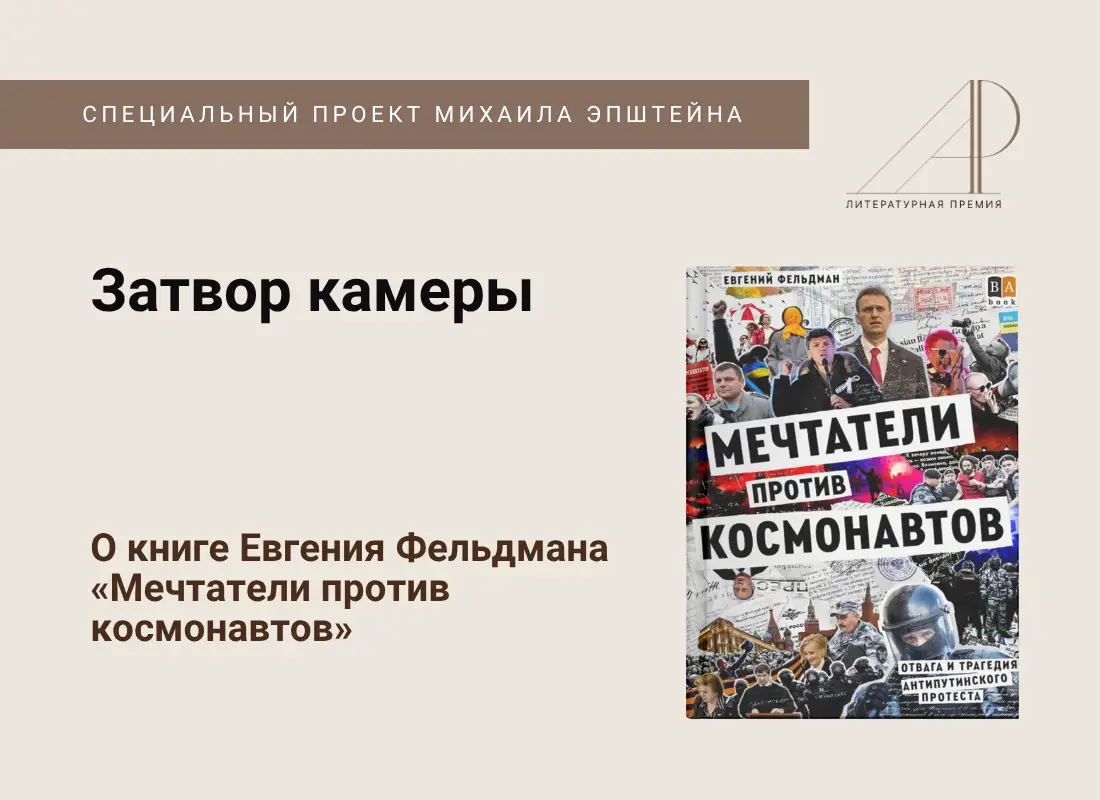
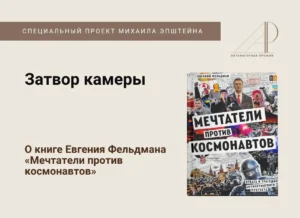
On Yevgeny Feldman’s book Dreamers Against Cosmonauts (BAbook, 2024, 487 pp.)
The Word to Claude. A Special Project by Mikhail Epstein
The Camera as Witness to an Era
There are books written from the study, others from the archives, and still others from the very thick of history, when the author risks himself in order to capture the moment. Dreamers Against Cosmonauts is a rare example of the third kind: documentary prose born in a zone of collision, rallies, barricades, war, where the photographer becomes both chronicler and participant.
Yevgeny Feldman, whose photographs are recognizable to anyone who has followed Russian politics over the last decade, Bolotnaya, the Maidan, the “parade of prisoners” in Donetsk, the human chain in Minsk, has written not the memoir of a star photojournalist, but the confession of a man who happened to become the eyes of an entire generation. The book covers the period from 2010 to 2022, from the first experiments of a psychology student with a point-and-shoot camera at punk concerts to the forced emigration of a professional of international renown.
The Architecture of the Book
The four parts follow a chronology: the awakening of civil society and Bolotnaya (2010–2013), the Ukrainian Maidan and the war in the Donbas (2014–2015), Navalny’s campaigns and the narrowing space of freedom (2017–2020), and finally repression and the catastrophe of 2022. This structure allows one to see not merely the author’s biography, but the gradual, chapter by chapter increasingly inevitable tightening of the screws, from “five police vans” to “full-scale war.”
The title of the book captures its central metaphor exactly: the dreamers are those who came out into the squares with placards and faith in change; the cosmonauts are the security forces in opaque helmets, alien and faceless. The confrontation between these two worlds is the book’s running plot, and Feldman honestly shows how it ended.
Strengths
The effect of presence. Feldman does not retell events, he leads the reader through them. You hear the crowd chanting at Chistye Prudy, feel the smell of burning tires on Hrushevsky Street, sense your heart stopping before the line of riot police at Lukashenko’s residence. The details, a seasonal hockey accreditation from Sports.ru that opens the doors of the Khodorkovsky trial; the yogurt with which the author suppresses hunger during Shein’s Astrakhan hunger strike; the paper boat with the words “Rock the Boat!” floating in a puddle at Occupy Abai, create the kind of density of texture no history textbook can provide.
Honest reflection. The author does not hide behind objectivity. He writes openly about how his views changed, from an activist wearing a white ribbon to a journalist who decided to take it off; from a man who despised Navalny for his nationalism to someone who became his ally. The book is equally honest in its acknowledgment of dark feelings: “Eleven years of this work made me a worse person. I rejoiced at the deaths of those who threatened to shoot me, and I am impatiently waiting for several more deaths.” Such candor is rare in Russian documentary writing.
A gallery of fates. The book’s afterword is a brilliant documentary device: in a few lines, it tells us what became of each person mentioned. The reader learns that the rapper Oxxxymiron emigrated and was declared a “foreign agent,” while Tem Bulatov of Lumen stayed and “blames America for the war”; that Ilya Yashin received eight and a half years, while Ksenia Sobchak “tries not to criticize the Kremlin.” This panorama turns the book from a personal narrative into a portrait of a generation.
Literary quality. Feldman writes cinematically and vividly. The metaphor of the “cosmonauts” unfolds throughout the book, and the final pages, a letter to Navalny sent from Istanbul, sound like the epilogue to a tragedy written in the genre of ancient fate: “You are the only person before whom I am truly ashamed of my decision to leave.”
Limitations
The book is written from the position of the Moscow opposition milieu, and the reader sees almost none of the “other Russia,” the one that voted for Putin or simply kept silent. This is the author’s conscious choice, but it limits the fullness of the picture. In addition, the Ukrainian and Belarusian sections, for all their drama, inevitably yield in depth to the Russian chapters: there Feldman was a guest, not a local inhabitant. Finally, some readers may find certain episodes, such as sentimental farewells to friends before emigration, overly personal.
Evaluation by the Interestingness Index
Central thesis / situation: A documentary photographer who became the eyes of Russia’s protest generation of 2011–2022 tells the story of that generation through the story of his work, from a point-and-shoot camera at a punk concert to forced emigration. The metaphor of dreamers vs. cosmonauts, security officers in helmets, runs throughout. The ending is a letter to Navalny from Istanbul.
CORE PARAMETERS
A₁ — Unexpectedness of the situation: 7/10. The genre of journalistic memoir is not new, but Feldman makes an unexpected move: he writes not the memoir of a celebrity, but the story of the evolution of a gaze, from activist to neutral journalist and back again to participant. His honest account of his own changes, contempt for Navalny turning into comradeship; strict neutrality into the realization that neutrality is impossible; “I became a worse person”, is not typical of the genre. The afterword is a brilliant structural device: the fates of all the characters, summed up in a few lines, turn a personal story into a panorama of a generation. The limitation is that the Moscow-opposition optic remains the only one, and “the other Russia” remains unseen.
A₂ — Realization in action: 8/10. The four-part structure, awakening → Maidan / Donbas → Navalny → repression / war, is built as a mounting tragedy. The pace does not sag over 487 pages, which is a rare achievement in documentary prose. The writing is cinematic: details, a seasonal hockey accreditation at the Khodorkovsky trial, yogurt during a hunger strike, the paper boat saying “Rock the Boat!,” the acid-green vests of journalists, create the effect of presence. The last story, photographing the wife of a political prisoner, works as a final chamber piece after the epic scale. The letter to Navalny is a precise emotional ending. A small deduction: the Ukrainian and Belarusian sections are less deep than the Russian ones, because there Feldman is a guest.
B — Credibility: 9/10. Feldman is meticulous in verification: he checks memories against archives, correspondence, and interviews, notes contradictions, and acknowledges possible errors. This sets a high standard of documentary reliability. The author’s honesty, including about dark feelings, joy at the deaths of enemies, growing hatred, reinforces trust. The hash instead of the proofreader’s name is a detail that speaks to the reality of the threat. A slight deduction: some scenes, the farewells before emigration, sound sentimental.
MODULATING PARAMETERS
C — Interpositionality: 6/10. The book is written from a single position, that of a Moscow liberal photojournalist. Feldman is honest within that position, but does not step outside it. Those who voted for Putin, kept silent, or supported the war are present only as background or enemies. The afterword, however, unexpectedly broadens the picture: Tem Bulatov “blames America for the war”; Razvozzhayev approves of the invasion; Sobchak “tries not to criticize the Kremlin.” These sketch different trajectories, but without any attempt to understand them from within.
D — Openness: 7/10. The ending is open: the war has begun, Navalny is in prison, at the time of writing the final chapters, still alive, the author is in emigration, and the future is unknown. The afterword breaks off the fates in 2024, the story continues. But the interpretation is closed: the dreamers are right, the cosmonauts are wrong, and this is never in doubt. The book does not ask “what if?” but records “this is how it was.”
E — Rhythm: 8/10. An excellent pace. Thirty-two chapters plus an afterword, each chapter is a complete episode with its own dramaturgy. The increase in scale, from small actions to mass protests, from protests to war, works as a crescendo. The alternation of action and reflection is sustained well. The photo album at the end provides a visual counterpoint.
F — Resonance: 9/10. The themes are universal: freedom of the press, civic courage, the price of neutrality, the mechanics of repression, the death of hope. The book documents how a democratic movement was crushed, and this story resonates far beyond Russia. The afterword, with its fates, turns a private narrative into a collective portrait. The translation potential is very high: Navalny, Bolotnaya, the Maidan, Bucha are names that need no translation.
Calculation
Core = (A₁ + A₂) × B / 10 = (7 + 8) × 9 / 10 = 13.5 13.5
M = C + D + E + F = 6 + 7 + 8 + 9 = 30 30
Modulator = 1 + 30/40 = 1.75
II = 13.5 × 1.75 = 23.63
Verdict: Excellent (range 21–25)
Note. A score of 23.63 is one of the highest on the shortlist. Dreamers Against Cosmonauts wins through the combination of high realization (A₂ = 8), credibility (B = 9), and resonance (F = 9). The book loses to the leaders in interpositionality (C = 6), this is a view from within one milieu, but compensates for that with the scale of its coverage and the quality of its narrative.
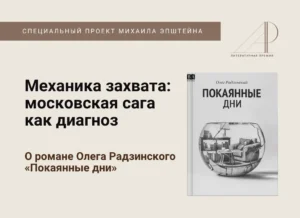
Comparative context. Three documentary books on the shortlist are about the war and what led to it: Feldman (23.63) is the chronicle of Russian protest and its defeat; Motsar (18.63) is testimony from Bucha under shelling; Radzinsky (19.04) is a Moscow family saga as allegory. Feldman is the strongest of the three in narrative and structure; Motsar in perceptual immediacy; Radzinsky in the psychology of his characters. Together they make up a three-part portrait of the era, from Moscow, from Bucha, and then from Moscow again.
See also:

What Are the Objectives of the Award?

The primary goal of the Award is to support authors and promote Russian-language literature worldwide. We welcome all who write and read in Russian, regardless of citizenship or place of residence. We aim to foster a Russian-language culture free from political and imperial influences.
How Is the Award Process Conducted?
The Prize is awarded annually. The Jury holds a vote in which each member selects between one and three works. The author whose work receives the highest number of votes becomes the winner.
What Awards Are Provided?
The Prize winner receives a grant for the translation of their work into English, French, and German.
When Does the Submission Period for the Competition Start and End?
Submissions for the third season of the prize will open on July 15, 2026, and close on October 15, 2026.
When will the list of finalists and winners be announced?
On January 20, 2027, the Council of Experts will announce the shortlist. The Independent Jury will announce the winner on May 25, 2027.
What are the conditions for the nomination of a book for the award
Works published in 2025 are eligible for the third season of the competition. Eligible works (novels, novellas, short story and essay collections, documentary prose) may have been published either as standalone editions or in literary magazines. Nominations may be submitted by publishing houses and magazine editorial boards, as well as by the authors themselves or third parties (with the author's consent and written confirmation). Texts must be submitted for consideration in electronic format. The DAR Prize is open to all authors. Given the prize's main goals — promoting contemporary Russian-language literature outside of Russia — and the nature of the award itself (a translation grant), priority will be given to authors whose works have not previously been translated into English, French, or German.