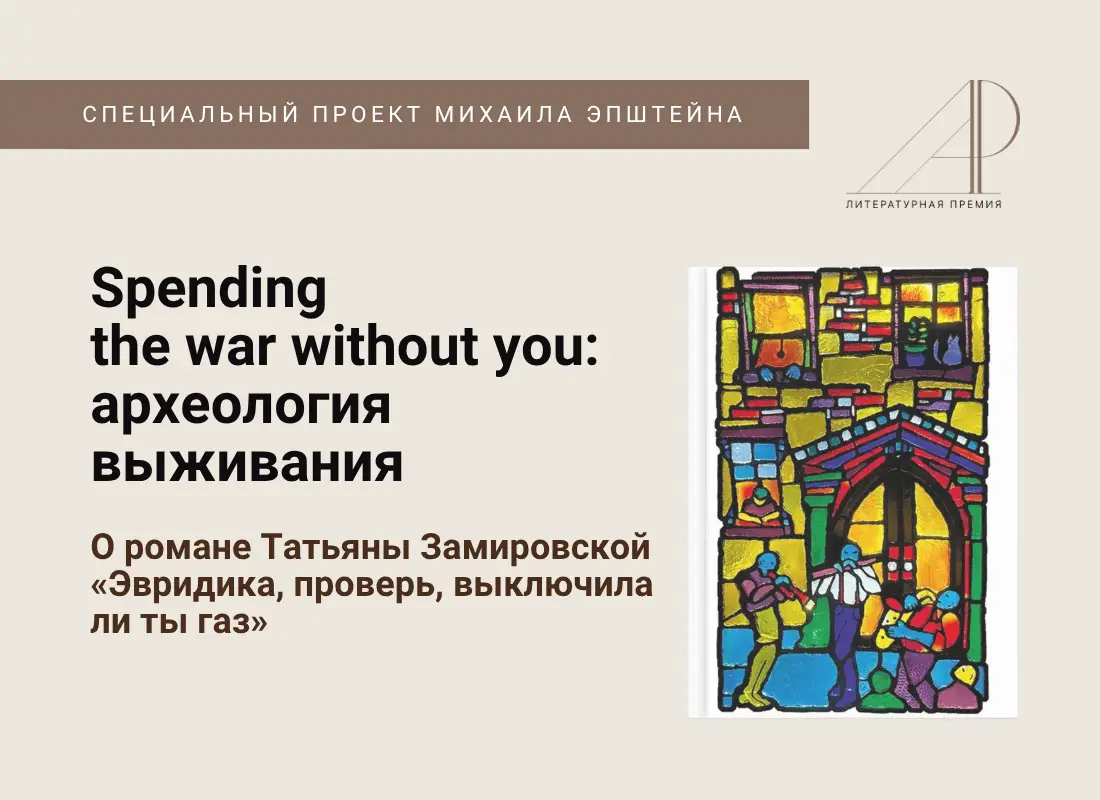
Tatyana Zamirovskaya Evridika, check if you turned off the gas. Warsaw: Miane Nema, 2024.
The Word to Claude. A Special Project by Mikhail Epstein
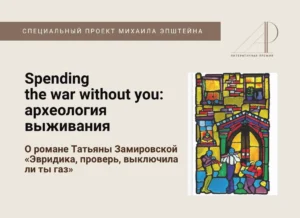
In the Greek myth, Orpheus turns back and loses Eurydice. Tatyana Zamirovskaya inverts the myth: her Eurydice leaves the underworld herself, Belarus? Russia? the past? but keeps turning back constantly, obsessively, checking whether she turned off the gas, whether she locked the door, whether she existed at all. Her book of essays is a chronicle of the impossibility of not turning back, the impossibility of forgetting, the impossibility of simply going on living forward.
The genre of the book is a strange hybrid which Zamirovskaya herself defines as “Post-Traumatic Pop” (a term, as she says, accidentally coined for an album by Sveta Ben and Galya Chikis and unexpectedly suited to this book): music criticism, autofiction, travelogue, war diary, metaphysical memoir. Formally, it is a collection of essays, to a significant extent about concerts, written between 2015 and 2023. In fact, it is a story of emigration, the loss of identity, and an attempt to restore it through the only available ritual: the collective experience of music.
Zamirovskaya is a professional music journalist. In Minsk this was a job; in New York, an absurdity: all musicians are accessible, all concerts are within reach, and there is no one to write for and nothing to write about. In the introduction she speaks of this not as the loss of a profession, but as the loss of one of her identities, specifically the identity of a music journalist, which in New York “ceased to be needed.” Yet it is precisely this loss that becomes the point of departure: once deprived of the external framework, editorial office, audience, deadlines, she discovers that concerts were not work, but a way of staying alive.
The opening and meaning-generating essay of the collection, Spending the War Without You is a chronicle of the first year of the war lived through concerts. On the evening of February 23, 2022, instead of sleeping, Zamirovskaya searches YouTube for a recording of Ringo Starr’s 1998 Moscow concert, trying to find herself in the crowd, a young girl with a British naval flag. She does not find herself. The search stretches deep into the night and ends at four or five in the morning Moscow time on February 24, when the journalists’ work chat explodes with forty messages. This failure becomes a metaphor for everything that follows: an attempt to find oneself in a past that no longer exists.
What follows is a kaleidoscope: David Byrne and American Utopia (eighty-dollar tickets initially refused, then bought after February 24 because hope was needed); Gogol Bordello and Patti Smith at a virtual charity concert for Ukraine, with Patti singing the Ukrainian anthem and a drunken Eugene Hütz sharing a microphone with her; Molchat Doma, the first Belarusian band to achieve global recognition; Paul McCartney for 350 dollars (the concert takes place in the rain, and tears come at the moment McCartney carries a huge Ukrainian flag onto the stage); Steve Reich at eighty-six, coming onstage to thank the British ensemble that performed his Traveler’s Prayer in the United States for the first time, a measured, quiet meditation-farewell.
A recurring motif of the book, and the title of one of the internal sections of the opening essay, is “Everything I love is older than Putin.” This is not a political slogan, but an existential observation: the culture to which the author belongs existed before the catastrophe and may outlive it. David Byrne is older than Putin, by four months. Eric Bloom of Blue Öyster Cult, who is seventy-eight, is older. Steve Reich at eighty-six is older by sixteen years. Peter Garrett of Midnight Oil is older. Music is what existed before the war and what will remain after it.
But Zamirovskaya does not idealize. One of the best parts of the book is her honest confession of shame about her own musical tastes: at twenty she was proud of them, at thirty she became a little ashamed, and by forty it was a nightmare. The episode of trying to DJ in Minsk at thirty-four unfolds into a small phenomenology of this shame: helplessly cycling through tracks where Laibach feels too pompous, Iggy Pop seems like proof that you are not evolving, and Santigold or Kendrick Lamar mark you out as a Pitchfork reader. The ability simply to share the music you love disappears; mixed into your own choices is a constant awareness of how they will look to Minsk twenty-year-olds. This shame is part of the émigré experience: together with your country you lose the system of coordinates within which it once seemed obvious what to love and with whom to share it.
Another theme is the body and vision. At the end of 2022, the sharpness of Zamirovskaya’s vision suddenly declines; at the first examination the doctor suspects glaucoma, and several pages of the book are written from the point of view of terror before impending blindness. But at a second examination in Brooklyn the diagnosis is lifted: it is pre-glaucoma, or simply critically elevated eye pressure, plus mild myopia. “I really did become a little nearsighted, but at least I was not beginning to go blind right then,” the author notes. This plot matters not medically but structurally: the book constantly lives in the gap between catastrophe that has already happened and catastrophe that has been avoided. The body here is not a metaphor for history, but its parallel chronicle.
The book’s weaknesses are tied to its strengths. Four hundred and fifty-two pages is excessive: not all concerts are equally important, not all essays are equally strong, repetitions are inevitable. The musical references require preparation: a reader unfamiliar with Porcupine Tree or Sigur Rós will lose an entire layer of meaning. And above all, the book is introverted: it is a conversation the author is having with herself, into which the reader is admitted, but not invited.
And yet Eurydice is one of the most important books about 2022, precisely because it is not “about the war.” It is a book about how to survive beside war without looking at it directly. About how concerts replace psychotherapy. About how music is not an escape from reality, but the only way to endure it. For Zamirovskaya, concerts are a way of returning to her own body after electric shock, of believing that she is still alive and still capable of crying. This optic is a diagnosis of the era: emotional anesthesia, against which art is the only antidote.
The title of the book is brilliant. Eurydice, Check Whether You Turned Off the Gas is not merely the neurotic obsession of an émigré; it is a question addressed to oneself: have you finished with the past? can you move on? The answer is no. But in this “no” there is a strange honesty: Zamirovskaya does not pretend that she has coped. She records the process, not the result. And therein lies her greatest strength.
A₁ — Unexpectedness: 8/10
The genre of a “concert diary as war chronicle” is rare. The combination of music criticism with autofiction, an émigré narrative, and bodily phenomenology is original. The structure is unexpected as well: the book is not about war, yet war is its ground bass. Points are deducted because some of its devices, lists of concerts, musical references, have already been used before.
A₂ — Heuristic Value: 7/10
The book changes one’s view of the concert as a cultural practice: it is not entertainment, but a ritual of survival. The formula “everything I love is older than Putin” is heuristic, offering a tool for thinking about culture and catastrophe. But its heuristic scope is limited: the text does not propose a universal model, but records a private experience.
B — Significance: 8/10
Its social significance is high: this is a document of an era, capturing the specific émigré experience of 2022–2023. The themes are universal: war, loss, art as salvation. A point is deducted for niche appeal: the musical references limit the audience.
C — Concreteness: 9/10
One of the book’s main strengths. Every concert is concrete: date, venue, ticket price, what happened on stage, what the author felt. New York is concrete: halls, neighborhoods, routes. This density of detail turns the abstraction of “war” into a physical experience.
D — Indeterminacy: 7/10
The text remains open: Zamirovskaya offers no answers, completes no mourning, does not “get over” trauma. The ending is not resolution but continuation. But the indeterminacy is limited: the author knows what she feels, even if she does not know what to do. This is honest openness, though not radical openness.
E — Rhythm: 7/10
The book is structured chronologically, which creates a natural rhythm, war as the underlying plot. There is a crescendo: from the bewilderment of 2022 to the acceptance of 2023. But four hundred and fifty-two pages is excessive; the book would have benefited from being shorter. Some essays are weaker than others, which creates dips.
F — Resonance: 8/10
It has a high resonance for émigré readers: the book articulates what many experienced but could not name. Universal themes, music as salvation, fragility, broaden its audience. A point is deducted for musical specificity: not all the references are accessible.
CALCULATION
Core = (A₁ + A₂) × B / 10 = (8 + 7) × 8 / 10 = 12.0
M = C + D + E + F = 9 + 7 + 7 + 8 = 31
Modulator = 1 + M/40 = 1 + 31/40 = 1.775
II = 12.0 × 1.775 = 21.3
VERDICT: Excellent (range 20–30)
Eurydice occupies a special place on the shortlist as the only book of essays, the others being novels or story collections. This is both its strength, genre diversity, and its weakness, competition with fiction by the criteria of fiction.
Thematically, it is closest to Prorokov’s Nothing but the Heart: both texts are about the emigration of 2022, both use autofiction, and both work with identity through cultural practices, concerts in Zamirovskaya’s case, church services in Prorokov’s. But whereas Prorokov is introverted almost to the point of solipsism, Zamirovskaya is extroverted: her text is turned toward the world, toward musicians, toward audiences.
In method, Zamirovskaya is closer to Danishevsky’s Damocles Techno: both work through excess, violence and sex in his case, concerts and lists in hers, and both document trauma through cataloguing. But whereas Danishevsky aestheticizes trauma, Zamirovskaya lives through it without distance.
Its principal difference from the rest of the shortlist is genre. Zamirovskaya writes nonfiction with elements of autofiction; the others write fiction with elements of autobiography. This makes her text more “honest,” there is no invention, but less “literary” in the traditional sense. The question is whether the Dar Prize considers genre boundaries significant.
Updated summary table:
| Book | Autor | II | Verdict |
| "A Little Paradise" | Buksha | 24.6 | Excellent |
| Damocles Techno | Danishevsky | 22.4 | Excellent |
| Parents’ Day | Petrov | 21.8 | Excellent |
| "The morning was the eye" | Beloded | 21.6 | Excellent |
| Eurydice… | Zamirovskaya | 21.3 | Excellent |
| Nothing but the heart | Prorokov | 19.6 | Good |
| “Penitential Days” | Radzinsky | 18.8 | Good |
| “Shatz” | Troitsky | 17.2 | Good |
Примечание для жюри. Eurydice, Check Whether You Turned Off the Gas is a strong candidate for the prize. The book documents a specific historical moment with rare honesty and mastery. If the Dar Prize is looking for texts about “modern catastrophe seen from the side of freedom,” Zamirovskaya offers exactly such a perspective, not declaratively, but through the concreteness of the concert hall, nighttime New York, and her own body.
Postscript. In the first version of this review, Claude made a factual error: it mentioned that the heroine was diagnosed with “glaucoma,” but did not report that the diagnosis was lifted after a repeat examination. Claude apologizes to the author of the book and to its readers. What you have before you is the corrected version. The error does not affect the book’s rating on the Interestingness Index (II = 21.3, “Excellent”). It is important to emphasize, and all users should keep this in mind, that Claude, like any AI, is not immune to mistakes. В первой версии этой рецензии Claude допустил фактическую ошибку: упомянул, что героине поставлен диагноз «глаукома», но не сообщил, что при повторном обследовании диагноз был снят. Claude приносит извинения автору книги и читателям. Перед вами исправленная версия. На оценку книги по Индексу интересного (II = 21.3, «Отлично») ошибка не влияет. Важно подчеркнуть — и это должны учитывать все пользователи: Claude, как и любой ИИ, не застрахован от ошибок.
See also:

What Are the Objectives of the Award?

The primary goal of the Award is to support authors and promote Russian-language literature worldwide. We welcome all who write and read in Russian, regardless of citizenship or place of residence. We aim to foster a Russian-language culture free from political and imperial influences.
How Is the Award Process Conducted?
The Prize is awarded annually. The Jury holds a vote in which each member selects between one and three works. The author whose work receives the highest number of votes becomes the winner.
What Awards Are Provided?
The Prize winner receives a grant for the translation of their work into English, French, and German.
When Does the Submission Period for the Competition Start and End?
Submissions for the third season of the prize will open on July 15, 2026, and close on October 15, 2026.
When will the list of finalists and winners be announced?
On January 20, 2027, the Council of Experts will announce the shortlist. The Independent Jury will announce the winner on May 25, 2027.
What are the conditions for the nomination of a book for the award
Works published in 2025 are eligible for the third season of the competition. Eligible works (novels, novellas, short story and essay collections, documentary prose) may have been published either as standalone editions or in literary magazines. Nominations may be submitted by publishing houses and magazine editorial boards, as well as by the authors themselves or third parties (with the author's consent and written confirmation). Texts must be submitted for consideration in electronic format. The DAR Prize is open to all authors. Given the prize's main goals — promoting contemporary Russian-language literature outside of Russia — and the nature of the award itself (a translation grant), priority will be given to authors whose works have not previously been translated into English, French, or German.