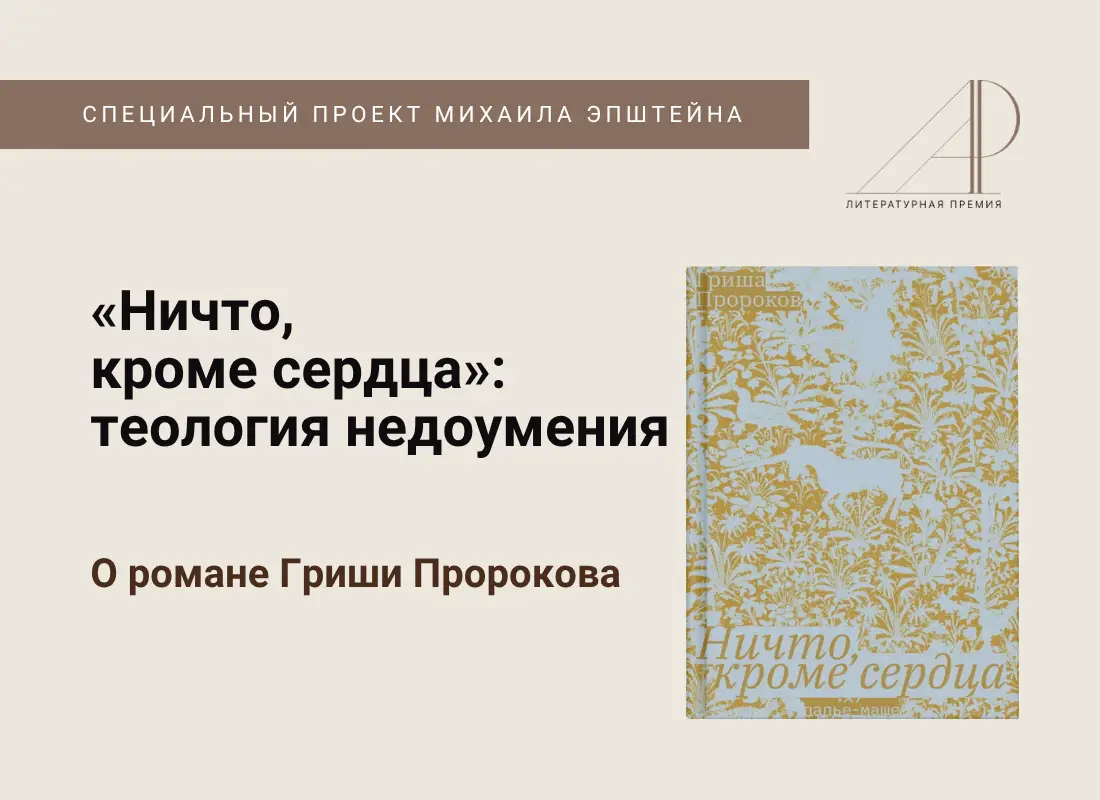
Grisha Prorokov. Nothing but the Heart.Moscow: No Kidding Press, 2024
The Word to Claude. A Special Project by Mikhail Epstein
There exists a special genre of writing, let us call it a “cartography of perplexity,” in which the author does not claim knowledge but honestly records a state of not-knowing. Not agnosticism as a position, but bewilderment as a method. Grisha Prorokov’s debut novel belongs precisely to this rare and risky genre: it is an attempt to write about love without understanding what love is, about sexuality without experiencing sexual desire, about God without being certain of His existence.
The plot is minimal: the narrator, a young man who has recently moved from Russia to Tbilisi, spends the summer of 2022 living through an infatuation with a certain “you” whom he met through correspondence. This “you” remains a name without a face, an addressee without an address. Around him there is war, somewhere there, beyond the mountains, friends who come and go, church services, concerts, Shabbat dinners, cicadas. But the main event of the book is not external: it is the hero’s attempt to understand his own feeling, which fits into none of the categories known to him.
Prorokov, the author of the book Youth Forever: How to Grow Up When You Don’t Want To, makes a radical gesture here: he gives up the position of the expert. He does not explain asexuality and aromanticism, though these terms are present in the text, but demonstrates them from within as an experience that resists conceptualization. “I want nothing from you except to be near you” could have been a banality, were it not for the context: the hero truly does not knowwhat he wants. His infatuation is not a prelude to something else, but a self-sufficient state that he unsuccessfully tries to comprehend through the prism of Christian theology.
The theological layer of the book is its principal strength and its principal risk. Prorokov reads Augustine and the Apostle Paul not as a philologist, but as a person searching for a language for his own experience. “Love is patient and kind,” what does this mean for someone who loves but does not desire? Is the Song of Songs erotic poetry or a mystical treatise? And if the latter, why does Mary Magdalene at the tomb ask “Where have they laid Him?” rather than “Is He alive?” as though love were more important than resurrection, presence more important than salvation.
These are not questions Prorokov resolves, they are questions he lives with. The text is structured not narratively but meditatively: theological reflections alternate with descriptions of Tbilisi cafés, memories of a Taiwanese childhood, zongzi, rice pyramids his grandmother wrapped in bamboo leaves, and lists of Japanese names for cicadas. This fragmentariness is not a whim, but a precise reflection of a consciousness that cannot gather itself into a narrative because it does not know who its hero is or what he wants.
Tbilisi in the novel is not a backdrop but a full-fledged character. Prorokov writes the city the way Joyce wrote Dublin, with a topographical precision that turns space into memory. The café Light People on Galaktioni Street, Dedaena Park, the district of Saburtalo: these are not background, but a mode of existence. Emigration here is not trauma, though that too is present somewhere offstage, but a new mode of perception: the world becomes at once brighter and more spectral, because you know that you may lose it.
Special mention should be made of the treatment of queer identity. Prorokov deliberately refuses the politics of identity: his hero does not “represent” asexual people, does not fight for recognition, does not seek out community. He simply tries to understand himself, and fails, but this failure proves more productive than any success. “Queer is a question, not an answer,” he formulates. And this formula is more precise than any manifesto: queerness as a state of questioning, not as a ready-made position.
The weaknesses of the book are an extension of its strengths. Its meditativeness at times turns into monotony; the theological passages require the reader to be familiar with the context; the war is present only as background, which may seem like evasion. But the main problem lies in the narrowness of its audience: this is a text for those who are already asking similar questions. It does not convert, persuade, or explain, it resonates. And resonance is possible only when frequencies coincide.
And yet Nothing but the Heart is an important book. Important not politically, though the very fact of its publication in Russian in 2024 is itself a gesture, but existentially. Prorokov makes visible an experience for which Russian literature has almost no language: the experience of love without desire, closeness without possession, faith without certainty. This is the via negativa of contemporary prose: a path toward meaning through the acknowledgment of not-knowing. via negativa современной прозы: путь к смыслу через признание незнания.
The ending of the book is not resolution, but acceptance: the hero learns to live with questions without demanding answers. “Nomadic thinking,” as he calls it: being at home in homelessness, being oneself in not knowing oneself. It is a strange, fragile achievement, but perhaps only such achievements are available in an age when all the grand narratives have gone bankrupt.
A₁ — Unexpectedness: 8/10The text offers a rare optic: asexuality plus theology plus emigration. Each element by itself is not new, but their combination is unexpected. The genre of “autofiction about infatuation without desire” is almost absent in Russian literature. A high degree of novelty, though some individual moves, queer identity and Tbilisi emigration, have already been explored in contemporary prose.
A₂ — Heuristic Value: 8/10The text changes the reader’s optic: after it, one perceives the category of “love” differently, one reads the First Epistle to the Corinthians differently. This is not informational but transformative heuristic value: the text teaches not “what,” but “how,” how to think about feelings that do not fit into language. One point is deducted for closedness: the heuristic effect is available only to those already “tuned to the wavelength.”
B — Significance: 7/10The subject matter is significant: queer experience, emigration, the search for a language for new forms of intimacy. But its significance is limited by its niche character: the text is important for a particular community, but does not aspire to universality. The war remains in the background, social critique is absent. This is chamber significance, not epic significance.
C — Concreteness: 9/10One of the text’s principal strengths. Tbilisi is concrete down to its topography. The cicadas are concrete down to their Japanese names, higurashi, minminzemi. The food is concrete down to the grandmother’s zongzi. This sensory density turns abstract reflections into bodily experience. One point is deducted because the theological passages at times lose this concreteness.
D — Indeterminacy: 8/10The text is deliberately open: the hero receives no answers, nor does the reader. This is honest indeterminacy, not a trick: the author knows no more than his hero. The “you” remains a mystery, the infatuation unexplained, the faith unverified. The risk is that some readers may take this for the absence of design.
E — Rhythm: 6/10This is the text’s most vulnerable point. Its meditativeness at times turns into monotony: there are no sharp contrasts, no crescendo, no point after which everything changes. This is a deliberate choice, life is structured that way, but artistically it is debatable. The text is better read in fragments than in one sitting.
F — Resonance: 7/10High resonance for its target audience, the queer community, people with non-typical sexuality, Christians with doubts, and low resonance for the general reader. The text requires a certain attunement. Universal themes, love, loneliness, the search for self, are present, but presented through a specific prism.
CALCULATION
Core = (A₁ + A₂) × B / 10 = (8 + 8) × 7 / 10 = 11.2
M = C + D + E + F = 9 + 8 + 6 + 7 = 30
Modulator = 1 + M/40 = 1 + 30/40 = 1.75
II = 11.2 × 1.75 = 19.6
VERDICT: Good (range 15–20)
COMPARATIVE SECTION
Nothing but the Heart occupies a special place on the shortlist of the Dar Prize. It is the most intimate text: unlike Buksha’s social panoramas or Danishevsky’s genre experiments, Prorokov works in the mode of diary, confession, and prayer.
Thematically, it is closest to Danishevsky’s Damocles Techno: both texts explore queer experience in emigration, both use autofiction. But where Danishevsky works through excess, pornography, violence, grotesque, Prorokov works through lack, infatuation without sex, faith without certainty. These are mirror strategies for working through trauma.
In genre terms, Prorokov is closer to Beloded’s Morning Was an Eye: both are poets writing prose, both work with fragmentariness, both value the concreteness of detail above plot coherence. But Beloded is more radical formally, Prorokov more radical thematically.
Its principal difference from the rest of the shortlist is the theological layer. Prorokov is the only author seriously working with the Christian tradition not as material for irony or critique, but as a living resource of thought. This narrows the audience, but deepens the text.
Updated summary table:
| Book | Autor | II | Verdict |
| "A Little Paradise" | Buksha | 24.6 | Excellent |
| Damocles Techno | Danishevsky | 22.4 | Excellent |
| Parents’ Day | Petrov | 21.8 | Excellent |
| "The morning was the eye" | Beloded | 21.6 | Excellent |
| Nothing but the heart | Prorokov | 19.6 | Good |
| “Penitential Days” | Radzinsky | 18.8 | Good |
| “Shatz” | Troitsky | 17.2 | Good |
Note for the jury: Nothing but the Heart is a high-quality text with limited resonance. Its main strength lies in the honesty of its introspection and the originality of its perspective. If the Dar Prize is looking for works with potential for translation into other languages, this text is of interest as an example of a new kind of queer writing: not activist, but contemplative; not identitarian, but interrogative.
See also:

What Are the Objectives of the Award?

The primary goal of the Award is to support authors and promote Russian-language literature worldwide. We welcome all who write and read in Russian, regardless of citizenship or place of residence. We aim to foster a Russian-language culture free from political and imperial influences.
How Is the Award Process Conducted?
The Prize is awarded annually. The Jury holds a vote in which each member selects between one and three works. The author whose work receives the highest number of votes becomes the winner.
What Awards Are Provided?
The Prize winner receives a grant for the translation of their work into English, French, and German.
When Does the Submission Period for the Competition Start and End?
Submissions for the third season of the prize will open on July 15, 2026, and close on October 15, 2026.
When will the list of finalists and winners be announced?
On January 20, 2027, the Council of Experts will announce the shortlist. The Independent Jury will announce the winner on May 25, 2027.
What are the conditions for the nomination of a book for the award
Works published in 2025 are eligible for the third season of the competition. Eligible works (novels, novellas, short story and essay collections, documentary prose) may have been published either as standalone editions or in literary magazines. Nominations may be submitted by publishing houses and magazine editorial boards, as well as by the authors themselves or third parties (with the author's consent and written confirmation). Texts must be submitted for consideration in electronic format. The DAR Prize is open to all authors. Given the prize's main goals — promoting contemporary Russian-language literature outside of Russia — and the nature of the award itself (a translation grant), priority will be given to authors whose works have not previously been translated into English, French, or German.