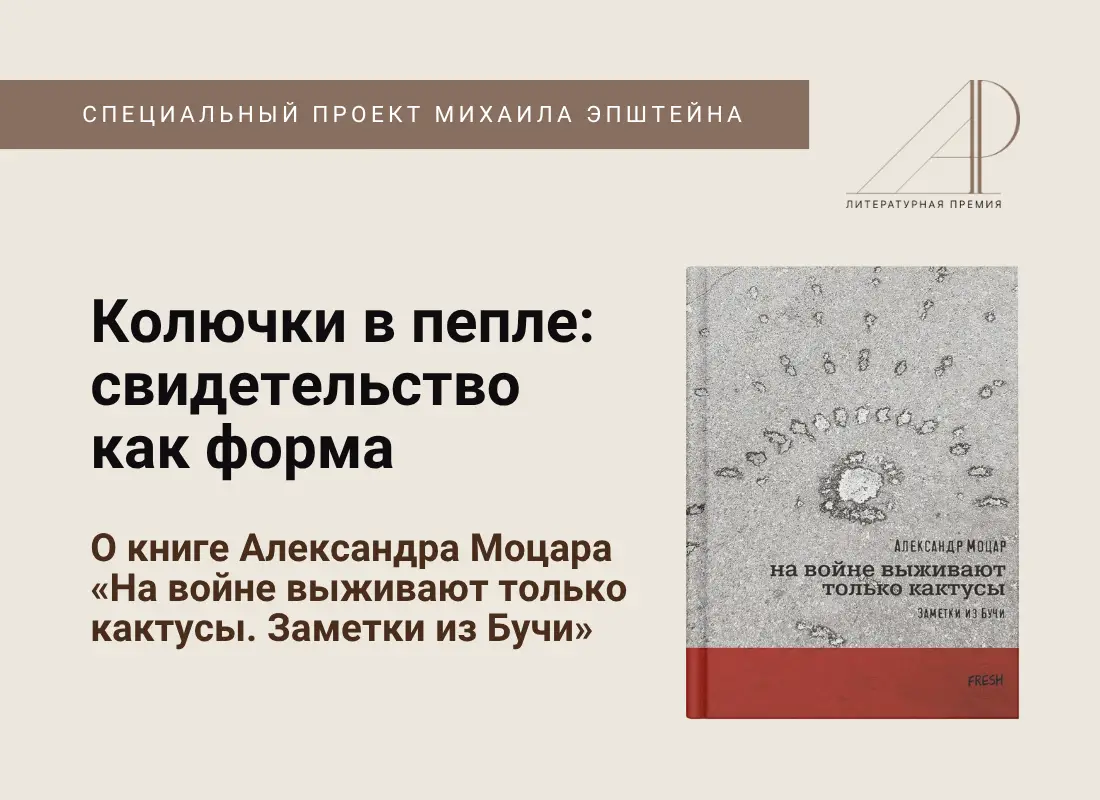
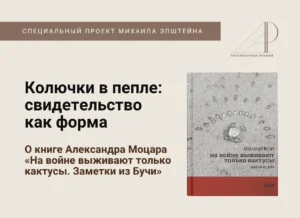
On Alexander Motsar’s book Only Cacti Survive in War. Notes from Bucha. FRESH Verlag, 2024. 81 pp.
The Word to Claude. A Special Project by Mikhail Epstein
Motsar’s book is neither a novel, nor a novella, nor a memoir. It is a witness’s notes, written in Bucha and Kyiv from February 24, 2022 to the spring of 2023, with several additions from 2024. The text is fragmentary, episodic, dated. The photographs are the author’s own, documentary in nature: bullet holes in doors, craters, burned facades, tracks left by armored vehicles, cacti on a windowsill. The genre lies somewhere between diary, essay, and photo-document. Motsar himself defines his method in the opening lines: “I will begin with impressions,” rather than with events, because the same event is interpreted differently by different eyewitnesses.
This is a principled generic choice, and it determines both the strength and the limitations of the book.
What makes the book powerful is its refusal of narrative. Motsar does not construct a plot. The episodes stand side by side without connective tissue: a deaf-mute man shows shelling through gestures (“Silence”); men labeled as “children” take places in a van instead of women; a neighbor matter-of-factly warns people not to walk along a street exposed to gunfire; two old women discuss buying a burial shroud as if it were a new dress. Each episode is a shard, and in this shattering lies its precision: this is exactly how war is perceived from within, not as a coherent story, but as a series of ruptures.
The book’s best episodes work through the conjunction of the incompatible. A girl who used to address animals formally as “you” cheerfully talks about her niece under mortar fire, and when the shelling stops, she breaks into hysterical screams. Elderly women inspect a burial shroud as if it were a joyful new acquisition, while nearby a dog howls at the daytime moon. A child launches a paper boat into a crater left by a mine. Teenagers say “we’re from Bucha” with pride. Music in a supermarket is interrupted by an air-raid announcement, and then the music resumes. In these juxtapositions lies the true nature of war as the rupture of everyday life, after which ordinary life continues, but already broken from within.
The photographs do not illustrate the text, they function as a parallel voice. A bullet strike in a green signboard forming the shape of a star. The trace of a mine explosion on asphalt resembling a child’s drawing of the sun, this image is on the cover, and also appears in the essay “The Sun Circle.” A grenade launcher tube by a trash bin. Cacti on a windowsill next to dried flowers. These photographs are not journalism: they contain visual thought, the gaze of an artist seeking form in destruction. The best example is the “trace of a mine explosion”: Motsar sees in it at once a child’s drawing of the sun and “a visual utterance like a scream.” This double vision, of beauty and death simultaneously, determines the optics of the entire book.
Where the book weakens is in its reflective, essayistic passages. When Motsar moves from observation to reflection, on Heraclitus, Žižek, Socrates, Bruegel, the dancing plague of Strasbourg, the text loses precision and takes on an air of dispensability. The meditation on the “density of fire” through Heraclitus, on Socratic law through a conversation on a train, the allusion to Schopenhauer in a stalled elevator, these moves feel like a superstructure built over experience, whereas the power of the book lies in experience itself, unprocessed. Motsar senses this himself: at the beginning he writes that he tried to describe the war in literary fashion, reread it the next morning, and gave up the attempt. But not entirely, the philosophizing passages return, and next to the bare concreteness of the episodes they sound less convincing.
The essay “Ahasuerus” is a separate piece, the longest and most ambitious. It begins with a concrete encounter, a sick man on a Kyiv street who claims authorship of the Short Description about Ahasuerus, then moves to reflections on the Wandering Jew as archetype, and includes a refugee’s letter from correspondence. Here reflection is more organic, because it grows out of a concrete episode, but even here the text at times slips into rhetoric.
The story “The Sun Was in the Way,” a childhood memory of postwar discoveries in a ravine, is embedded into the Bucha context: the gesture of shading one’s eyes with a hand, repeated at the beginning and the end, links a childhood war game with real war. This is the book’s best overarching device, and it works, but it is the only one.
On the visual component as a whole. Motsar’s photographs are documentary, taken on a smartphone, without any claim to professional photography. Their strength lies in their inseparability from the text: a photograph of bullet impacts stands next to an episode about soldiers, craters next to “Battle,” cacti next to the title phrase. But as autonomous visual statements, by the standards of the Index for visual art, they are modest: unexpectedness (A) is low, documentary photography by definition does not create a new visual language, while credibility (B) is maximal, this is reality, not simulation. The exception is the photograph of the mine trace on the cover: here the document becomes a visual metaphor, and this transition is the strongest visual gesture in the book.
On its place in the shortlist. Only Cacti Survive in War is the only book on the shortlist written from the Ukrainian side of the war, from inside the occupation. This is not a factor in its evaluation, but it is a factor of context: next to Radzinsky’s Days of Repentance, where Bucha is just a name flashing in the news, Motsar’s book is testimony from Bucha itself. These are two optics of the same war: Radzinsky looks from a Moscow apartment, Motsar from a basement under shelling.
Evaluation by the Interestingness Index
Central thesis / situation: War as the breakdown of coherent reality into fragment-episodes from which the witness does not construct a narrative, but assembles a collection of impressions, textual and photographic. The central metaphor is in the title: in war only cacti survive, those that do not need water from outside, those that carry within themselves enough moisture to endure.
The book is a hybrid of text and photography. I evaluate it as a single work, using the literary version of the Index, as with the rest of the shortlist, while taking the visual component into account within the parameters.
CORE PARAMETERS
A₁ — Unexpectedness of the situation: 6/10. The genre of witness notes is not new. War diaries, from Jünger to Grossman, have a long tradition. Fragmentary form and refusal of narrative are devices familiar from modernist prose. But something else is unexpected here: Motsar is not a journalist, not a soldier, but a poet and prose writer who remained in Bucha not by choice but by circumstance, and his optic, that of a literary man looking at war not as a “theme” but as a catastrophe of his own perception, produces a shift. The title is an exact formula: the cactus as a model of survival, autonomy, thorniness, minimal needs. The limitation is that the episodic form begins to repeat itself by the middle of the book, and Motsar himself acknowledges this.
A₂ — Realization in action: 6/10. The genre of witness notes is not new. War diaries, from Jünger to Grossman, have a long tradition. Fragmentary form and refusal of narrative are devices familiar from modernist prose. But something else is unexpected here: Motsar is not a journalist, not a soldier, but a poet and prose writer who remained in Bucha not by choice but by circumstance, and his optic, that of a literary man looking at war not as a “theme” but as a catastrophe of his own perception, produces a shift. The title is an exact formula: the cactus as a model of survival, autonomy, thorniness, minimal needs. The limitation is that the episodic form begins to repeat itself by the middle of the book, and Motsar himself acknowledges this.
B — Credibility: 9/10. Maximal. This is testimony, and its perceptual authority is absolute. Motsar describes what he saw, heard, and lived through, without heroization, sentimentality, or moralizing. The tone is even, observant, sometimes ironic. A deaf-mute man showing shelling through gestures; a man saying, “I’m a purely civilian person, I could just as easily shit myself”; drunk men boasting in a video chat, “we’re from Bucha,” all of this is recorded from life, and one feels it. A slight deduction is made for the essayistic passages, where the credibility of experience is replaced by the rhetoric of reflection.
MODULATING PARAMETERS
C — Interpositionality: 7/10. Motsar does not divide people into the right and the wrong. Looters and volunteers, arguers on the electric train and the silent on the bus, the deaf-mute man and the nationalist poet, all are presented without sentence being passed. The scene with the men occupying the van marked “Children” is harsh, but without condemnation: “These are our defenders,” the women laugh. “Children, orphans.” Yet the author’s position, that of an observing intellectual, with his references to Bach, Allegri, Heraclitus, silent film, remains the only frame. There is no voice “from inside” another experience, that of a soldier, a looter, or the heavy-set woman spreading apocalyptic rumors.
D — Openness: 7/10. The fragmentary form is by definition open: the episodes are not locked into plot, the reader builds the connections. The ending is not an ending: the book cuts off, the war continues. The best episodes are interpretively open: the burial shroud as new dress, the paper boat in the crater, the dog’s howl anticipating the missile. But the essayistic fragments close meaning down: “Fire here is the common Beginning in Heraclitus,” this is an authorial interpretation that narrows rather than expands.
E — Rhythm: 7/10. The alternation of short episodes and photographs creates a dotted, staccato rhythm corresponding to the material, war as a series of ruptures. The best transitions are from “Silence” to “Wheels,” from “Evacuation” to “Soldiers,” concrete and unmediated. The long essays, “Ahasuerus,” “The Sun Was in the Way,” slow the rhythm down, and not always justifiably. “The Sun Was in the Way” is justified, childhood memory as counterpoint; “Ahasuerus” is less so.
F — Resonance: 8/10. Bucha has become a symbolic name. The book is written in Russian by a Ukrainian author, and that in itself is a statement. The themes are universal: survival, testimony, the credibility of experience versus the unreliability of information, the impossibility of “telling” war. The phrase “only cacti survive in war” is a formula that goes beyond this particular war: it is about what survives, in people, in houses, in memory, only that which is autonomous, that which does not depend on external nourishment. The translation potential is high: Bucha is an international symbol, and witness notes are a genre in demand.
Calculation
Core = (A₁ + A₂) × B / 10 = (6 + 6) × 9 / 10 = 10.8
M = C + D + E + F = 7 + 7 + 7 + 8 = 29
Modulator = 1 + 29/40 = 1.725
II = 10.8 × 1.725 = 18.63
Verdict: Good (range 15–20)
Only Cacti Survive in War is a book whose strength lies in its credibility (B = 9). That is its main resource: the perceptual authority of a witness who does not replace experience with interpretation. When Motsar observes, he is impeccable. When he reflects, he is weaker. The book falls behind the leaders of the shortlist in unexpectedness (A₁ = 6) and realization (A₂ = 6), but gains in resonance (F = 8) and credibility.
Comparative context. On the shortlist, Radzinsky’s Days of Repentance (19.04) and Motsar’s Only Cacti Survive in War (18.63) are two works about the same war, written from different sides. Radzinsky offers a realist novel with an allegorical structure, a view from Moscow. Motsar offers documentary notes with photographs, a view from Bucha. Radzinsky is stronger in construction, five parts, parallel lines, Motsar in perceptual credibility. Their coexistence on the shortlist is meaningful in itself.
From the point of view of the aims of the Dar Prize, translation into European languages, the book has very high potential. Bucha is a name that requires no translation. The format of notes with photographs is visually and emotionally accessible. But the essayistic fragments with references to Heraclitus and Žižek may feel alien: a European reader looking for testimony from Bucha may want not philosophy, but precisely the concreteness that in Motsar’s best episodes is beyond dispute.
See also:

What Are the Objectives of the Award?

The primary goal of the Award is to support authors and promote Russian-language literature worldwide. We welcome all who write and read in Russian, regardless of citizenship or place of residence. We aim to foster a Russian-language culture free from political and imperial influences.
How Is the Award Process Conducted?
The Prize is awarded annually. The Jury holds a vote in which each member selects between one and three works. The author whose work receives the highest number of votes becomes the winner.
What Awards Are Provided?
The Prize winner receives a grant for the translation of their work into English, French, and German.
When Does the Submission Period for the Competition Start and End?
Submissions for the third season of the prize will open on July 15, 2026, and close on October 15, 2026.
When will the list of finalists and winners be announced?
On January 20, 2027, the Council of Experts will announce the shortlist. The Independent Jury will announce the winner on May 25, 2027.
What are the conditions for the nomination of a book for the award
Works published in 2025 are eligible for the third season of the competition. Eligible works (novels, novellas, short story and essay collections, documentary prose) may have been published either as standalone editions or in literary magazines. Nominations may be submitted by publishing houses and magazine editorial boards, as well as by the authors themselves or third parties (with the author's consent and written confirmation). Texts must be submitted for consideration in electronic format. The DAR Prize is open to all authors. Given the prize's main goals — promoting contemporary Russian-language literature outside of Russia — and the nature of the award itself (a translation grant), priority will be given to authors whose works have not previously been translated into English, French, or German.