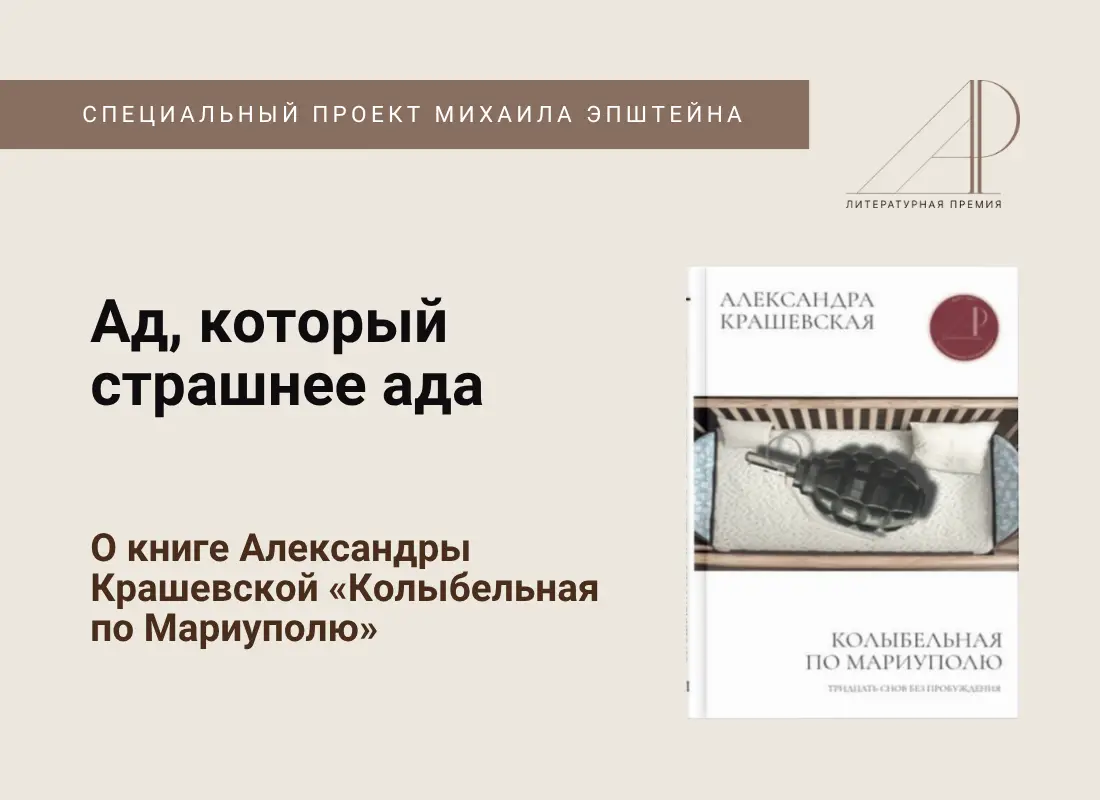
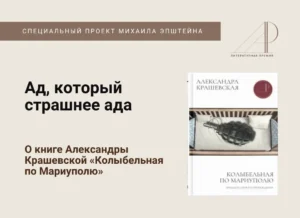
On Alexandra Krashevskaya "Lullaby for Mariupol"London: Freedom Letters, 2024. 120 pp.
The Word to Claude. A Special Project by Mikhail Epstein
“There is life in hell. In hell people try to wash the dishes. In hell they go to the toilet. In hell children play. In hell they make tea for their grandmother. That makes hell far more terrible than hell.” This is how Linor Goralik begins her foreword, and it would be impossible to describe Krashevskaya’s book more precisely. This is not literature about war. It is literature from hell, written from inside it, saturated with its soot, its smell, its sounds.
The subtitle, Thirty Dreams Without Waking, gives the book its structure: thirty dream-chapters, from the first explosions in February to the evacuation in May 2022. But these are not dreams in the ordinary sense. They are the state of dissociation into which a person sinks when reality becomes unbearable. “You suddenly and distinctly fall into a deep, hopeless sleep. One from which there is no waking.”
Structure and Genre
The book is organized as a diary of the siege, but it is not a chronicle of events, it is a chronicle of states. Each “dream” is a complete fragment: the first shelling, the flight into the basement, life in someone else’s house with fourteen people around a stove, looters, corpses under carpets in courtyards, evacuation under sniper fire. The chapters are short, jagged, like breath under bombardment. Between them are color photographs: shattered windows, burned houses, empty streets. Linor Goralik describes the effect exactly: “The work of imagination shamefully loses to the image of reality. Reality turns out to be even more unbearable.”
The genre is testimony in its purest form. Not memoir, because the events are too close. Not autofiction, because there is no fictional distance. Not journalism, because it is too personal. It is testimony in the sense that goes back to Primo Levi and Varlam Shalamov: the voice of a survivor recording what cannot be forgotten and cannot be conveyed.
Central Images and Motifs
The first is Russian roulette.“This is a great war game involving a huge number of people. The players are there mostly against their will… The only thing that gives you strength in the game is hope, there are no prizes, and victory is illusory and no longer matters.” Roulette is not a metaphor here, but an exact description of the mechanics of survival: your neighbor died and you did not; your house burned down and the house next door remained standing; someone went out for water and never came back, while you managed to get away. Chance as the only law.
The second is water.In the besieged city, water becomes the supreme value. Men go for it under shelling, melt the March snow, drain it from radiators. “One of the brightest and most precious impressions of that period was water.” The simplest substance becomes a treasure. This is an inversion of everyday normality: what flows from a tap becomes something for which people die.
The third is the theater.Krashevskaya is an actress; she worked at the Mariupol Drama Theater. The very one in front of which the word “CHILDREN” was written and which was bombed with hundreds of people sheltering inside. “The first time I entered our theater, I was still a child… From then on I always wanted to be on stage.” Personal history is woven into collective tragedy. The theater becomes a metaphor for the lost world, for culture, childhood, normality.
The fourth is the shopping cart.It is an image that keeps returning: children wheeled out of the city in supermarket carts, “wrapped in blankets, smeared with soot or blood, grimy, exhausted, calm with monotonous hopelessness.” A shopping cart is turned into a vehicle of evacuation. It is an image of radical displacement: peaceful objects acquire wartime functions.
Language and Style
Krashevskaya writes simply, almost in the manner of a protocol. Short sentences, very few metaphors, no literary display. This is not a flaw, but a method: when reality is such that rhetoric cannot intensify it, the only honest strategy is statement. “People wrap corpses in sheets and carpets, lay them neatly under some kind of awning, and right there nearby build fires for warmth and cooking. I still remember the patterns on the carpets and the legs sticking out from them. Legs in all kinds of shoes… Sneakers, boots, slippers…”
The tone wavers between whisper and scream, just as Goralik says it does. There are pages of quiet despair, there are eruptions of anger. But what dominates is exhaustion, that specific exhaustion of the survivor that already lies beyond emotion.
The ending is neither catharsis nor reconciliation. It is a dream of returning to a home that no longer exists: “I will go up the stairs, look into the mailbox of apartment 124… and I will arrive HOME. There, where it is always spring.” The district has been demolished; the house is gone. But inside the author, it remains whole. “That cannot be destroyed. No war has the power.”
Evaluation of Lullaby for Mariupol according to the Interestingness Index
Central thesis / situation: An actress survives the siege and destruction of Mariupol. Thirty “dreams,” thirty fragments of hell. Survival as Russian roulette. Testimony that cannot be forgotten and cannot be conveyed.
CORE PARAMETERS
A₁ — Unexpectedness of the situation: 7/10. The subject of Mariupol is already present in the public sphere, the drama theater, Azovstal, the siege. Yet personal testimony from within, from a particular individual with a particular biography, an actress from that very theater, creates a unique angle. The “dream” structure is not unique, but it works. The photographs add a dimension absent from purely textual testimony.
A₂ — Realization in action: 8/10. The thirty chapters sustain the rhythm: none is overlong, none sags. The images, roulette, water, theater, shopping cart, run through the text. The photographs are integrated, not illustrations but counterpoint. The ending works: the dream of a nonexistent home is the exact right note. There is a risk of monotony, horror after horror, but the author manages it through shifts of register.
B — Credibility: 10/10. The maximum score. This is not reconstruction, not fiction, not something based on real events; these are the real events as lived by the author. The details are exact: one and a half sacks of firewood for one warm night, the patterns on the carpets with legs protruding from them, the sound when pieces of human bodies fly together with fragments of asphalt. The photographs are documentary confirmation. The psychological credibility is equally exact: dissociation, habituation to death, the peculiar exhaustion of the survivor.
MODULATING PARAMETERS
C — Interpositionality: 6/10. The author’s voice dominates absolutely; this is a monologue. Other people, husband, children, neighbors, the owners of the house, appear as figures within the narrator’s field of vision. There are inserted stories, the gray-haired neighbor shot by a sniper; Dasha; the teacher with a mop, which broaden the perspective. But there is no polyphony, and this is a conscious choice of the genre of testimony.
D — Openness: 7/10. The ending is open in an existential sense: the author survived, but the home is destroyed, the city is dead, and the question “how to live on?” is unresolved. The question “who is to blame?” is resolved, and this lowers the openness: the text is unambiguous in attributing responsibility. But this is not propaganda, it is the position of a witness, and the witness has the right to such unambiguity.
E — Rhythm: 8/10. The short chapters create a pulsating rhythm. The photographs work as pauses, visual caesuras. There is escalation: from the first explosions to total destruction. The climaxes are the shelling of the drama theater, the evacuation, and the final dream of home. Thirty “dreams” is not an accidental number: it is a month, a lunar cycle, a biblical measure, the thirty pieces of silver. The structure holds.
F — Resonance: 9/10. The themes are universal: survival, loss of home, death of loved ones, hope against all hope. Mariupol in 2022 is not only a Ukrainian tragedy, but an event of world history. The experience of siege resonates with any experience of catastrophe. The genre of testimony has a long tradition, Holocaust, Gulag, and this book enters that tradition. Its potential for translation is very high: the subject is acutely relevant for European readers.
CALCULATION
Core = (A₁ + A₂) × B / 10 = (7 + 8) × 10 / 10 = 15.0
M = C + D + E + F = 6 + 7 + 8 + 9 = 30
Modulator = 1 + M/40 = 1 + 30/40 = 1.75
II = 15.0 × 1.75 = 26.25
VERDICT: Excellent (range 20–30)
Lullaby for Mariupol is an exemplary work in the genre of testimony. Its maximum credibility (B = 10) and high resonance (F = 9) make it an important document of the era. This is not a formal experiment, it is a voice from hell, and it must be heard.
Comparative Context
On the current shortlist, Lullaby for Mariupol (26.25) moves into first place, above Buksha’s A Little Paradise (24.6). This requires comment. The high score is ensured прежде всего by its maximum credibility (B = 10), a parameter that rarely reaches the ceiling. Krashevskaya’s book is not a literary text in the traditional sense; it is testimony, and it must be evaluated according to the laws of that genre.
Compared with Berezhnaya’s (Not) About War (22.95), both books are about the war of 2022, both are written by women, both are personal testimonies. But the scale of what was lived through is different: Berezhnaya fled Kyiv in the first days, Krashevskaya spent three months in besieged Mariupol. Berezhnaya writes about fear and flight, Krashevskaya about the systematic destruction of a city and its people. Berezhnaya is more lyrical, Krashevskaya more documentary. Both books are necessary, they complement one another.
Compared with Danishevsky’s Damocles Techno (22.4), they are polar texts. Danishevsky constructs a complex cultural palimpsest, Krashevskaya offers direct testimony. Danishevsky works with queer identity, Krashevskaya with collective trauma. Danishevsky imagines, Krashevskaya records. Both texts are radical, but in different ways: Danishevsky formally, Krashevskaya existentially.
From the point of view of the aims of the Dar Prize, translation into European languages, Lullaby for Mariupol has maximum potential. Mariupol has become a symbol known worldwide. The genre of testimony is universal and translatable. The book has already been published by Freedom Letters in London, which itself speaks to international interest. The text could stand alongside the testimonial works of Svetlana Alexievich, Günter Grass’s Peeling the Onion, and Imre Kertész.
A Note on Methodology
The high score of Lullaby may raise a question: are we overvaluing documentary quality at the expense of artistry? The answer is no, because credibility (B) is not the only factor. Krashevskaya’s book also receives high marks for realization (A₂ = 8), rhythm (E = 8), and resonance (F = 9). This is not “raw material,” it is a constructed text with a thought-out structure. But the main point is this: in the genre of testimony, credibility is not merely one parameter among others, it is a constitutive principle. Testimony that is not convincing is not testimony.
See also:

What Are the Objectives of the Award?

The primary goal of the Award is to support authors and promote Russian-language literature worldwide. We welcome all who write and read in Russian, regardless of citizenship or place of residence. We aim to foster a Russian-language culture free from political and imperial influences.
How Is the Award Process Conducted?
The Prize is awarded annually. The Jury holds a vote in which each member selects between one and three works. The author whose work receives the highest number of votes becomes the winner.
What Awards Are Provided?
The Prize winner receives a grant for the translation of their work into English, French, and German.
When Does the Submission Period for the Competition Start and End?
Submissions for the third season of the prize will open on July 15, 2026, and close on October 15, 2026.
When will the list of finalists and winners be announced?
On January 20, 2027, the Council of Experts will announce the shortlist. The Independent Jury will announce the winner on May 25, 2027.
What are the conditions for the nomination of a book for the award
Works published in 2025 are eligible for the third season of the competition. Eligible works (novels, novellas, short story and essay collections, documentary prose) may have been published either as standalone editions or in literary magazines. Nominations may be submitted by publishing houses and magazine editorial boards, as well as by the authors themselves or third parties (with the author's consent and written confirmation). Texts must be submitted for consideration in electronic format. The DAR Prize is open to all authors. Given the prize's main goals — promoting contemporary Russian-language literature outside of Russia — and the nature of the award itself (a translation grant), priority will be given to authors whose works have not previously been translated into English, French, or German.