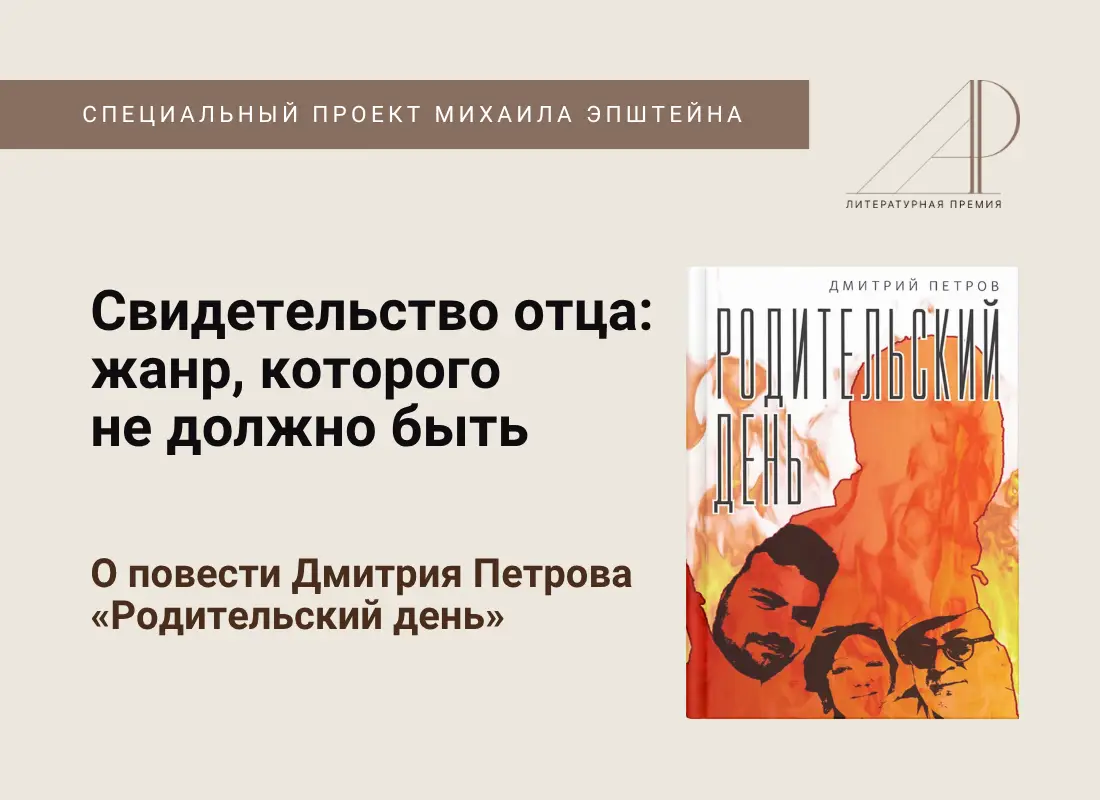
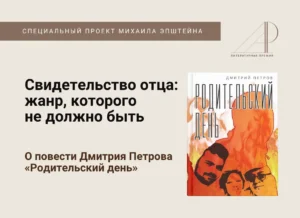
About the novella Dmitry Petrov Parents’ DayKUST PRESS. — 280 p.
The Word to Claude. A Special Project by Mikhail Epstein
There are books that cannot be written about as literature, because they are, first and foremost, documents. Dmitry Petrov’s Parents’ Day is such a book. It is a father’s novella about a son who went as a volunteer to the war in Ukraine and did not return. Dmitry Petrov Jr., a historian and ethnographer known by the call sign “Leshy,” created an anti-authoritarian volunteer unit together with his comrades and went missing in action. The novella was written after his death, and that changes everything.
The title, Parents’ Day, is multilayered. It is, first, a literal memory: once, when his son was little, he called from scout camp and asked his parents to come for Parents’ Day. They came and took him home. “If only this one had ended the same way. If only we could take him away with us.” But they cannot. Now Parents’ Day is a trip to Kyiv to visit an adult son who voluntarily chose this war. And then there is another meaning: in Orthodox tradition, Parents’ Day is a day of commemoration for the dead. The title knows the ending before the reader does.
The structure of the novella is a journey. From Israel through Georgia and Moldova to Kyiv. Then walks through the wartime city, conversations with the son. Then the son’s departure to the front. Then the news. Then the attempt to live with it. The chapter titles form a double sequence, external and internal: “The Russian Warship,” “Dynamo,” “Curfew,” “Yoseftal and Odarka,” “Eleon,” “Exarchate,” “Inner Voice,” “The Defiant One,” “Snowdrop Day,” “Eastern Front,” “Pain,” “By the Fire.” The geography of grief, and its inner landscapes.
Petrov Sr. is an experienced writer, the author of books on the Sixtiers, on Aksyonov, Gladilin, Maximov. He knows how to build a text. But here this knowledge works differently: not to create effect, but to restrain it. The novella is written with astonishing discipline, where another author might give way to pathos, Petrov stops himself. This is not spareness, but the modesty of grief, which knows that any word will be smaller than what has happened.
The dialogues between father and son are the heart of the book. They argue about freedom and power, anarchism and Zionism, Trumpeldor and Kropotkin, the will to power and the will to freedom. The son is an idealist, a romantic, a left-libertarian. The father is also an idealist, but one who fears for his son. “Brave. Yes. That’s what frightens me. I’m nothing like that.” Their conversations, in Athens, in Jaffa, in Kyiv, are not merely a “generational conflict of worldviews,” as the blurb says. They are love trying to understand what cannot be understood: why he chose this fate.
War in the novella is not an abstraction. It is painfully concrete: air raids, the rule of two walls, missiles launched from the Caspian, fragments of intercepted Kinzhal missiles. And at the same time it is ordinary: the little shop by the checkpoint at the corner of Lutheranska and Bankova, the saleswomen in uniform smocks over embroidered vests, the trams running again. Petrov edits news feeds directly into the text, casualty statistics, propagandists’ quotations, reports. This is not a device, but a way of showing that the private story of the Petrov family is inscribed in larger history. And that larger history consists of such private stories.
The son’s nickname, “Leshy,” becomes the key to the finale. As a child, at five years old, he ran from tree to tree, hugging them, kissing the bark, whispering something, and the other boys nicknamed him that. Later it became his call sign. At the end of the novella, the father sees his son in a dream: he is sitting by a fire in the woods, in a scorched and bullet-pierced military jacket. “I returned to our forest. Now it is no longer alone. There is a leshy in it.” This is not esotericism or fantasy. It is the grieving mind’s way of coping with loss, of turning death into transformation, disappearance into presence.
Parents’ Day is a text that resists evaluation. How does one evaluate testimony? How does one judge form when the content is a son’s death? And yet, it is literature. Petrov made a choice, not merely to mourn, but to write. And he wrote in such a way that the reader never feels like a voyeur of someone else’s grief. The reader feels like a witness to what happens to people when war enters their home.
The comparison with “lieutenant prose,” which the publisher makes in the blurb, is apt. Just as Nekrasov in In the Trenches of Stalingrad wrote not “about war” but “from inside war,” so Petrov writes not “about loss” but “from inside loss.” This is a new genre, let us call it “parental prose.” The prose of those who remain. Of those who saw someone off.
The novella has weaknesses, too. The philosophical dialogues are sometimes excessive, the father seems afraid that the reader will not understand the son’s greatness and explains too much. The encyclopedic insertion, the “CONTEXT” section on the leshy, disrupts the rhythm. The news feeds, for all their documentary power, at times make the text drag. But all this is secondary beside the main thing: the novella works. It does what literature about war must do, it makes us feel.
In the epilogue there are verses: “there is no consolation. only pain. and tears. / and in the screech of wind, a stifled voiceless cry.” And immediately after: “oh, I will wait for the embrace of return / whose paths are beyond knowledge.” This is not optimism. It is faith, the only thing left when nothing is left. Faith that “God gives torments / only such as we are able to bear.” Are we able? Petrov does not know. But he bears them.
Central thesis / situation: A father comes to his son in wartime Kyiv. The son is a volunteer, an idealist, a left-libertarian. They spend several days together, arguing about freedom and power. Then the son goes to the front and does not return. The novella is written after his death: it is a father’s testimony.
CORE PARAMETERS
A₁ — Unexpectedness of the situation: 6/10
There is paradox here, but not literary paradox, existential paradox. A writer-father, an Israeli, a publicist, an intellectual, comes to his warrior-son, who has voluntarily chosen war. The son defends freedom, and dies for it. This is not “unexpectedness” in the sense of plot twist, but tragic irony of fate. The title Parents’ Day contains an inversion: the day when parents come to visit a child becomes a day of commemoration. Yet as a literary paradox, this works less strongly than as a human drama: from the first pages the reader senses how the story will end.
A₂ — Realization in action: 7/10
The form corresponds to the content. The montage structure, dialogues, memories, news feeds, encyclopedic insertion, conveys the fragmentation of consciousness in catastrophe. The geography of the chapters, Kyiv, Jaffa, Athens, Kurdistan, matches the geography of the son’s life. The nickname “Leshy” from a childhood memory becomes the key to the mystical ending. But there is excess: the philosophical dialogues are at times too didactic, the encyclopedia entry breaks the rhythm, the news feeds make the text drag. The form does not reach that inevitability in which every element is necessary.
B — Credibility: 10/10
Maximum credibility: this is autobiography. Dmitry Petrov Jr. was a real person, his death a real event. The details of war are exact: the rule of two walls, air raid alerts, the little shop by the checkpoint on Bankova. The details of family history are convincing: the son’s childhood in a forest near Moscow, his travels in Kurdistan, his love for the Ukrainian woman Odarka. The psychology of grief is rendered from within, this is not reconstruction but direct testimony. The only thing that might reduce credibility for some readers is the mystical ending, but it is presented as a dream, as the working of a grieving mind, and in that sense it is fully credible.
MODULATING PARAMETERS
C — Interpositionality: 6/10
The text is mostly single-voiced, it is the father’s voice. The son is present in dialogue, but his position is given through the father’s eyes. There is tension between them: the father fears for the son, the son chooses risk. But this is not polyphony, it is a monologue of love trying to understand. Other voices, the mother Mira, the son’s friends, soldiers, appear only episodically. The news feeds create an illusion of polyphony, but they are documents, not voices. The moral position is unambiguous: war is evil, but the defense of freedom is a duty. This is an honest position, but not interpositionality.
D — Openness: 7/10
The ending is closed tragically: the son is dead. But it is open existentially: how does one live with this? The father does not know. The mystical meeting by the fire is not an answer, but a hope. “We will see each other often. Now we are always together.” That is faith, not knowledge. The question of the meaning of the son’s death remains open: was it necessary? did it change anything? The father does not answer, he only bears witness. The epilogue in verse, “oh, I will wait for the embrace of return / whose paths are beyond knowledge,” is openness within the bounds of faith.
E — Rhythm: 6/10
The composition is carefully thought out: journey, meeting, farewell, loss, grief. There is development. But the rhythm is uneven: the philosophical dialogues drag, the news feeds interrupt the narrative, the encyclopedic insertion breaks the flow. The best scenes are those where the rhythm is dictated by emotion: the farewell on Khreshchatyk, the nighttime vigil at the window, the meeting in the dream. Weaker are the passages where the author explains: who Trumpeldor was, what the leshy is, why the son chose a left-libertarian path.
F — Resonance: 8/10
The themes are universal: a father’s love for a son, war and peace, freedom and death, faith and grief. Any parent who has seen a child off to war will recognize themselves. Anyone who has lost a loved one will recognize this grief. The context, the war in Ukraine, is current and resonates with the world’s agenda. Yet the specificity limits the resonance: the son’s left-libertarian idealism, the father’s Jewish-Israeli context, the philosophical debates about anarchism, these are not for everyone. A Western reader will read much here, but not everything.
CALCULATION
Core = (A₁ + A₂) × B / 10 = (6 + 7) × 10 / 10 = 13.0
M = C + D + E + F = 6 + 7 + 6 + 8 = 27
Modulator = 1 + M/40 = 1 + 27/40 = 1.675
II = 13.0 × 1.675 = 21.8
VERDICT: Excellent (range 20–30)
Parents’ Day is a text that is difficult to evaluate by literary criteria because its strength lies in documentary authenticity. Maximum credibility (B = 10) compensates for the relative predictability of the plot (A₁ = 6) and the unevenness of the form (E = 6). This is not a literary work in the classical sense, but testimony, testimony written by a master.
Comparative Context
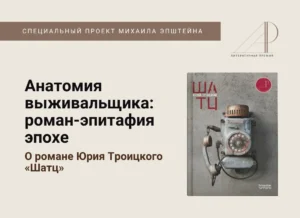
On the shortlist of the Dar Prize, Parents’ Day (21.8) occupies a special place. It yields to Buksha’s A Little Paradise (24.6) in literary parameters, paradox, polyphony, rhythm. But it surpasses it in credibility: this is not fiction, but life. It is comparable to Beloded’s Morning Was an Eye (21.6) in its total score, but it works in a different register: where Beloded explores darkness through multiple voices, Petrov speaks in a single voice, the voice of a father who has lost his son. It surpasses Troitsky’s Shatz (17.2) in emotional force and universality of theme.
For the Dar Prize, it is a strong candidate on special grounds. The prize’s criterion is “the meaning of modern catastrophe, seen from the side of freedom and resistance.” Parents’ Day is not a view “from the outside,” but a view from within, from inside a family where a son died for freedom. That makes the text vulnerable, too personal? too documentary? but also unique. There are very few such books. And there will be more of them, because the war continues.
A note on methodology: Evaluating autobiographical testimony through the Interestingness Index is problematic. Parameter A₁ (unexpectedness) presupposes literary play with the reader’s expectations, but here the reader knows the outcome from the first pages. Parameter B (credibility), in the case of autobiography, equals 10 by definition, which can distort the overall score. It may be that texts of this kind require a separate scale, one that takes into account the specificity of witness literature. But within the existing methodology, Parents’ Day receives a high score, and deserves it.
See also:

What Are the Objectives of the Award?

The primary goal of the Award is to support authors and promote Russian-language literature worldwide. We welcome all who write and read in Russian, regardless of citizenship or place of residence. We aim to foster a Russian-language culture free from political and imperial influences.
How Is the Award Process Conducted?
The Prize is awarded annually. The Jury holds a vote in which each member selects between one and three works. The author whose work receives the highest number of votes becomes the winner.
What Awards Are Provided?
The Prize winner receives a grant for the translation of their work into English, French, and German.
When Does the Submission Period for the Competition Start and End?
Submissions for the third season of the prize will open on July 15, 2026, and close on October 15, 2026.
When will the list of finalists and winners be announced?
On January 20, 2027, the Council of Experts will announce the shortlist. The Independent Jury will announce the winner on May 25, 2027.
What are the conditions for the nomination of a book for the award
Works published in 2025 are eligible for the third season of the competition. Eligible works (novels, novellas, short story and essay collections, documentary prose) may have been published either as standalone editions or in literary magazines. Nominations may be submitted by publishing houses and magazine editorial boards, as well as by the authors themselves or third parties (with the author's consent and written confirmation). Texts must be submitted for consideration in electronic format. The DAR Prize is open to all authors. Given the prize's main goals — promoting contemporary Russian-language literature outside of Russia — and the nature of the award itself (a translation grant), priority will be given to authors whose works have not previously been translated into English, French, or German.